
The Australian Stock Saddle
and the Saddlers that made them
FRANCIS (FRANK) JOHN ARNOLD 1857 - 1921
The first that can be found of Frank Arnold as a saddler is an insolvency notice in Forbes, NSW on 31 January 1881. There are no records as to whom he completed his saddlery apprenticeship nor the town. He must have been at Forbes for quite a while, and obviously well thought of, as the [Forbes Advocate] printed a small article upon his death 40 years after his tenure in that town. It said: 'The deceased was for many years in business at Forbes, and in his day was a champion pedestrian. Old Forbesites remember him well.'
Scant records continued in the early days, but he was mentioned as an excellent foot runner in the town of Bourke, plus he had the misfortune of being a victim of a large fire in October 1883, that decimated his business, and others, stating that very little was insured.
Sometime between 1883 and 1902 he made the move to Sydney, and was already established in Pitt Street, by May 1902. His reason for the move was related to a journalist some years later. 'Mr. Arnold was an inlander for some years, but as his fame as a saddle and harness maker brought orders from all over the Commonwealth and beyond it, he had to arrange for central location. That is why he decided to leave the country air for the smoky atmosphere of the city.' The move proved very profitable for Frank, and his famous 'Bosca' trademark became very well known throughout the colonies.
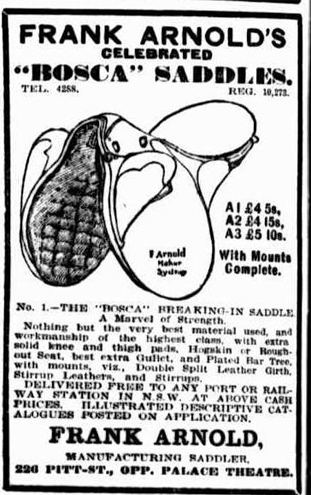
By way of apology the Sydney Stock and Station Journal wrote up a story in 1905 on the ensuing success of Arnold since positioning himself in Sydney. 'The advertisement of Frank Arnold, manufacturing saddler, of 226 Pitt-street, Sydney, has been appearing in this journal for some time past, giving the address as 266 instead of the number above stated. Although a newcomer in the advertising field, Mr. Frank Arnold is by no means a new man in the trade. He is a manufacturing saddler of very high repute in Sydney, and he is apparently well known for the quality of his work in India, for we are informed that the S.S. Euryalus, which left Sydney last month for Calcutta, took a consignment of 30 race and exercising saddles for a leading Indian sportsman from his establishment. The different weights of these saddles were : — 1¼lb. mounted, 1½., and 2lb. mounted and steeplechase saddles, 3lb., 4lb., 5lb., and 6lb., and exercising saddles, 8lb. and 10lb., and were turned out in Mr. Arnold's best style. The saddles we are advertising are the No. 3 "Bosca" stock and station saddle and the No. 7 "Bosca" park saddle, which possess quality and workmanship of the highest grade, combined with reasonable prices. The word "Bosca" has been registered by Mr. Frank Arnold, from whom illustrations of saddles, manufactured by him will be sent on application.'
Government Gazette of the State of New South Wales (Sydney, NSW : 1901 - 2001), Tuesday 11 April 1905 (No.186 (SUPPLEMENT)), page 2551
Trade Marks Office,
Sydney, 11th April, 1905.
TRADE MARKS.
Applications for the registration of Trade Marks.
Francis John Arnold, trading as Frank Arnold, saddler, of 226, Pitt-street, Sydney, New South Wales—
The word
" B0SCA"
and a device consisting of an oval containing the name, description, and address "F. Arnold, Maker, Sydney,"— to be applied to saddlery and harness in all its branches, under Class 37.
10.274. 7th April, 1905.
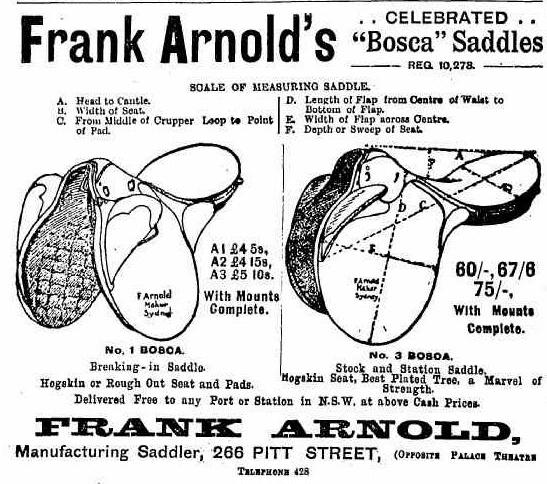
His good partners Sydney Stock and Station Journal were singing praises of his work in 1905 as follows:
'GOOD SADDLERY
Very often we see a man showing the most liberal spirit in the purchase of horseflesh, and yet his ignorance or easy-going way in regard to harness depreciates to a very great extent the results obtained with his horses. To-day the proper use of harness and saddlery gear has become almost a science. The good horse with harness that does not fit him is little better than an inferior animal properly geared. The other morning I dropped in to the establishment of Mr. Frank Arnold, of Pitt Street, and inspected a few lines of his big stock of 'Bosca' saddlery and harness, the whole of which is manufactured on the premises. It's a great thing to see the raw material and the progress of manufacture, as it gives even a layman some idea of how the finished article is likely to pan out. I've seen harness and vehicles from overseas looking just the thing, varnished, mid veneered to catch the eye of the buyer, but when the 'gilt' wears off they look as sickly looking as a lead sixpence. Nothing can be manufactured to stand the test of long usage unless good materials are used. That is where Mr. Frank Arnold's 'Bosca' goods come in. At his establishment may be purchased everything needful to the stockman, the squatter, the cocky, the racing man, the trotting man, or the owner of a fashionable turn-out. There are featherweight riding saddles, exercise saddles, superb stock saddles, and so on. Trotting harness, sulky harness, carriage sets, boots and clothing for racehorses and trotters and rugs and mouth-gear in endless variety. Mr. Arnold advertises well in the 'Stock and Station Journal', and when our inlanders send along orders to him, we hope that they will mention the bushies’ paper.'
In 1906 the [Evening News] posed a question that was responded to by some of the top saddlers of the day.
SADDLES AND KNEEPADS.
WHAT IS AN ORDINARY STOCK SADDLE?
The question 'What is an ordinary stock saddle?' was debated for some two hours at the buckjumping contest on Saturday night last. One competitor wants to ride in a saddle with steel plates in the kneepads, and claimed that it was an ordinary stock saddle. A representative of the 'Evening News' visited some of our leading saddlers to-day to make inquiries on this point.
Messrs. John Brush and Company said that they would not recognise a saddle with steel plates in the kneepads as an ordinary stock saddle. They had heard that a few such saddles were being made by some smart Queensland saddler, but considered it was only done for the purpose of appearing to be a little singular in his methods. No manufacturing firm, so far as they knew, turned out such saddles, and they would not be classed as ordinary saddles. Messrs. Simpson and Son agreed that no such saddle would be classed as ordinary, and Mr. Hillier said that they never made or handled any such saddles. The consensus of opinion amongst the saddlers is that a steel plate in the kneepad is only a fad, and that a kneepad rigid enough for all purposes can be made in the ordinary way, if the foundation is properly put in. 'Some men,' said Messrs. Brush's representative, 'can only ride in a specially made saddle. But the saddle that Waite rides in was just bought by him off our shelves in the ordinary way, and is what we would call a polo saddle. It is light, and not strengthened in any way.'
Frank Arnold, who was in business in Bourke for some years, says that he has made a few saddles with the plate in the kneepads, but only a few of them, and he looks on them as special, and not ordinary saddles.
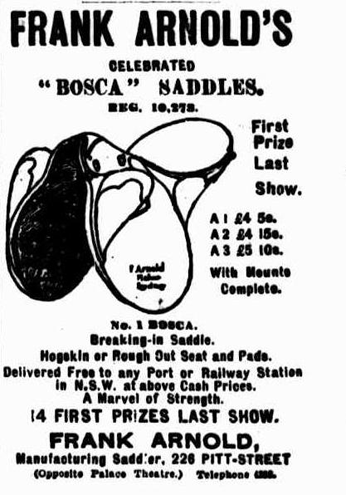
This 1907 advertisement was the start of an extraordinary record of prize winning at the Royal Sydney Agricultural Show.
For approximately 12 years Frank Arnold won an average of 14-15 first and special prizes for his saddlery and harness from 1906. (Advertisement below)
Note the influence, once again, of the 'Wagga' design saddle as per the illustration.
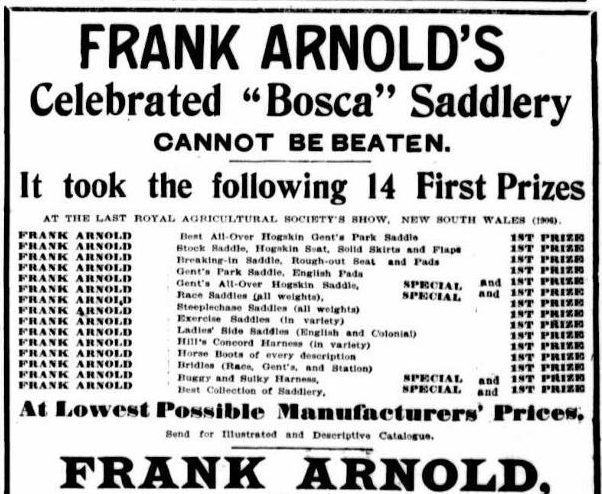
'Who's Frank Arnold,' asked one of his friends, noticing the sign at the entrance to the Industrial Hall. 'Why, he's the maker of the 'Bosca' saddles.' replied the other, whose peculiarly curved legs betokened the fact that he had been accustomed to throwing his 'right' across a saddle for many a year; and his tone showed surprise at the enquirer s ignorance. For which, perhaps, there was some slight justification, for although the 'Bosca' saddles have been on the market for only about three years they are now known throughout the land; moreover, Arnold has been in the business a very much longer time. And the Pitt St. saddler and harness maker had a fine display of his handicraft on show. There were to be seen all the requisites for harnessing and clothing a horse for whatever purpose, be it for the carriage or cart, racing or riding, farming or warring. Arnold's make is distinguishing itself in the prize ring too; and at this show he secured no less than fourteen firsts for saddles, harness and bridles. A striking exhibit was one of racing gear; it was complete and included saddles ranging from 11/2lbs. mounted, to 9lbs. mounted, and it was awarded a special prize. [Sydney Stock and Station Journal, 1907]
Another write up in the December Sydney Stock and Station Journal gives a small insight into the hard work that Arnold puts into his business.
'At Mr. Arnold's establishment, 226 Pitt St., Sydney, is always to be found a splendid collection of high-class saddlery and harness. What is more, Mr. Arnold, who is himself an incessant worker, is to be seen in business hours supervising the work done in the different branches of the trade. There is no secrecy, and if a man orders a saddle he can see the whole process of manufacture from tree to finished article. Stock saddles of all patterns are being constantly turned out, while a big demand for saddlery from polo enthusiasts and racing men is steadily met. If you want trotting harness, boots, hopples, clothing or other gear you have but to send a post-card to receive by return post full particulars as to the price and description of any requirement you may mention. All stable requisites are kept in stock, and Mr. Arnold paces the times by getting early any novelty of service to horse masters. This Pitt-street saddler came from the bush and he understands all the little things that an inlander likes or dislikes.'
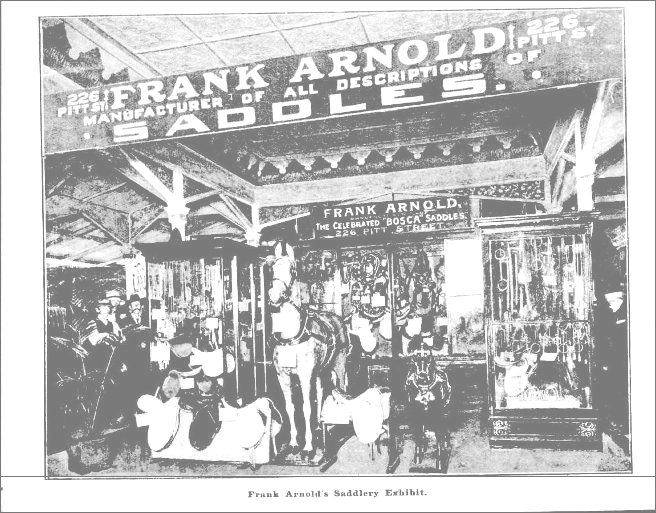
Sydney Royal Agriculture Show Exhibit - 1908
Frank Arnold's Saddlery.
TRADE MARK "BOSCA."
Frank Arnold, manufacturing saddler, of 226 Pitt-street, Sydney (opposite the Palace Theatre), had at the main entrance . of the industrial pavilion one of the finest exhibits at this year's show. Certainly, it was the most comprehensive and up-to-date one of locally manufactured saddlery that has been exhibited on the society's grounds for many years past. Frank Arnold's well-known trade mark, "Bosca," is a good one —a word meaning exactly what the articles are on which that trade mark is stamped, viz., of the finest quality and make. This, at any rate, is what the public must think of "Frank Arnold's Bosca Saddlery," if a criterion of its merits may be gauged by the long lists of first and special prizes that have been awarded him for his capital work for many years past. This year Mr . Arnold was again to the front, a great winner, as the following list of prizes show: —
HARNESS AND SADDLERY. Sub-section G.
First prize .—Best set black buggy harness, made from New South Wales leather hand-sewn.
First prize. — Best set black or brown pair horse station harness, made from New South Wales tanned leather, wooden hames, single leather traces simple pads.
First prize. — Best colonial pattern stock saddle, hog-skin seat, solid skirts and flaps.
First prize. — Best colonial pattern quilted safe side-saddle, hogskin or bag leather
First prize.— Best English pattern low off-horn side-saddle, hogskin seat, bolstered hogskin safe.
First prize. — Best three Pelham bridles.
Special prize. — Best polo saddles, all weights.
Special prize. — Race saddles, all weights, from 1lb to 31b.
Special .prize. — Steeplechase saddles, all weights, from 31b to. 61b.
Special prize. — Exercise saddles, all weights, from 61b to 101b .
Special prize for the best collection of saddlery.
"Australian Leather Trades' Review" prize for best collection of saddlery.
A great attraction in the collection among the country visitors was the display of breaking-in saddles. Mr. Arnold, in a little chat with a representative of this journal, mentioned he had been very busy for some time past, in fact, wonderfully busy. He had no cause to complain of the dullness of trade. Even with many extra hands, it was as much as he could do to keep pace with orders. When a squatter, trainer, or jockey sends an order, they generally expect it to be executed pretty smartly, and that is just what he prides himself in doing. "And that reminds me," continued Mr. Arnold, "of the wide area from which I constantly receive orders - I can show you hundreds of letters, containing orders for 'Bosca' saddles, etc., from well-known squatters, station managers, and also from most of the leading racehorse trainers and jockeys, not only of our States, but from the Cape, New Zealand, New Caledonia, Fiji, etc. I have received orders from India of batches of 30 exercise saddles at a time. Now, that speaks well for the reputation and quality of the 'Bosca' saddles. Mind you, my saddles are not 'got up' for show purposes, but for long and hard work. "I certainly put the result of my 'busy trade,' more especially that from far-away parts, down to the wide circulation of your journal." To which the representative, of this journal [Australian Town and Country Journal] modestly replied, "Exactly, and, of course, to your good work and materials in your 'Bosca' saddlery." A good business idea of Frank Arnold's is his order form for saddles. There the different measurements are shown on a block saddle, thus making it easy for customers to send him the exact sizes they have been accustomed to and require.
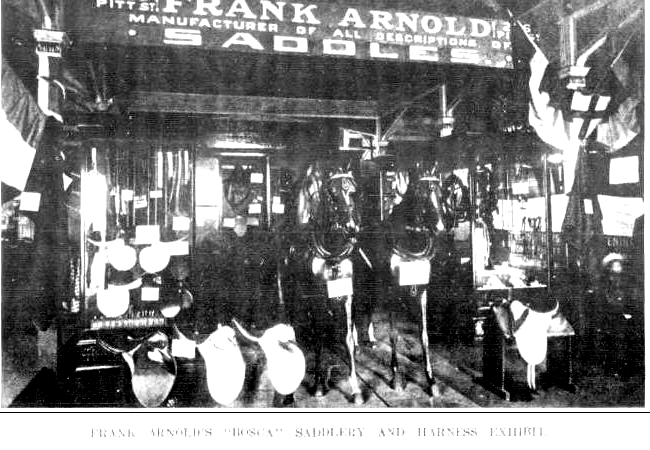
The stunning display (above) at the RAS, 1909 was accompanied by the following article in the [Sydney Stock and Station Journal]
Mr. Frank Arnold, the saddler, is principally known to our country friends as the maker of the celebrated ''Bosca" saddle, but his big exhibit in the main pavilion soon advertises the fact that he also excels in every line of harness and other equine requirements. As a prize-taker Mr. Arnold has practically "scooped the pool'' this year, gaining about fifteen firsts.
Later in that year a nod was given for his excellent work with an order from the 'home country'. A flattering tribute to the excellence of Mr. Frank Arnold's saddlery came in the shape of an order from the Old Country to the Pitt-street establishment last week. It was for a racing saddle of the Ted Sloan pattern, and a steeplechase saddle. The two 'Boscas' were consigned per mail steamer this week to Captain George H. Beaumont, Swannington House, Coalville, M.R. England. With Australian trainers and jockeys doing so well in the Old Country at the present time, the appreciation of Australian saddlery comes as a matter of course. The saddle, forwarded by Mr. Arnold, will doubtless increase this influence.
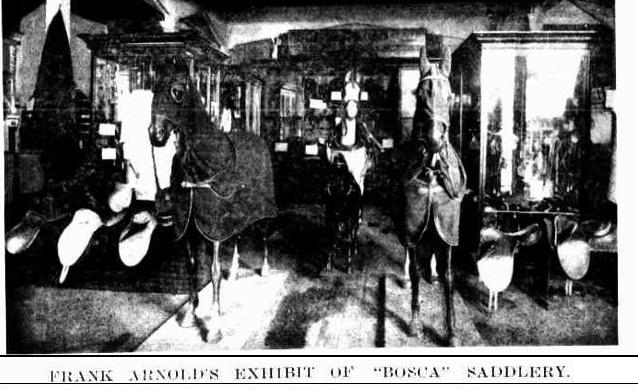
Another quality exhibit at the RAS in 1910 above and below Frank travelled to Brisbane to the Exhibition, also in 1910
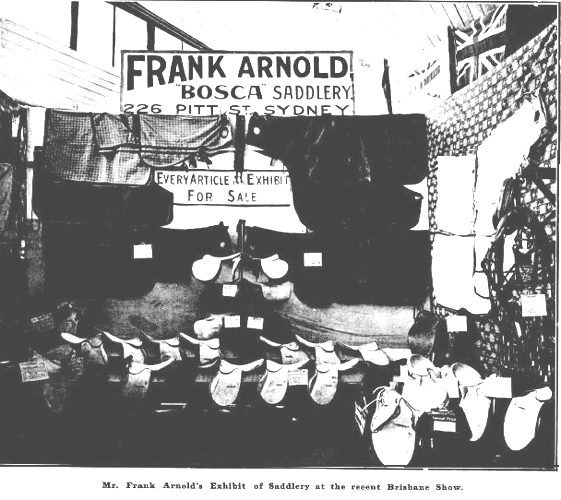
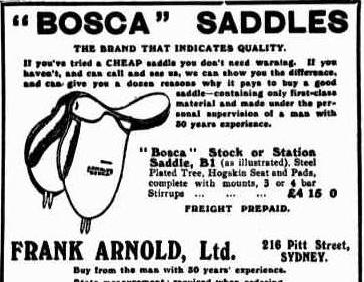
1915 Advert in the Farmer and Settler
In October 1916 the Referee declared a new invention for the racing industry:
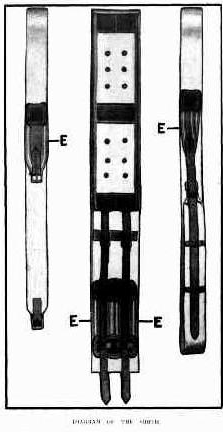
Now on view in the window of Frank Arnold, 'Bosca' Saddlery, 226 Pitt-street, is the patent 'Aboyeur' girth and surcingle used on Panacre, winner of the Epsom at Randwick, ridden by C. Davies and trained by A. Inkpen, who both consider the patent of great assistance to a horse when racing. Panacre is owned by Mr. J. C. Wood, of Newcastle, who also expresses himself in the highest terms of the invention. The 'Aboyeur' patent was also used on Jack Rice in the Hurdle Race with equally successful results, carrying over 3st dead weight. W. Ross, trainer of Jack Rice, speaks highly of the patent. Frank Arnold is sole agent for N.S. Wales, Queensland, and New Zealand for the 'Aboyeur' patent.

Then came a repeat in history as the Sydney Times reported on Mr Arnold being in a bit of strife.
LIQUIDATIONS
The following company is being voluntarily liquidated. Arnold, Frank, Ltd. By resolution confirmed October 17, 1917, the company to be wound up voluntarily, and Frank Arnold, Sydney, saddler, appointed liquidator. Registered October 27, 1917.
However Arnold must have traded out of this predicament fairly quickly as they were advertising for saddler hands in May 1918.
1921 proved a pivotal year for Frank Arnold saddlery, with the announcement in the 'Funerals' section of the paper.
ARNOLD. - The Friends of the late Mr. FRANCIS JOHN ARNOLD, saddler, Pitt-street city, are kindly invited to attend his Funeral; to leave his late residence, 128 Baptist-street, Redfern, THIS (Thursday) AFTERNOON, at 2 o'clock, for Church of England Cemetery, Waverley. Aged 64 years
For a man of such importance, it was unusual for no obituary being written by some admirer of the man, however a small article was run in the [Sunday Times]. 'Recollections of the palmy days of foot running in Australia were revived during the past, couple of weeks through the presence in Sydney of Mr. Lou Cassimir and the death of Mr. Frank Arnold, the well-known Pitt-street saddler. Both men won big Botany handicaps.'
At no stage was anything written about the demise of Frank Arnold and the current state of the business upon his death. The trading name remained the same and in 1933 a photo write up has a Frank Arnold 'principal' holding onto a race saddle. The only consideration that can be given is that the family took over the business in 1921. The papers continued to write up stories using Frank Arnold in the present tense, however they were obviously referring to the business name rather than the gentleman.
This 1922 article in the [Sydney Sportsman] is a prime example:
BOSCA SADDLES
Frank Arnold, the maker of the well known Bosca saddles, is the originator of the device for carrying dead-weight in front of the saddle, instead of over the horse's ribs. Saddles with the pockets for lead in front of the rider are so common nowadays so not to excite any notice. But when Arnold took the matter in hand the use of a lead bag behind the rider was universal. Arnold argued that if it paid to put the jockey's weight on the horse's shoulders it should equally pay to put the dead-weight there, and after experimenting he perfected the Bosca race saddles, which are now so eagerly sought after by race riders. In fact, they are used in all the five continents, and have been on winners of such classic races as the English Derby, the Grand Prix de Paris and the Calcutta Cup. Another device of which Arnold is sole manufacturer in Australia is the Aboyeur girth, which is fitted with powerful elastic so that the girth does not pinch a racehorse or compress his chest when in action. Australia led the way in the starting gate and numbered saddle-cloth, and the Bosca saddle is another racing improvement to the credit of Australia.
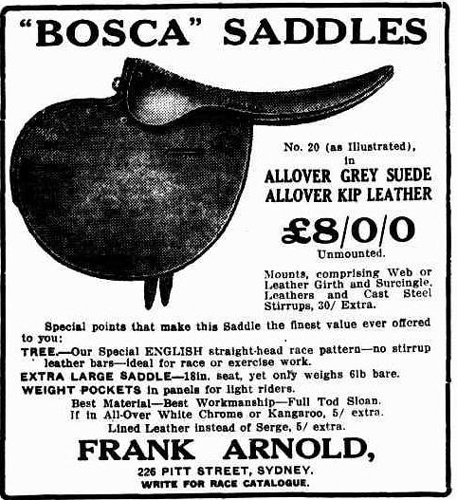
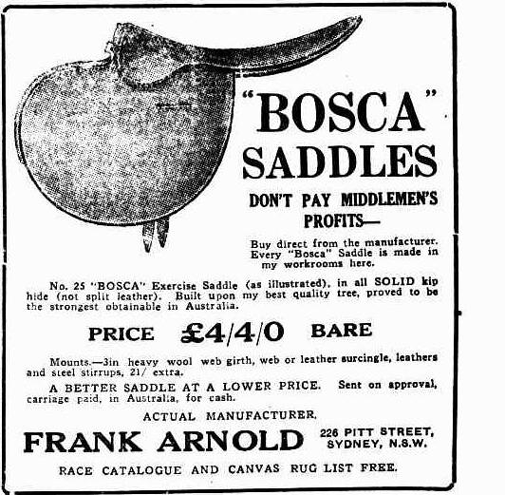
1922 Advert above and 1923 below
£2000 DAMAGE IN CITY FIRE Third Outbreak to Threaten Shop announced the Daily Telegraph in January 1930
Damage estimated at £2000 was caused when a fire broke out last night in Auto House, Castlereagh Street. Eight fire engines were called out.
For the third time in six months Tyrrell's museum of native curios and antiques, which is in the building, was menaced. Others to suffer by last night's fire, were:— Frank Arnold, saddler; Auto Sales (Aust.), Ltd.; Sample and Wilson; Chas. T. Vivian; H. C. Gibbons; and E. T. Bourke. No Rest for Firemen!
No extra information was to be gleaned as to what destruction took place at the Arnold premises.
FAMOUS RIDERS USE SYDNEY-MADE SADDLES
THE white buckskin kangaroo lined saddle in which J. O'Sullivan won the Melbourne Cup on Hall Mark, was purchased from the firm of Frank Arnold,-makers of 'Bosca' saddlery and all racing requisites, of Castlereagh Street, Sydney, The saddle was purchased by O'Sullivan's master, the Rosehill trainer, R. C. Stanton, and was specially made for the jockey. The firm sent several saddles to England in January, 1932, made to the order of jockeys W. Sibbritt. Gordon Richards, W. Rickarby, and Brownie Carslake.
Richards rode many winners in his Sydney bought saddle. The smallest saddle made is all white wallaby leather lined, and weighs just under one pound. Others weigh 2lb, 4lb, 6lb. 8lb, and 12lb. J. Pike had a saddle specially made by the firm for Chatham, while other riders using Frank Arnold saddles include M. McCarten, 'Togo' Johnstone, (France and England), J. Munro (used in Germany and India), L. Davison (Java), W.Cook (India), and 'Snowy' Baker (Hollywood). E. Britt took three to America. Frank Arnold has sent saddles to all countries except South America.
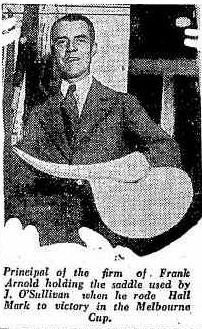
The above article and photo taken in 1933. In these years past Frank Arnold's death they seemed to concentrate more on the racing industry than the other disciplines
A change of address in January 1937, had Frank Arnold's relocating to 122 Bathurst Street, Sydney. The last mention from this firm was a small advertisement selling scrap leather from their shop in 1947. Sadly this was the last article found on this famous firm of Frank Arnold's, home of the 'Bosca' saddlery.

This brown leather and metal tack was part of a collection of Phar Lap's equipment which had been keep in a suitcase by his strapper Tommy Woodcock as a memorial to his beloved friend.
He brought the suitcase to the Museum of Victoria in 1986, and donated it and the contents to the Museum. Museum staff remember that he was visibly moved as he carefully removed each item from the case, such was his affection for the horse.
Horse's tack consisting of a leather bridle, egg-butt snaffle bit, leather reins with rubber grips. All are made of brown leather bound by light brown tape. There are a number of fastenings and metal rings.
The bridle was stamped 'Bosca' Frank Arnold, Sydney
Pic Credit: Victorian Museum