
The Australian Stock Saddle
and the Saddlers that made them
GEORGE SNEYD 1851 - 1936
George Sneyd, aged 73 in 1924. 'Now there are two things I want specially to mention. If I am strong enough, I intend to have an exhibit of Sneyd saddles at the next exhibition held in Adelaide, and you can bet that I will put some top-notch stuff before the public. The other is this: I do not want my years of study and work to go with me into the grave, and as I find myself becoming too feeble for work I will place my secret at the disposal of the saddle merchants of this city, and sell it to the highest bidder. Just one more word. I rode many a buckjumper myself in the old South Eastern days, and I flatter myself that I know, just what is wanted in a saddle. That, perhaps, has been one of the secrets of my success.'
Born at Liverpool on February 24, 1851, Sneyd came to Australia at the age of four, landing at Port Adelaide, thus being a colonist of many years. His father was engaged as superintendent in the erection of telegraph lines, and the young hopeful started going to a school situated at the corner of King William street and North Terrace, where a palatial bank stands at present. When he was about ten years of age his parents removed to Robe, and he was apprenticed to the saddlery trade with Mr. John Ekers of that town. Later his employer sold out to Mr. W. Dawson. Robe in those days was a boom town, and two events that Mr. Sneyd remembers are that the Governor used to spend his holidays at the charming seaside resort, and that Chinamen used to land there to escape the poll tax when on their way to the Ballarat diggings. After one of these landings he remembers 18 men being found where they had camped.
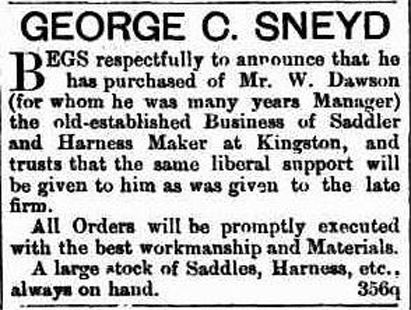
Mr. Sneyd was sent by Mr. Dawson to open a branch at Kingston, and on May 14, 1851, he purchased the business and remained at the seaside town for seven years. During his time at Kingston he used to organise races, the prizes being saddles and bridles. He recalled how Jack Miller, a noted rough rider, managed to win one of these. Being short of the entrance fee he pulled his horse's tail, and with the money thus earned entered and won the race.
George did not have it all his way as is reflected by this article in the South Australian Register, 1887.
"There was a splendid collection of harness, shown by Mr. J. J. Osman, a local maker. For bush saddle and bridle there were two entries, Mr. Osman, and Mr. Sneyd of Kingston. Both exhibits were so good and so nearly alike that the Judges called on Mr. Grieve, a practical saddler, of Mount Gambier, to examine both saddles. Having done so he awarded the prize to Mr. Osman, as the workmanship and finish on his saddle was superior to Mr. Sneyd's. He considered both exhibits good serviceable saddles. It was reported here that Mr. Sneyd's saddle was the one with which he gained the prize at the Industrial Exhibition lately held in Adelaide. If so, all the more credit is due to our local tradesman."

Adelaide Jubilee Exhibition, 1887 - Saddlery section where Mr Sneyd won a prize
Pic Credit: State Library of South Australia
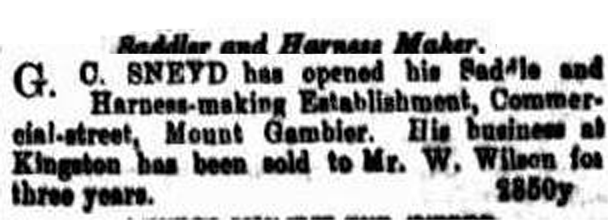
Mr. Sneyd relocated to Mount Gambier, where he stayed for 31 years. The below advertisement was run in the Border Watch (Mount Gambier, SA ), Wednesday 2 September 1891.

Commercial Street, Mt Gambier 1890
Photo Credit: State Library of Sth. Australia
Mr. George Fowler, on leaving school went to work for the late Mr. G. C. Sneyd, who conducted a saddlery and harness business in Robe. Mr. Sneyd's saddles had an Australian-wide reputation, and young Fowler soon became an expert saddler. When Mr. Sneyd left Robe and opened a business in Commercial Street, Mt. Gambier, Mr. Fowler came with him. When Mr. Sneyd left Mt. Gambier in approximately 1922, Mr. Fowler took over the business, which he carried on for many years.
The death of young men in the war took a toll on the parents left behind. Never so much as George Sneyd upon hearing of the death of his son Les. George attempted to commit suicide at Mt Gambier in 1920. The article read: 'Ever since the loss of his son Corporal Les Sneyd, D.C.M., in action about two years ago, he had been dejected and appeared more than ordinarily worried during the week. He was seen to enter his shop at 7.30am on the Saturday morning and at 10 o’clock James Meldrum a boot-maker opposite, noticed him come out and stagger across the road with a deep gash across his throat. Mr Sneyd survived the attempt.' The Sneyd’s had also lost their second son, Harold in 1892, at Kingston aged 5, many years before this event.
In 1924, the Mail ran an article on the famous saddler. It said: In a small shed at the rear of a dwelling in Fullarton, Adelaide, a grey headed old man works unceasingly at a saddle maker's bench. His name is Sneyd — George Coleman Sneyd. To the city dweller this name conveys nothing. Mention G. C. Sneyd to any bronco-busting stockman, however, and watch him prick up his ears. Wherever bushmen foregather, and clear-eyed men grapple with foam flecked outlaws of plain and range, the name of Sneyd is known. Ask any Australian stockman to mention the best saddle in the world, and invariably one name springs to his lips: 'The Sneyd.' And yet this world-famous saddle genius is content to work in the quietude of a suburban backyard.
But this grey bearded worker is no ordinary saddler, and he does not toil for monetary gain. His bench is the bench of the inventor, and the evolution of the perfect saddle is his aim. Mr. Sneyd will be 73 years old on February 24, 1924 and for 58 years he has been making saddles. But let him tell his tale in his own way.
"A little over two years ago I had a break down in health, which made me forsake my business at Mount Gambier and come to Adelaide. Soon, however I began to feel much better, and I told the wife it was no good to me walking about doing nothing, and I straightway rigged up a shed and bench in the back yard those two years I have made 34 saddles, and every succeeding one has been a little bit better than the other. I set myself the task of evolving the perfect saddle, and I believe I have now got as near perfection as possible. One saddle takes me more than three weeks to make, and my boast is that no man in the world makes a saddle in exactly the same way as I do."
"I first learnt the trade, with old John Ekers, of Robe. I was only a young fellow then, but I well remember Adam Lindsay Gordon. He was a fine big chap, with curly hair, and as well as being abnormally short sighted, was absent-minded. He walked into our shop in Robe on day, and tossing his pocket book on the counter, said, 'Mend that for me, John,' and walked out again. Old John picked up the pocket boot, and fumbled with the buckle. When he held the book up to the light a shower of golden sovereigns came tumbling out of it. To me fell the job of picking them up, and all told I counted eighty. Eighty golden sovereigns. Gordon had forgotten the existence of the money— typical of him. I never had the pleasure of making a saddle for him.
Another time, when I was still at John Ekers' shop, I remember a kangaroo hunt being organised for Governor Ferguson. We all went out and had a real good day's fun. Bill Hales, Morris Moore and James Banka were famous buckjump riders who all lived in Robe. Banks, who is 78 years old, lives close to me on the Fullarton road. Fred Drury and Con Connell were renowned Penola riders. I saw the latter mount a colt with the throat strap of the bridle undone. As soon as he was in the saddle he pushed the bridle off with his thumb and I witnessed one of the finest exhibitions of buckjumping and riding I ever saw in my life."
He continued on, "Now you hear people talk about knee pads. Well, my knee pads are really not knee pads at all. A man riding in one of my saddles grips the pad with the inner part of the leg, just above the knee. I always had the idea, that the immovable knee pad was what was wanted, and after 57 years I claim that I have got it. I defy the strongest man to shift one of my pads by pressure more than he could a railway engine. They are as near perfect as possible."
"I've received testimonials from all over the world. Thousands of them. Just wait and I'll dig you up a few. Here you are. Here's one each from England, New Zealand, the Darling River, Western Australia, and hello! listen to this: —
Out on the common, out on the plain.
Giving a colt the full length of rein,
They can't throw me off when once I straddle .
One of Sneyd's buck-jumping saddles.
Ha! Ha! That is only one of many such effusions that roll in from outback. It is surprising how easily your bushman breaks into verse. Here's a typical letter from the back country:
'Dear Sir — I had the experience of trying your saddle on an outlaw today. It quite came up to expectations, and I fear no horse on the Darling River astride a Sneyd'."
The press was still praising the work of old George when a letter was printed in the Advertiser in 1931:
A South-Eastern station owner writer:- "Dear Rufus, Now that there is a growing demand for horses, saddlers should soon be kept busy again. If G. C. Sneyd, who is well over 80, and will be having another birthday at the beginning of the New Year, was to start saddle making, there would be no trouble to get our colts broken in. Several of our South-East veteran riders, C. W. Flint, D. Campbell, and P. Drury, still have in their possession their good old Sneyd saddles. All three are rough riders, and amongst the best of horseman. Their saddles having been in use for over 30 years, are still practically as good as new."
And finally, a small obituary on the famous man upon his death in 1936.
Mr. George Coleman Sneyd, who died recently (11 October, 1936) at Fullarton, was a well-known saddler who was engaged in business at Robe, Kingston, and Mt. Gambier. His saddles are in use on many stations throughout Australia, and several were taken to India and England. He retired, from business about 10 years ago, and finding idleness irksome he made a further 88 saddles, some of which are in the storeroom of a well-known pastoralist for use in the future. Mr. Sneyd was a fine horseman and a good swimmer, and, when living at Robe, rescued several persons from drowning. He was a member of the Manchester Unity for over 60 years. Mrs Sneyd died two years ago. Two sons survive, Messrs. Percy G. Sneyd, of Riverton, and Ernest E. Sneyd, of Allenby Gardens.

George Sneyd Buckjump Saddle early 1900's
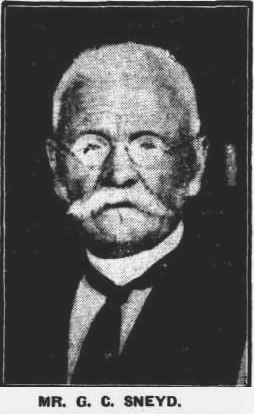
Photographed by the "Mail" Adelaide in 1924 aged 72