
The Australian Stock Saddle
and the Saddlers that made them
WILLIAM EBENEZEER KINNEAR 1863 - 1951
Australia was very lucky that Mr George Kinnear was a robust gentleman, as his health was tested when on his ship voyage to Melbourne, as the passengers were decimated by typhus fever with 178 deaths out of 811. The year was 1852 and eleven years later William Ebenezeer Kinnear was born in Kilmore, Victoria.
Seventeen years later at the Kilmore Ag Show the judge had this to say about a particular saddle. “A lady's saddle made by a lad of seventeen is highly creditable to the young man who has proved such an adept at the work.” That lad was Billy Kinnear.
In 1880 a report in the Argus stated. “Mr W E Kinnear, of Kilmore, sends in a case (to the Inter-Colonial Melbourne Exhibition) containing a quantity of highly ornamental saddlery, such as show bridle for stallion and surcingle of the same character, with other ornamental bridles, also some saddles in buckskin and hogskin, with plain bridles and other specimens of saddlers' work. An interest attaches to this exhibit from the fact that the maker of the articles, is only 18 years of age.” Billy won a Silver Medal for a Ladies’ and Gentlemen’s Bridle entry.
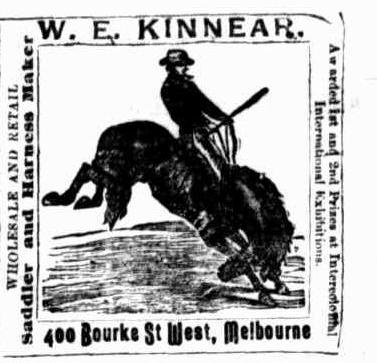
1890 sees the arrival of William (Billy) Kinnear from Euroa to Melbourne, with a warning from a sceptical friend ringing in his ears. "Keep your money in your pocket, young man, and go back to the bush. There are 17 saddlers' shops in Bourke Street. You'll lose your money." But 27-year-old Bill Kinnear stayed on. He had the sporting instinct, and took a chance. Bill's original business in Bourke Street was at the corner of Kirk's Horse Bazaar, where Hardware Lane now stands.
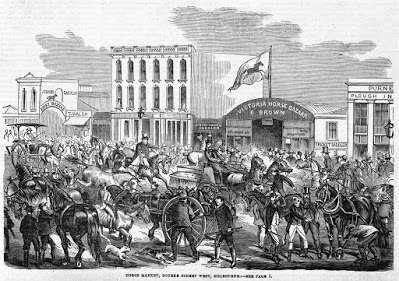
Billy claims to have staged the first rough riding competition ever held in Melbourne during 1892. Lance Skuthorpe Snr. was ringmaster. There were 127 competitors from most States for the £50 prize. As the producer of buckjumping shows Billy Kinnear knew a good hand when he met one and of those he had seen, an aboriginal lad - Mulga Fred - had a special place in his memory. Mulga was a West Australian boy who made his way down to Adelaide droving horses and must have found the city an alien enough place until he discovered Broncho George's buckjumping show. Broncho had a good team as might be expected, in that time and place. Despite the reputation of the horse, times were different then, and the challenge ride was 20 seconds for £5 and this on a supposedly unrideable buckjumper.
The advent of just one more aboriginal stockman into the ring to try his luck on King didn't even cause Broncho to give a tired smile; but when Mulga rode the outlaw not for 20 seconds but to an outright stand still, the showman was quick to give him both the fiver and a permanent job. Mulga stayed with the show until its Melbourne season in 1908, and gained a terrific reputation. He was a wonderful horseman and could ride in any gear with or without assistance. He could vault on to a horse when it was in action, and ride it from head to tail. Mr. Kinnear has also seen him beat a horse which continually reared over him, by slipping off as the horse came over and slipping on again as fast as he tried to rise.
In 1911, Billy engaged Mulga Fred as star rider in a show he was then running at Melbourne and he proved a great attraction. He was never thrown until a spectator put up £2 that he could not better the time of four seconds that was the longest recorded on Paul, the champion bucking bullock. Mulga stayed on for four seconds, and got his £2 and two ribs broken into the bargain. These souvenirs were collected when Paul threw him into the arena fence. Mulga retired from the game to the Western District and was living near Hamilton. He often attended sports meetings to give exhibitions with his stockwhips and boomerangs, and, at Hamilton, last year, was presented with a special belt that Mr. Kinnear had made himself for the occasion.
Mulga Fred was hit by a train on Horsham station in November, 1948 and died.
Billy had many stories to tell, being situated in the hub at Kirk’s Bazaar for all those years. He knew the Kellys well — but not Ned, whose picture, nevertheless, hung over his bench. He lost a good friend, when Jim Kelly died at Greta in 1947.
One of his cherished memories links Kirk's with the Kellys and with poet-steeplechaser Adam Lindsay Gordon. On Canary, in the 70's, Harry Mauby won a hunt club cup from Adam, who rode neck and neck to second. Mauby bought Canary from "Wild" Wright, of Mansfield, recorded in legends as the man who helped the Kellys. Canary passed to Sam Waldock who hunted a pack at Flemington and who lent the horse to Campbell's, then proprietors of Kirk's, for exhibition. Billy Enderson famous as the "jockey who leapt with death," used to jump Canary over a six-foot bar 40 ft. long every morning at 11 at Kirk's bazaar. Gordon was a regular at Kirk’s.
Even in his later years Bill Kinnear retained many interests, including the "Cobb and Co. Old Coach Drivers' Association" and the wearers of the horseshoe badge. Bill did not drive a coach himself, nor did his father. "But we made so much harness for them— that we couldn't very well be left out," he said. President of the association in the late 1940s was well-known paddock bookmaker, Mr Wallace Mitchell, whose father Hughie Mitchell, regularly drove the coaches from Melbourne to Kilmore— on the fifth stage of the north-east run.
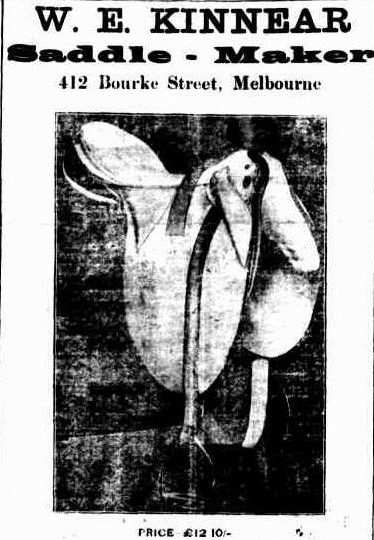

The Tom Lloyd Buckjump saddle was made by W E Kinnear
First mention to be found (in the press) on the famous saddle “The Bulldog Poley” he made, was in 1915 for a buckjumping prize at a Benalla competition. Not a common name in Australian language it could be one consideration that the name came from the well-known American, Buffalo Vernon, who was famous at Bull-Dogging a Steer. In 1912 a complete American Wild West Show and Australian Stockmen “Entertainment of the Age” was held featuring Vernon and Billy Kinnear presented a saddle, which was to be handed to the rider of the Melbourne Cup winner during the Circus Performance. Perhaps, also, he had a penchant for bulldogs as the maker's mark does take the shape of a bull-dog? (See photo at end of page.) However, we will probably never know how the saddle's celebrated name came about.
Many interviews over the years produced some great stories but one in particular stands out. Bobby Lewis rode several of his eight V.R.C. Derby winners, and four winners of the Melbourne Cup, mounted in saddles made by Mr. Bill Kinnear, of Bourke Street, Melbourne.
The veterans — saddler and jockey — had known each other since Lewis, as an apprentice, walked into the Bourke Street shop and asked the price of a light racing bridle of intricate workmanship. Bill Kinnear looked over his spectacles. "A jar of jam to you my boy," he said. The youngster disappeared and returned in half an hour with a pot of jam. He left the shop with the bridle!
"WHAT would you have done?" asked the 85-year-old saddler of the interviewer. "I had a joke with him, and he was a smart lad. He took me up on it!" That interlude was the beginning of a very long friendship.
Another that makes you wonder where is this beauty now? Made in the late 1890s, and right up until his death, this miniature saddle was displayed with pride in the shop window.
The 1947 article stated: “In a glass case in the window of Bill Kinnear's Bourke Street shop, is a saddle three inches long, and weighing a few ounces. It was made, with all trimmings, more than 50 years ago by Mr Kinnear. There was a contemporary craze for making tiny saddles, but when Bill turned out his midget masterpiece most of the others gave him best.”
During all this research on Bill it was astounding as to how many saddles, bridles and whips that he donated to the community. It appeared that he practically gave away a whip nearly every week to some event.
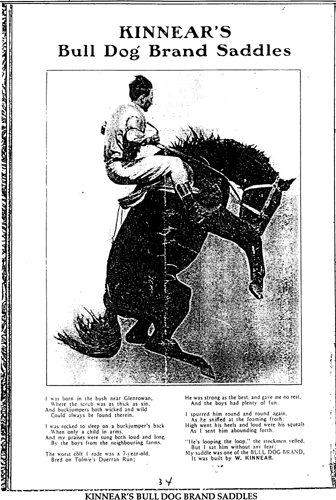
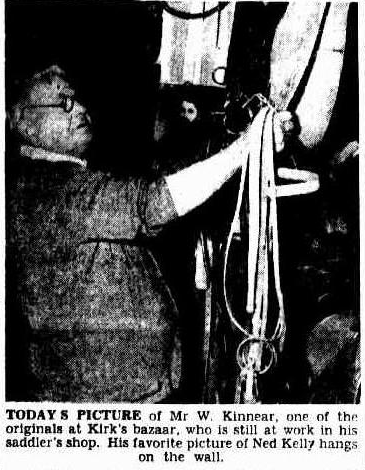
1947 Pic
A sad announcement was made in the Weekly Times on Wednesday 25 April 1951.
HE MADE SADDLES:
One of Victoria's oldest and best-known saddlers, Mr William E. Kinnear, died in Melbourne last week, aged 89.
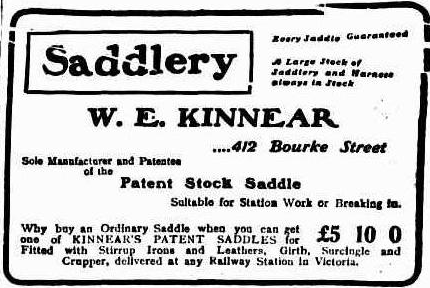
Remembered by his friends as "Old Bill", Mr Kinnear seventy years ago founded in Bourke Street, the business from which saddles and harness have gone to many parts of Australia and beyond. For years he shipped saddles to Calcutta and Madras, where the quality of their workmanship won esteem from officers of the Indian Army. Many of Victoria's oldest and best known families were among his customers. It was "Old Bill" who first introduced the "Poley" buck-jump saddle, which he designed with the pad set high on the tree to give the rider a longer grip with his thighs, and which still enjoys popularity here, and in America. About 30 years ago, when more than a dozen saddlers prospered in Bourke Street, Mr Kinnear employed about 20 men. Today the business is carried on by the founder's son, Mr Ray Kinnear.
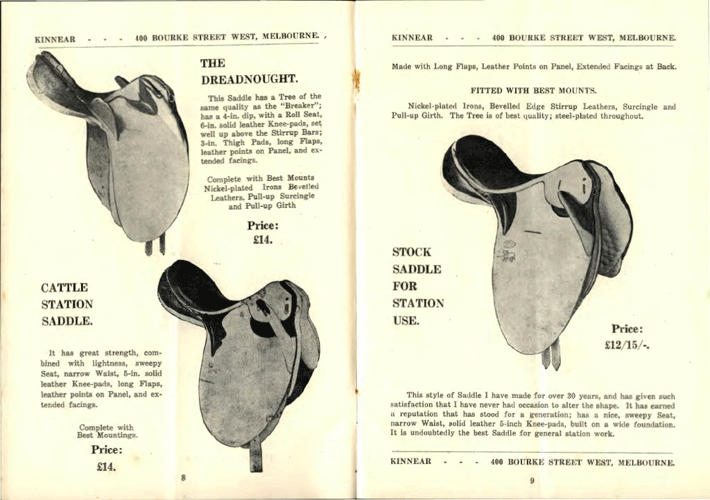
W E Kinnear - 1934 Catalogue

CECIL RAYMOND KINNEAR 1900 - 1957
Prior to Billy’s death, Ray had been interviewed in 1950 on his views of the saddlery trade.
“Saddlers, like farriers, are a dying race.”
“Few regret it more than Mr. Ray Kinnear, 51-year-old Bourke St. saddler, who was one of the last boy apprentices. There are few saddlers left nowadays, he says, and no one is learning the trade. Present demand comes mostly from racing men, young women riders, tradesmen, and men on the land. Business is better for remaining saddlers, because there is Mr. Kinnear, senior, among the last of the saddlers, no competition, says Mr. Kinnear.
In Sydney saddles are being made on a chain system, but Ray Kinnear considers that the mass-produced article will never be as good as the individual product. Mr Kinnear was apprenticed in 1912 (as a 13 year old), when there were 45 saddlers in Melbourne. Now there are five, he says. His father, 89-year-old Mr. W E Kinnear still comes to work. He started the firm in Bourke St. seventy years ago.”
Cecil Raymond Kinnear died in July 1957, just six years after his father’s death. Thereby ending the enduring trade of the Kinnear brand, favoured by so many bushman, and general horse riders alike.
Rainbows Saddle, was written by Howard James (an excerpt)
She was broken to the saddle, and a special one was made
By a saddler down in Bourke Street, the best known in the trade
It was the well known Bulldog brand, made for mountain use
The same type other cattlemen had, and it took some hard abuse
At first she wouldn’t take to it, or a bridle and bit
But patiently they worked with her and she soon accepted it
No other one did she carry in all her living years
Only the Boss ever rode her in that saddle from Kinnear’s

A bulldog Kinnear made by Billy in c1922 and held at the Mansfield Museum Pic: Clive Barton
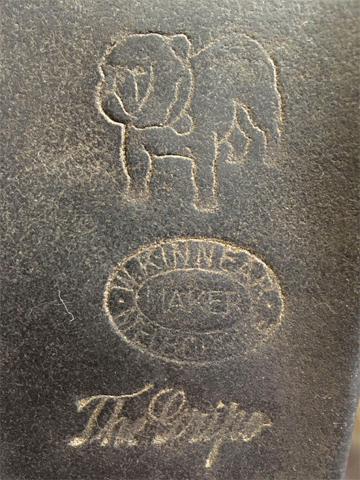
An excellent example of the Kinnear maker's mark, The Gripo being one of his styles of a Bulldog poley stock saddle Photo Credit: Clive Barton