
The Australian Stock Saddle
and the Saddlers that made them
PROFESSOR EDWARD BATES ?(CAN) - 1930
Famous in Australia for developing a hair lined poley stock saddle with swinging fenders in conjunction with L Uhl & Sons, Brisbane in 1911, and marketed in 1912. See Picture below.

History is a little clouded as to when Professor Bates landed in Australia and the first article found was written in the Maitland Daily Mercury in November 1908 espousing the new method of colt castration, cattle speying and equine dentistry.
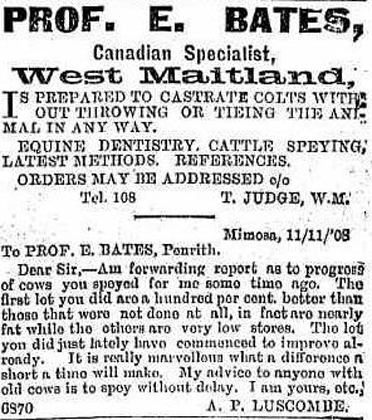
The Canadian Professor was diversifying from his profession with this event advertised in the Raleigh Sun (Bellingen), on Friday 27 August 1909. It read:
PROFESSOR BATES' SHOW.
Professor Bates' buckjumping show drew a crowded house on Saturday night. The enclosure was rather small, but it was nicely lighted, and on the whole answered well. The first item was a boxing contest in which one of the contestants had a decided advantage, but he did not uphold his prestige to the same extent in a later set-to, when a somewhat heavier opponent entered the lists against him. A first-class exhibition of throwing a horse by means of a lassoo was given by Professor Bates, after which a local pony with buck jumping proclivities was brought in, a volunteer from among the audience essaying to ride it. He was unseated at an early stage, but fell on sawdust and was unhurt. David Roberts gave two samples of his skill as a log-chopper, operating on a black-butt log. He wielded the axe like an expert, and the athletic force of his strokes severed the logs in double-quick time. Looping a rope by the Professor and knot-tying with a rope by Mrs. Bates were good items. Other events also took place. The one drawback was the absence of buckjumping horses, but this was not the Professor's fault. He was there to ride any brought along; if they did not come, the forfeit was not on his side. On the whole he gave a very good show, and the applause, like the patronage, was liberal.
In January 1910 the Sydney Stock and Station Journal the article announced that the Professor was speying cattle.
PROFESSOR BATES IN QUEENSLAND.
Professor Bates, who advertises in the ''Journal" is at present speying cows at Buckrumbi Station, Glen Innes.
No doubt the Daily Standard (Brisbane), caused a ripple of interest when this article was published in January 1913.
THE AMERICAN STOCK SADDLE. (Picture at top of page)
Of all ideas in window dressing, those of L Uhl and Sons' can safely claim to rank among the most original. A very attractive display of saddlery and carriage equipments is made in one of the windows. The firm is making a specialty of the American stock saddle, which, it is claimed, has several advantages over the Australian rough-riding saddle. For this purpose, the famous Professor Bates, America's most daring rider, has been engaged to make a supply of those saddles on the firm's premises at Petrie Bight. The saddle, it is claimed, has a more comfortable and a more secure seat than the Australian one; the flaps are cut short, the knee-pads are big, and the stirrup leathers are very broad. A window has been specially set aside by the firm for exhibiting these saddles, in which a boy rides a pony. This proves a great "draw."
Note: These saddles were still being advertised for sale in their 1960's catalogues.

Professor Bates mounted in his "American" stock saddle together with tapaderos. Note the horse is also in a curb bit.
Professor Bates worked closely with Uhl & Sons in Brisbane for a few years. He helped design new saddles, patented the Bates fastener in Australia and also used the Uhl premises in January 1914 with a Horse Dentistry demonstration.
"An interesting dental operation on 9th January took place at Messrs. L. Uhl and Sons' yard in the presence of several gentlemen associated with live stock interests. The operator was Professor Bates, and the subject was an aged horse belonging to a Mr. Forster. The animal was suffering from the effects of two upper molars, which protruded quite an inch beyond the level of the other teeth, not only rendering the mastication of grain absolutely impossible, but also causing havoc in the lower jaws, which presented a sorry appearance internally. In less time than it takes to relate, the professor had snipped off the tops of the offending molars, the jagged tops of which he smoothed off with a file. The equine patient meantime stood perfectly still as if realising that he was in good hands, and that he would emerge a much better horse from the dentist's attentions. Amongst those who witnessed the operation were Mr. Carl Zoeller, Mr. A. Dryden, and Messrs. Uhl & Sons. It afterwards was learnt that Professor Bates for several years past has successfully, performed numerous dental operations on horses belonging to Messrs. Baynes Bros."
Professor Edward Bates' Dentistry Diploma gained in 1906 at the Detroit Veterinary Dental College, Michigan, USA

The Morning Bulletin (Rockhampton, Qld.), on Tuesday 19 June 1923, ran the below article:
VISIT OF PROFESSOR BATES.
Stockowners who are visiting Rockhampton this week will be interest to learn that Professor Bates, speyer, is in town. Since he was last here Professor Bates has been following his occupation in the western districts. Among the stations that he has opera-ted on is Peak Vale, Clermont. He holds a letter from the manager, Mr. R. Tindale, dated the 1st instant, stating that since June, 1919, he has treated 8209 cattle on that holding and that the estimated proportion of deaths was one per cent. The biggest day's work was 276 head, and the day, with a break of an hour for dinner, ended at half-past three o'clock in the after-noon. Mr. Tindale further says that Professor Bates speyed stock on Peak Vale from 1909 to 1913, but as the station books were swept away by flood, in 1916, he cannot give the exact number dealt with in that period. He thinks, however, that he can safely assert that it was over 8000. All the cattle that passed through Professor Bates's hands were treated at the meat works of the Australian Meat Export Company (Brisbane), Messrs. Baynes Brothers (Brisbane), the Gladstone Meat Works, Limited (Gladstone), and the Central Queensland Meat Export Company (Lake's Creek).
Professor Bates was still speying in the district six months later. The Morning Bulletin (Rockhampton, Qld.), on Saturday 8 December 1923, recorded that Professor Bates arrived from Malvern Downs yesterday, where he completed the speying of 1030 cattle.
Professor Bates proved himself a horseman in many rodeos and carnivals. At one event he actually beat Professor Kemp in a buckjumping competition, to which Professor Kemp had asked for a re-match to see if he could beat the man at the next event. The Morning Bulletin (Rockhampton, Qld.), on Friday 7 March 1924, reported:
THE CARNIVAL. SHOW GROUNDS SPORTS. PROFESSOR BATES' SUGGESTIONS.
Since the Rockhampton Agricultural Society first promoted a sports day on its Show Grounds on the Tuesday in Carnival week a few years ago, the sports have proved each year to be one of the most outstanding attractions of our Carnival, and, with fine weather, can always be relied upon to give a satisfactory profit. Realising the field it opens to many identified with stock in some way, apart from the financial consideration, the Society proposes to submit a very attractive programme for the Tuesday in the next Carnival week in June. The programme will be completed at the next monthly meeting of the Committee, when some suggestions by Professor Bates will be considered.
Professor Bates suggests that the programme should include a stockman's race, the stockman to gallop to the centre of two barrels, equidistant from the starting and finishing points, make a figure eight round the barrels, and then practically finish in a direct line from the point of commencement, the fastest time to be the deciding factor in awarding the prizes.
In the relay race Professor Bates' proposition is that the competitor should race round the ring three times, making one change of horses and finishing on the first, the changing stations to be arranged at the edge of the ring as the competitors desired, and the fastest time to count in the allocation of the prizes.
In the cast of cattle drafting, Professor Bates offers the suggestion that the bullock should be drafted by a man other than the competitor and that the competitor, stationed at a point close to the entrance of the bullock enclosure, should only figure in the competition once the animal, after being drafted out of the enclosure, crosses the semi-circular chalk line distant 20 yards at any point from the competitor. Then the competitor should draft the bullock between two barrels some distance away, making a sharp circle round the left-hand barrel, then passing round the second, and finally sending the animal back into the enclosure, the fastest time to be the only consideration in making the awards.
In regard to throwing and tieing a bullock, Professor Bates suggests that the drafting should be eliminated and only the actual time for tieing a bullock with a 20 yards start, reckoned in deciding the prize winners. In all probability, the Society will this year substitute a bullock riding competition in-stead of cattle throwing and tieing ; but this is a matter for the final meeting of the Committee.
At present the programme includes £100 for an open cattle drafting com-petition, £15 for cattle drafting for boys 16 years of age and under, £35 for cattle riding, £30 for buckjumping, £10 for a relay race, £9 for a flag race, and £35 for trotting. With fastest time as the condition in certain events, there should be a bigger number of entries and the prospect of a better distribution of prizes.
Another article, this time in the Capricornian (Rockhampton, Qld.), on 22 November 1924, printed:
Looking hale and hearty and none the worse for six months sojourn in the Never Never, Professor Bates returned to Rockhampton last week. The professor left this city six months ago and since then he has travelled over a good deal of Queensland and the Never Never and was greatly impressed. From here Professor Bates went to Glenormiston, the big cattle station on the Georgina, and to Roxborough, an adjourning station to the north. At these—and the other stations he went to—he was engaged in speying cows. From Roxborough he came back to Cork and then went to Strathfield. From the latter he journeyed to Avon Downs, in The Territory. He travelled back in his car to Richmond and there took train for Townsville and Rockhampton. Speaking of the Barkly Tableland, which he saw for the first time, Professor Bates said that it struck him as being excellent sheep country and no doubt with railway extension it would eventually carry sheep. The season was somewhat dry, but just as he was leaving, the rain was setting in and useful showers had fallen out there. Professor Bates expects to have a good run next year, on the far western stations.
The Morning Bulletin (Rockhampton, Qld.), reported how busy he was in May 1927.
PROFESSOR KEMP BATES
Since leaving Brisbane three weeks ago Professor Kemp Bates has speyed the following cattle:—Messrs. J. McKenzie, Pearl Creek, Duaringa, 360; L. A. McKenzie, Telson, Dingo, 83; Moray Downs and Twin Hills, 480; Beak's Pastoral Co., Kooingal, 588. Seventy per cent were passage speyed and the balance flank speyed. At Kooingal the 588 head were put through in two and a-half days comfortably. The best tally being 277 in seven hours, or an average of 40 an hour. Professor Bates best records are as follows, working with single bail and crush:—375 head in 10 hours, 335 head in 8 hours, 60 head in one hour. Operating time, for 1 cow only, 23 seconds. On February 16th last he speyed 550 head for Mr. R. G. Barton, Toweran, Lowmead, and he is in receipt of a report from Mr. Barton saying the losses were nil. Some time previously 1006 were speyed at Strathfield, Mackinley, without loss. N.B. It is unknown as to whether Edward Bates allowed himself to be called Professor Kemp Bates with a view to trade in on the famous name of Professor Kemp or was an incorrect report.
Sadly the Central Queensland Herald (Rockhampton, Qld.), reported on Thursday 24 July 1930, that Professor Bates had passed away.
PROFESSOR E. BATES. ROCKHAMPTON, July 18, 1930.
The death occurred recently in the Ayr Hospital of Professor E. Bates, well-known veterinary surgeon and cattle speyer, as the result of a kick from a horse.

Very interesting saddle, note the knee roll and a very large knee pad. Photo taken outside Uhl's, Petrie Bight, Brisbane in 1912. This saddle was designed by Professor Bates together with Uhl & Sons