The Australian Stock Saddle
and the Saddlers that made them
JOHN BRUSH SNR 1814 - 1894
JOHN BRUSH JNR 1852 - 1911
‘Indeed, Mr. Brush's experience in this direction quite coincides with that of many local producers, who having carefully studied the peculiar circumstances attending the Colony and its very special wants, have laboured to carry them into practice. As illustrative of this leading idea, the Colonial saddle may be cited. It was to the peculiar and special conditions under which riding had to be done that the Colonial saddle was modelled. The risks and dangers to horsemen in the Australian bush, in the mustering and driving of stock, suggested to some practical mind the addition of knee-pads to the flaps - a trifling addition certainly, yet constituting an element of safety, appreciable to all’ Illustrated Sydney News, 1887
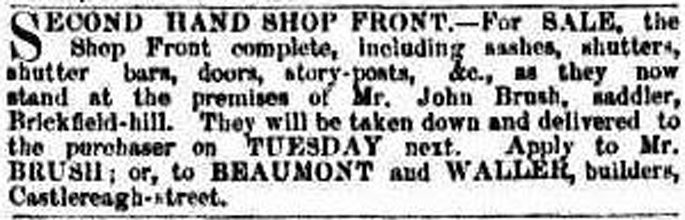
This firm was founded by John Brush, in the Haymarket in 1840. Sydney was a poor little town then, but the Haymarket was an important part of it. John Brush was a good business man, and he moved with the times. He left the Haymarket, and set up on Brickfield Hill sometime before 1844. In 1856 came a newspaper advertisement calling for employees of the trade: TO HARNESS-MAKERS.-Wanted, a good useful hand in the shop; to a sober steady man constant employment and good wages. Apply to JOHN BRUSH, 483, George-street South. Business must have been progressing nicely as he also had the capital to change the shopfront of the building to encourage more trade.
In 1861 Brush moved once again to bigger premises in George Street, with this accompanying notification to the public.
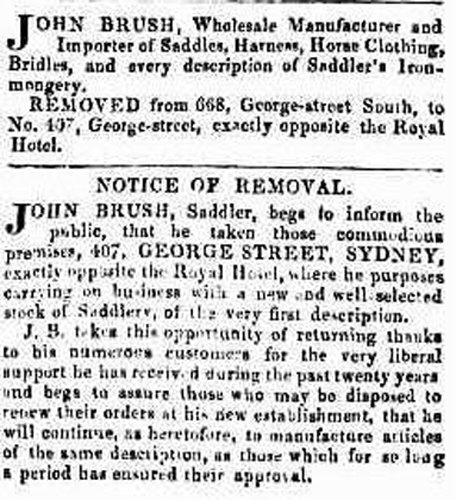
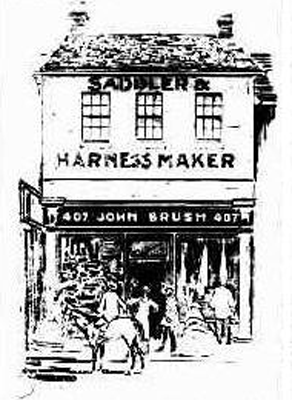
From 1861 when he moved to 407 George Street until 1866, Brush continued with a steady trade and obviously thought it not a bad idea to enter a saddle in the Melbourne Intercolonial Exhibition. This saddle placed him 'on the map' so to speak with his peers, as it was considered quite famous, as the below stories in 1866 depict.
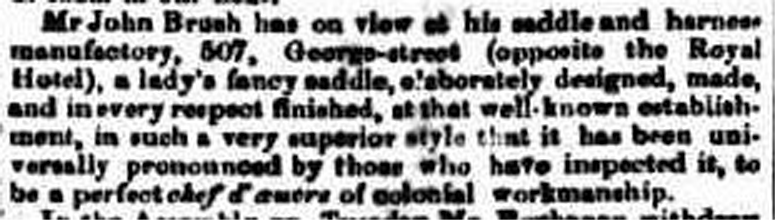
"Chef d auvre" - a masterpiece especially in art or literature
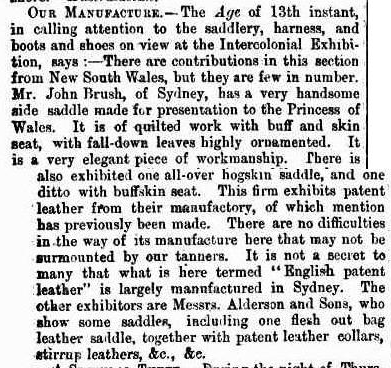
Sydney Morning Herald (NSW : 1842 - 1954), Thursday 21 February 1867, page 7
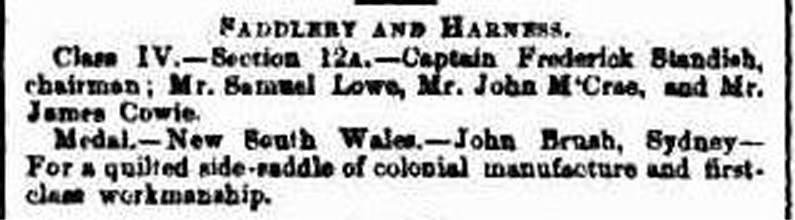
SADDLERY AND HARNESS.
Class IV -Section 12A Captain Frederick Standish, chairman, Mr Samuel Lowe, Mr John M'Crae, and Mr James Cowie
Medal New South Wales John Brush, Sydney For a quilted side saddle of colonial manufacture and first class workmanship (Palm award medal)
The [Goulburn Herald and Chronicle] in January 1868, was still waxing lyricals about John Snr.'s feats.
John Brush, in this city at whose shop in George street, opposite the Royal Hotel, was manufactured that very beautiful side-saddle which (it may be remembered) not only carried off the palm at the Melbourne Intercolonial Exhibition, but was subsequently forwarded to Paris, and there presented to the Princess of Wales-a four horse set of harness, made to order for the Duke of Edinburgh, has just been completed, and that, too, in a style which, as a piece of colonial work, fully sustains the high reputation of Mr. Brush's establishment. It is made of patent leather of the most, superior quality, crested in sterling silver, and otherwise elaborately and artistically ornamented; it being, of course, needless to say that those parts of the harness which are necessarily made of steel, are of an equally good quality, in the bridles the eye-straps and face-drops are each cut out of one piece of leather, the nose-bands being embroidered with open work. The different hip-straps and britches are likewise cut out of single pieces. The hame-tugs are also of patent leather, with silver ornaments. This elegant harness which, although so elaborately finished, is of a severe and unexceptional simplicity has been made for the official reception of his Royal Highness and will be used, for the first time, on Wednesday. Besides this set of harness, we are informed that Mr. John Brush has been honoured with orders to make another for the Prince's private use. It is to be observed that the official harness, above described, is ornamented with the double crests borne by the family of the Earl of Belmore, it being intended, we believe, that this carriage harness, and the vehicle to which it will be attached, will eventually be placed at the disposal of his Excellency.
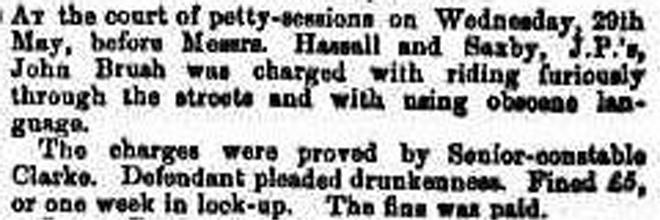
The next news item in 1867 can reasonably be associated with John Snr., however it would not be out of the realms of possibility that it could have been John Jnr.. Interesting to note that the seven days of jail was not an option, so they copped the large fine instead.
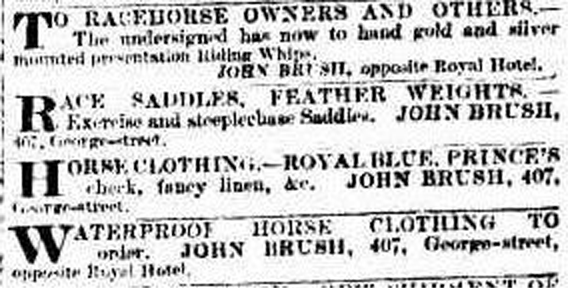
1877 sees some additional horse items being made available to the public. It was also the year that John Snr. did some travel to America and England to ascertain the current trends around the world for all the equestrian needs. This trip resulted in a constant supply of American carriage equipment being imported in the ensuing years.
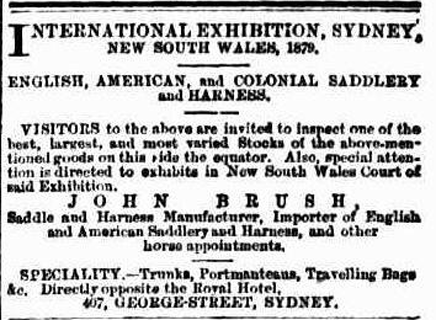
ESTABLISHED 1840.-407, George street, opposite Royal Hotel,-Mr. BRUSH, having returned from his tour through England and America, desires to make it known that he has made large purchases in both markets, and that he has now to hand, ex Ladoga from New York, 14 cases containing American Buggy Harness (single and pair horse), from the best manufacturers, and of the most superior description some of which is made to his own order, and under his supervision, and the remainder selected by him personally, also American Leather and Materials for the manufacture of harness after the American models; American whips and fancy saddlery goods, all of which are now ready for inspection, and to which your special attention is directed. In consequence of the extensive stock of English and Colonial Goods on hand, and in order to display to advantage and facilitate business he has secured the upper portion of the adjoining premises Nos. 403 and 405, especially for American goods. Ex Nyares, now landing 14 cases English Saddlery. JOHN BRUSH, Wholesale and Retail Saddler and Harness Manufacturer; Importer of English and American Harness, buggy, Carriage, and Brougham, Lamps, Saratoga Travelling Trunks, Portmanteaus, and every description of Saddlery.
This lucrative trend of imports continued on over the years, resulting in numerous newspaper advertisements.

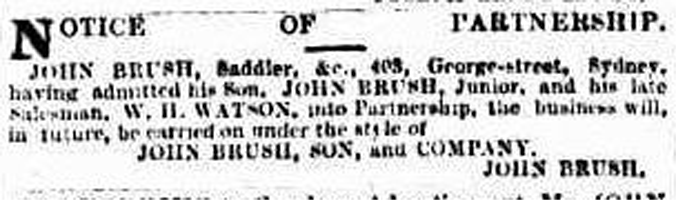
John Brush Jnr. had attained the age of 30 in 1883 which must have prompted Brush Snr. to enter him into the business in a formal partnership, however it is interesting to note that their long standing manager/salesman was included, a Mr W. H. Watson.
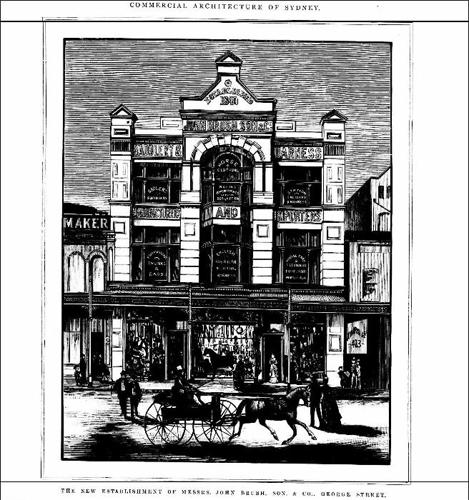
The success with the firm prompted the re-building of the premises which was promptly reported on by the [Illustrated Sydney News] in April 1887.
SYDNEY COMMERCIAL ARCHITECTURE.
THE NEW ESTABLISHMENT OF MESSES. JOHN BRUSH SON, AND CO., GEORGE STREET.
EXACTLY in the centre of the city, directly opposite the Royal Hotel, that old landmark of Sydney-have been erected the commodious premises here described. Forty seven years ago Mr. John Brush commenced business in this city, and for twenty-five years past he has occupied with his old establishment the site now covered by the new building, which extends far back till it abuts on York Street. Those portions of the buildings intervening are used as stores and work-rooms, in which are carried on all the operations incidental to the business of which the firm is the leading representative house in Sydney-and, indeed, in the Australian Colonies. Messrs. Brush, Son, and Co. have for many years cultivated a very special class of business, that of manufacturers and importers of really high-class goods in contradistinction to the low type of "slop and job" made articles with which so many importers deluge this market, and of the demerits of which so few people know, or take the trouble to know, until they fully realize by bitter experience.
The recent trip of the senior partner of the firm throughout Europe and America served to suggest new avenues for trade and the introduction of many features characteristic of the advanced ideas of the progressive people of old world cities; and a leading step towards this new departure was the erection of the extensive premises now under review.
With the growing inclination for travel and the extraordinary facilities yearly increasing to that end, Mr. Brush soon realized the direction in which his business would become materially modified, and with this in view special attention was paid to accessories for travel, and it may be doubted if in any establishment, even in the old country or America, a finer or more extensive display could be afforded than that arranged in the front division and the show-rooms. These embrace every form of portmanteau, travelling bag, toilet and dressing-cases, shooting, fishing, and cricketing goods, with every requisite for the comfort and convenience of the excursionist or tourist.
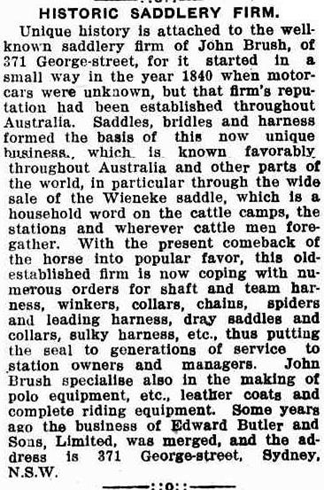
In the harness show-rooms the extensive range of cases is filled with every form of high-class harness-carriage, buggy, and general-made by the firm, or imported under special order from the noteworthy houses engaged in this special branch of industry in England and America. As a matter of fact, the really reliable goods-under guarantee-are made on the premises, and, as a rule, by workmen who have learnt their business and been trained under the guidance of Mr. Brush, many of them having grown grey in his employment; or by efficient London workmen trained to colonial requirements. Indeed, we learn on this point that when additional help is wanted it is extremely difficult to procure efficient workmen, many of those offering being either incompetent, or only possessing very special and restricted knowledge of peculiar branches of the trade of certain classes of work common enough in England, but not at all in harmony with colonial requirements. Indeed, Mr. Brush's experience in this direction quite coincides with that of many local producers, who having carefully studied the peculiar circumstances attending the Colony and its very special wants, have laboured to carry them into practice. This has naturally led to manufacturing firms here lifting their methods out of the old grooves, and has stimulated in a great degree the inventive and adaptive faculty in all.
As illustrative of this leading idea, the Colonial saddle may be cited. It was to the peculiar and special conditions under which riding had to be done that the Colonial saddle was modelled. The risks and dangers to horsemen in the Australian bush, in the mustering and driving of stock, suggested to some practical mind the addition of knee-pads to the flaps - a trifling addition certainly, yet constituting an element of safety, appreciable to all. These saddles have become so popular that the usual English style of make would rarely find a customer in the Colonies, and every saddler in England branch of their business Messrs. Brush, Son, & Co. do an immense trade; a large division of these premises being devoted to the work of building up the saddle from the "tree" to the finished article. Some excellent samples of gentlemen's and ladies' saddles home-made has to keep the Australian in this and imported are on exhibition; and we are informed that, from the firm's long connection with their English makers, these latter have now come to understand exactly the details of colonial wants, and to work with great exactness to Messrs. Brush, Son & Co.'s specifications on any orders sent home for execution.
In addition to their manufacturing trade Messrs. Brush, Son, & Co. do a large business in all matters appertaining to the supply of squatters, farmers, and other country customers.
It is really difficult in the space available for these notes to describe at greater length the striking features and extensive range of departmental divisions of the business of Messrs. Brush, Son, & Co.
It remains for us just to notice the chief architectural features of the building which has grown up under the supervision of Messrs. Slicerin and Hennessy, who are the architects. The premises have a frontage of about 50 feet to George Street, the general façade being of very neat and harmonious design, in which has been avoided all over elaboration or excessive ornamentation, which so frequently becomes marred by climate or ordinary wear and tear, and speedily loses its sharpness and clearness of outline. There are two commodious entrances from the street - one leading to the portmanteaus and other travelling requisites, the other to the saddle and harness department and show-rooms. The general design of the building is classic, boldly treated with some striking and original features, the handsome central pediment with bold dentilled cornice being highly effective. In designing the front, great care was bestowed on the fenestration, in order to obtain as much light as possible without marring the substantial character of the structure. The centre window-opening has an arched head, with key-stone and moulding mullions and transoms the others being similarly treated. The ground floor is a spacious room, 45 ft. x 80 ft., and 16 ft. high, the other floors being lofty and roomy. The shop windows are in three bays, with highly ornate pilasters, transoms, and spandrilled top lights; the huge sheets of plate-glass giving excellent accommodation for display. The building is a great feature in George Street, and well worthy of the commanding position it occupies.
The [Evening News] paid a visit to Brush's in 1889 reporting on the thriving saddlery business in George Street.
JOHN BRUSH, SON, AND CO.
Then are very few in the colony, nay in Australia, to whom the well-known harness and saddlery firm of John Brush and Son is not known. The building where their business is carried on is an extensive one, and every available inch of space on each floor is occupied with goods of all possible descriptions: The windows in George street are so beautifully adorned that they are sufficient to show anyone what the interior must be like. In the larger window there is saddlery with a few exceptions all made by this firm. The Warialda saddle, with extraordinary large kneepads, has a prominent position, and a lady's large side saddle is the chief attraction in this window. Portion of it is made of real doeskin. Girls' and boys' saddles are also displayed, as well as horse clothing, carriage harness, and multitudes of other necessities for stable use. On entering the building the bag department may be observed, in which are displayed some handsome crocodile skin Gladstone travelling bags, fitted either with or without dressing cases, and lined with the very best of leather. A new article here is a crocodile skin ladies' hand bag, which has been named 'Princess Alice'. This is a beautiful piece of work, and, together with purses mounted with silver, is worthy of special mention. There is also a nice stock of ladies' belts and writing desks made of pigskin. The toy department looks magnificent, and were some children to get a glimpse of it, they would not be contented until it had been bought out. Here are the latest novelties, including a very new idea, a tricycle for three children. Baby carriages are here in great quantity. Games for old and young of all kinds are also to be had. Another branch deals with trotting horse requisites, and men are to be seen engaged in making them. A feature here, are some trotting horse boots, made by a leading English firm. The harness room is stocked with the best harness in the world, there being no two sets alike. A beautiful set of brown leather harness for a private cab has been made for a well-known lady residing at Enfield. There are also some single and double panniers, or riding chairs for children, of basket work and leather. In the harness workroom none but the very best of men are employed, some having been in the service of the firm for as long as 37 years.

Date of photo unknown Pic Credit: Brett Watson
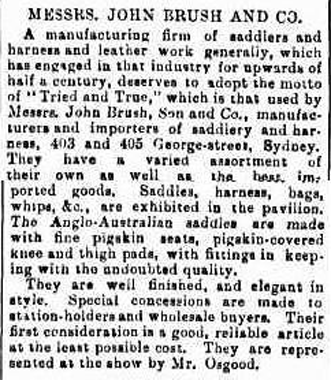
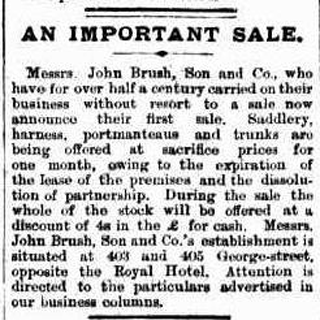
1894 saw the death of John Brush Snr., thereby leaving the business in the hands of John Brush Jnr. and Mr W. H.Watson. Brush Snr. must have been the steadying factor in driving the business as less than two years later, in 1896, saw the dissolution of the John Brush, Son and Co. partnership. One would tend to think that the exiting partner would be Watson, however a report in 1898 still has him situated in the shop, unless Brush Jnr. still held him on as a paid position to run the business, but lost the say in the running of it. It is quite astounding that John Brush traded for 56 years before they held a sale of any kind, of their stock on hand.
An entertaining story was put forward by an English ex-pat journalist working for the [Sydney Stock and Station Journal] in 1898.
John Brush, Son and Company.
OUR AUSTRALIAN SADDLERS.
When this 'Stock Journal' of ours started under the guidance of Wm. Brooks, some five years ago, it was a very poor little affair, and nobody took much heed of it. We've had a long pull for it but we've got to the top of the hill, and now we're taking a kind of a 'Smoke oh !' and looking round. We want now to take a survey and see who helped us, and see if we can give them a kind of a helping hand. Of course the fashion is, when you get up a bit, to forget your old friends, to forget, as it were, the pit from whence you were digged. As Shakespeare says —
'But that is a common proof,
That lowliness is young ambition's ladder,
Where to the climber-upwards turns his face;
But when he once attains the uppermost round,
He then unto the ladder turns his back,
Looks in the clouds, scorning the blue degrees
By which he did ascend'
My word, Shakespeare had a good grip of things, hadn't he? But this journal is different. We're running a paper on a new basis. We want to be clean and honest. It took some years to get a start, but we're beginning to do very well now, because people have come to realise that we mean what we say. A long time ago we had a bad time with Messrs. John Brush, Son and Co., the saddler because a canvasser of ours had made a foolish agreement with them. That canvasser thought that the Stock Journal was always going to be a subsidised rag, and he made a low-down agreement. I went to see the saddlers, and we had a bad time. But they were good people, and we made it up somehow, and they came along advertising with us. Now that we're succeeding I write to see them, and met the man I had the coolness with, and he turned out a regular trump. His name was W. H. Watson, one of the principals. He'll want to scalp me for saying this, but I rather like a man that I can quarrel with and then make it up. I like a man I can fight with, and have no ill-feelings after. When I went to look for Mr. Watson I met the other principal, Mr. John Brush, and I've about concluded that I'm going up there again to have something to eat with them. They're good people! What impressed me about them was this, I was under the impression that they were importers. I thought that the lovely harness and trunks and dressing cases and things were all brought from England and America. Now, I've got no derry on a man because he's an importer, but I have a profound respect for a manufacturer. You see, Wm. Brooks and Co. is the first Australian firm that ever published Australian school books, and I'm proud of them. Australia for the Australians, sez I, in that sense. Well, I found that this saddler's place was a complete revelation. About 60 years ago the firm was founded by John Brush, in the Haymarket. Think of what the Sydney Haymarket was 60 years ago ! Great Scott ! Sydney was a poor little town then, but the Haymarket was an important part of it. John Brush was a good business man, and he moved with the times. He left the Haymarket, and set up on Brickfield Hill. I never met the old man who founded the business, because I'm only a new chum, as it were, but I'll bet I could write his history from the look of the shop now, and the sight of his son's face. He worked steadily and honestly, and about 36 years ago he moved into George-street.
Here is a picture of the tumbledown little shop, with its overhanging eaves, and its very, very limited accommodation of a generation ago. Then Mr. Watson came in as manager some 27 years ago, and the business has grown and grown and grown, until it is simply marvellous. The old shop had 18 foot of frontage, and the reno was small. The new shop has 45 feet, with a vast 'hinterland', and the rent is not small. I had looked at that shop many a time in the years gone by, but I never dreamed that the bonnie things in the windows were made on the premises. They are not importers — they are manufacturers! When I go to Paris I'm going to buy a swagger travelling-bag at that shop, made in George-street of colonial leather, just to lob the folks at home see what we can do in Australia. What amazed me was this: That colonial leather didn’t stink. Do you know what I mean? I know a good man who bought a pair of colonial leather shoes and went into a bus on a hot day. There was an awful bad smell in that bus, and everybody got to smelling and somebody thought of the rhyme —
'There was an old man of Clonmell,
Who said, 'I'm aware of a smell'
But whether it's drains or human remains
I'm wholly unable to tell.'
Everybody got out of that 'bus, even an old lady with a basket, whom everybody suspected of being the smellee, and my friend was left alone — with the smell. It. was his colonial leather shoes!
This leather at Brush's doesn't smell, and Mr. Watson told me that years ago he had an awful struggle to get that smell out of it, but he got it out, and there's a story in that for somebody to tell. But I looked at the bags from 20 shillings to 20 guineas, and I concluded that we have got as good workmen in Australia as they have in any part of the world, and all that local industry needs is encouragement. We'll develop all right. Give us a fair show, and don't go to England or the States for your goods till you've seen ours. I went upstairs in that vast place and saw as much style and good Australian work as any man would want to see. I feel proud. In the saddlery room there were the Australian saddlers at work — clean, smart, active, brainy men. They weren't new chums either. One of them had been 44 years at the business, and had seen John Brush, Son and Co. grow up. The sons of the men who worked with the firm in the olden time were at work there now, and Australians mechanics took a step up in my estimation. We get used to hearing Australians lied about, until we come, in a kind of a way, to accept it as a truth. The foreman and the assistant foreman in that room, Mr. Delaney and Mr. Clapham, struck me as very fine specimens of Australian working men and I'm proud of them. I saw them working at the saddles they advertise in our paper, and I'm glad that they advertised with us when we were poor and lived in a cellar, because their goods are reliable and made in George street. They've got a big factory behind, where they make everything that is required in the trade, and I'm very pleased to have made the acquaintance of the firm, and to have learned what Australians can do.
Printing testimonials was a common practice in the early years and John Brush was not short on the number sent to their establishment. The below advertisement showed just how robust Brush's goods were as they were used way outside their parameters of usage without failing their owners.
A Good Testimonial.
Port Darwin. Messrs. John Brush, Son and Co., George-street, Sydney. August 1898.
Dear Sirs,— You asked me to let you know how the saddlery you supplied me with stood the wear and tear of my first trip, exploring the Macarthur River and its sources in the Northern Territory. I can say that I do not wish for better material for work in the outside country. Although exposed be considerable and unavoidable rough using, the saddles and pack saddles came back as serviceable as ever. In addition, and it is an important consideration, I have suffered less from sore-backed horses this trip than I ever did before. I attribute this to the saddles being well constructed, so as to distribute the rider's weight equally over that portion of the horse's back on which the saddle rests. Unequal pressure is the main cause of sore backs during long journeys. The surcingles, pack straps and other gear belonging to the pack saddles stood splendidly, although constantly used for other purposes, for which they were never intended. I must also speak highly of the headstall bridles you made me, which allow a horse to feed and water so easily, without any trouble to the rider. Yours faithfully, (Signed) Ernest Favenc.
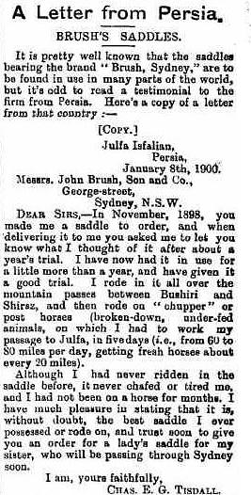
As with most people in Australia, the Boer War had a great affect in many different ways. The saddle manufacturers were no different, as a lot of the good knowledgeable saddlers were caught up in shoddy workmanship scandals, and it took some persuading from very experienced folks to get their reputations back in order.
Age Melbourne, Vic. : Friday 24 August 1900
THE SYDNEY CONTINGENT INQUIRY
The defective saddlery. SYDNEY, Thursday
The inquiry into the working of the Military department was continued to-day, when further evidence about the saddles was taken.
Mr. John Brush, of the firm of John Brush and Son, saddlery and harness makers, said he was asked to tender for the saddlery for the Imperial Bushmen. He had made some for the Citizens' Bushmen, and altogether supplied about 400 saddles. The new saddle produced was not made by his firm. It was about the lowest class of saddle made, except for the Islands. (Laughter.) It was an ordinary good stock saddle. The other saddle produced (returned from South Africa), was a fair one. The workmanship of both saddles was about the same, the D's were not strong enough for military use, and were fastened with pieces of bridle leather, nailed to the cantle with tacks. They should have been champed. Among the exhibits were saddles, &c., which Colonel Roberts stated had been "picked out of the Harbor," having been immersed for 6 months. It was not explained how the saddles got in the Harbor. The witness said a saddle which had been immersed for six months would carry a Goliath. He had not heard that some of the stirrup irons were made of pewter. The valise bag pad produced was not in much demand now. He would not be surprised to hear that the Colonial troops threw these things into the Orange River.
The Chairman: They expressed regret that they could not throw in the man who supplied them.
Witness (J Brush Jnr.) did not dispute that the bright ornaments on the breastplates should be thrown down the Bondi sewer, because they would attract the eyes of the enemy, with sun playing on them. His firm had made 100 saddles for the Citizens' Bushmen, and the ornamentation on the breastplates was like coffin furniture.
Mr. T. H. Goodwin, MLA for Gunnedah, also said he had had a good deal of experience with horses and saddlery, was, in January, called to Sydney to report on saddles for the Government. Those he inspected were much inferior even to that produced, which was not a good saddle. He would be sorry to see a good man sent out to fight with such gear. He told the adjutant that the backs of the horses would be ruined in three days with these saddles. A cavalryman's safety depended upon his saddle, as his arms were attached to it. The No. 1 saddle produced was very inferior, owing to the flat nature of the tree; it would be impossible to put this saddle on a horse without wounding the animal. The girths were disgraceful. All the bridles he inspected buckled on the off, instead of the near side. The web girths supplied to the second contingent were absolutely valueless. They had only three or four stitches holding the buckles to the end, and the Webbing was of inferior quality, and webbing was out of date for country work. After his inspection he was told they were taking the saddles with them to remedy the defects on the voyage.
William Henry Simpson, a master saddler, said he did not supply any saddles to the contingents, but he supplied some privately to members of the contingents. The saddle produced was unsuitable for military work. The American military saddle was the best for military purposes. He would not be surprised to hear that the colonial troops very quickly discarded them. The saddles would ruin the back of any horse in the world.
The committee adjourned till Tuesday.
An addendum to this article. It was reported in 1920 on the excellent reputation of the Brush saddles supplied to the Contingent:
Indeed, it is a well-known fact that many of the Light Horsemen who took part in the Great Adventure in Egypt and Palestine saddled their wiry Walers with Brush's saddles. Among the firm's exhibits was a half-military saddle that had been used throughout the war by Lieut. -Col. R. F. Fitzgerald, D.S.O., who saw service in Egypt, Simla, France, and Belgium. The saddle, which was used continuously in all weathers with the 20th, 24th, and 51st battalions of the A.I.F., and with mounted troops until July, 1919, was apparently as good as ever, a great tribute to the firm and the excellence of their work.
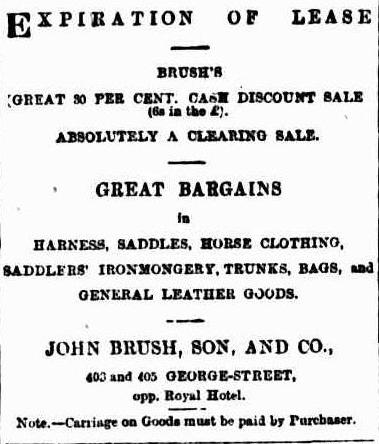
1903 sees the expiration of the lease of the building which was obviously renewed, and five years after the death of his father, John Brush Jnr. purchased the goodwill from John Brush, Son and Co., with a name change to John Brush.
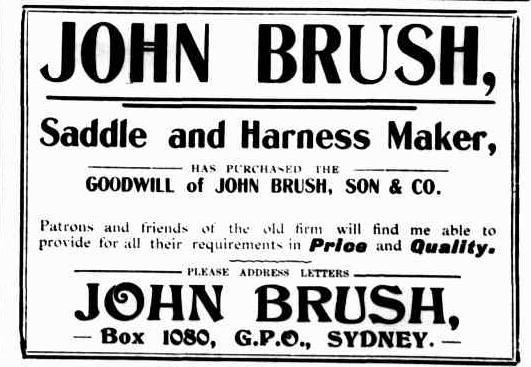
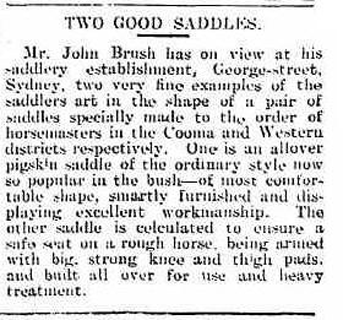
1904 Advertisement of Stock Saddles
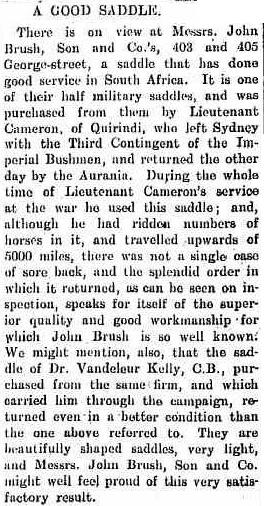
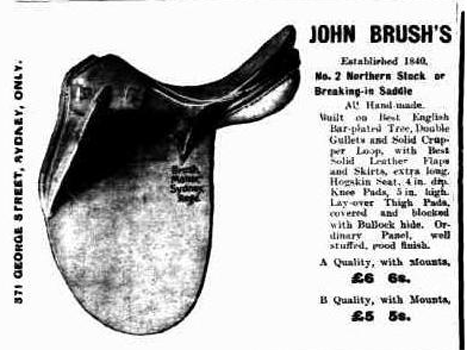
Even though John Brush (the company) seemed to be holding their own in the saddlery trade, circumstances that will never be known, caused a tragedy in the Brush family.
LYSOL POISONING AT HOMEBUSH. The Parramatta district coroner held an inquest at Homebush, concerning the death of John Brush, 59, who was found dead at his residence Homebush, on 5 May 1911. Evidence was given that Brush went to bed as usual and got up early. His wife rose at about 7 o’clock and went to the breakfast room, and saw him lying dead on the sofa. Two empty Lysol bottles were found empty on the breakfast table. A cup containing dregs of Lysol was found on the hen coop in a paddock adjoining the house. The Coroner found that death resulted from the effects of poison self administered.
Two months after John Jnr. passed away a notice was placed in the paper announcing the amalgamation of John Brush and Pneumatic Harness, maintaining the 371 George Street address. There was no mention as to the new partners in the business. Perhaps John Jnr.'s son, also called John, may have been involved.
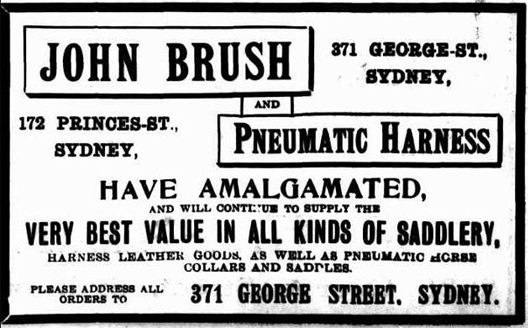
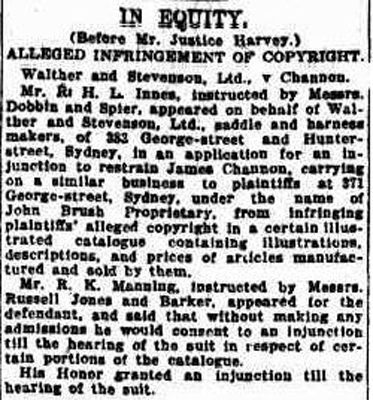
In 1914 an alleged infringement of copyright concerning saddlery catalogues occurred between Walther and Stevenson and James Channon of John Brush Proprietary (position in firm unknown). The result of the infringement court case was not found.
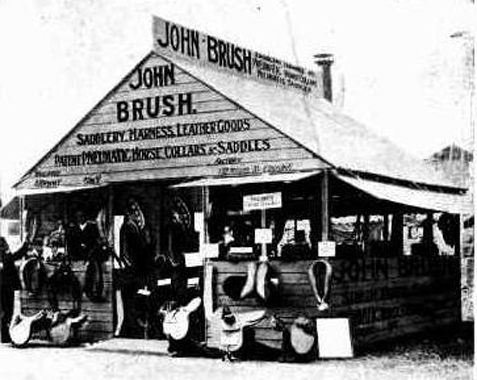
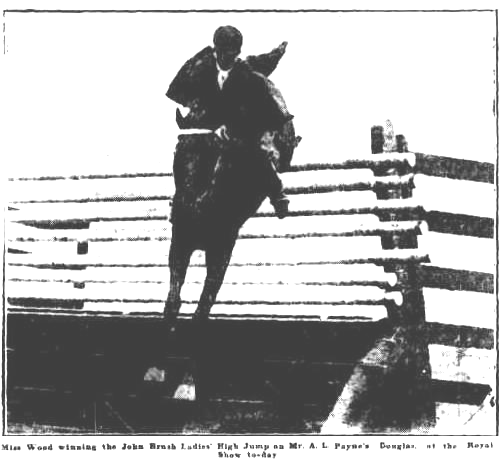
John Brush was very prominent at the Sydney Royal Show each year. For many years Brush's sponsored the ladies high jump, a very popular yearly competition at the show. The above photo was taken in 1915 and the write up accompanying the photo is below:
Brush and Co.'s Saddlery.
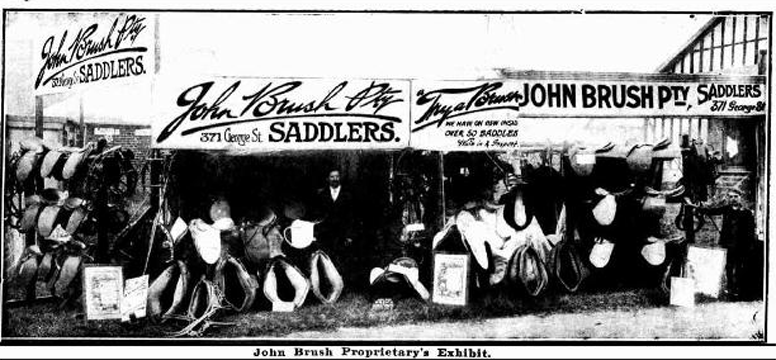
Among the many things that attracted the attention of people from the country was the splendid display of saddlery and leather goods belonging to Messrs. John Brush Proprietary. At their pavilion they showed samples of thousands of useful articles which are to be found at their establishment at 371 George-street, Sydney. There were saddles of all sorts and sizes, including ordinary riding saddles, hunting saddles, and ladies' saddles. One article, of which the firm is justly proud, was the latest style of rough breaking saddle used in Queensland. It is so perfectly made that nothing short of starvation could shift the rider. The firm always holds stocks of a couple of hundred riding saddles, besides large quantities of harness of all varieties and other leather goods. A speciality is rubber and gold-mounted harness, which, besides being handsome, is eminently serviceable. The dog fancier appreciated the varied assortment of collars and other dog goods. Among the many other articles were riding whips, leggings, money belts, dog clothing, and horse rugs. The business of the firm, which is an old-established one, is managed by young active men who give personal and active attention to every detail, so that customers are assured of receiving every satisfaction.
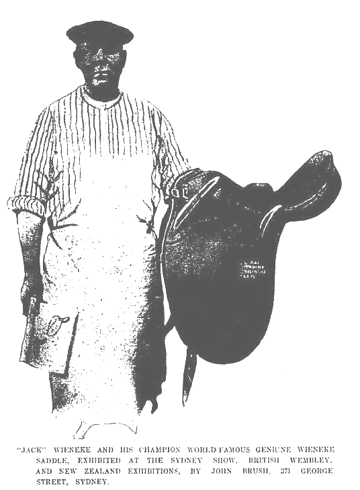
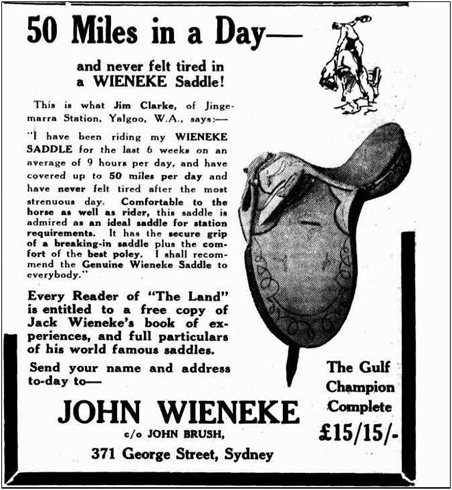
c1924 saw an injection into the success of the business with an agreement signed with John Julius Wieneke. The press produced many stories of the new partnership, plus Wieneke was not short of entrepreneurial skills announcing to all and sundry that his saddles could be obtained from John Brush and Edward Butler's (another partnership not reported in the press, therefore date unknown of merger) in both Sydney and Brisbane.
The [Australasian Melbourne] on 18 April 1925, reported on the amalgamation.
JOHN BRUSH.
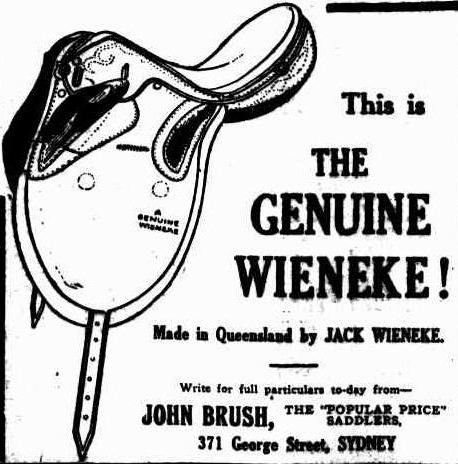
Another very interesting exhibit which attracted much attention was that of John Brush and Butlers (who have now been in the saddlery business since 1840), of 371 George Street Sydney, and 421 Queen street, Brisbane. Of particular interest to stockmen was the display of genuine "Wieneke" saddles. These are all made by Mr. John J. Wieneke, late of Roma, Queensland, who has had much experience amongst cattle, horses, and of station life generally. The result is these saddles will stand the test of many years wear with comfort to the rider and horse. "The Buckjumper" type, an illustration of which appears in the "'Pictorial" section, has been called the ''Rolls Royce" of saddles. It is made from the best kip twice-oiled leather, on best steel plated tree, with 61/2in. knee pads set high up, and 3in. thigh pads. Some of these saddles were exhibited last year at the British Empire Exhibition at Wembley, and attracted great interest. Among the other features of the exhibit were the harness of all descriptions, polo equipment, Eureka horse rugs, whips, travelling trunks, kit bags, house and dog medicines, &c. A new and complete catalogue may be bad on application to either of the addresses given.
A further story, a year later, reported on the prize winning Wieneke saddle made by John Brush.
JOHN BRUSH SADDLES.
Among the interesting exhibits at the Sydney Show was that of John Brush, saddler, of 371 George street, the Sydney representative for Jack Wieneke saddles. Forty years ago a young athlete named Jack Wieneke won a footrace and £150, with which he started in business as a saddle maker in Roma, Queensland. He rode outlaw horses on his own saddles, and thus learned exactly what the stockmen required. All through his life he has insisted on nothing but the best of material and work in every saddle, so that the genuine Wieneke saddle is high-class. A prize medal has just been received for the exhibit at the British Wembley Exhibition, and another exhibit is now attracting great attention at the New Zealand Exhibition, Dunedin. The genuine Wieneke saddle will last over 30 years. The new catalogue can now be obtained post free.
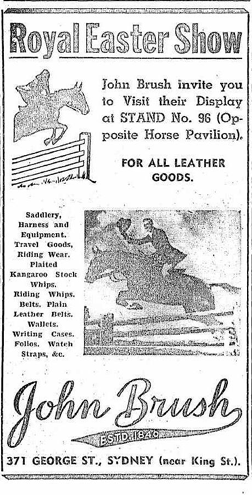
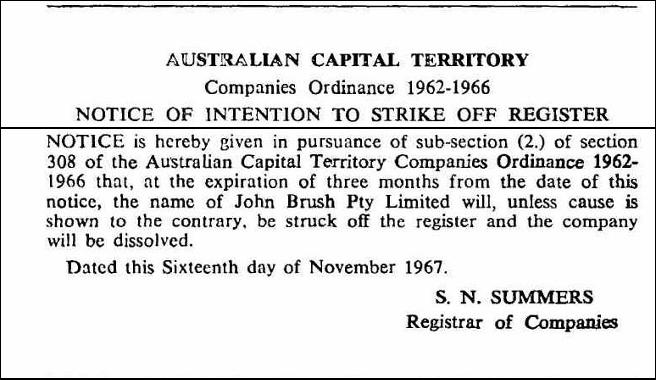
John Brush Proprietary continued supplying Australia with saddlery goods, the owners, managers and workmen unknown. A small ad appeared in 1952 calling equestrians to come and see their exhibit at the Sydney Royal and then a notice to de-register the business in 1967, one hundred and twenty seven years since John Brush Snr. would have dreamed of establishing a prominent, and successful, saddlery manufacturing firm. His dreams came true.