
The Australian Stock Saddle
and the Saddlers that made them
CHRISTOPHER GORRY 1819 - 1893
Gorry was born at Summer Hill, County Meath, Ireland, on the 25th of December, 1819 — Christmas Day; hence his Christian name, Christopher. He arrived in Sydney in 1841, and there worked at his trade as a saddler for some time; and while living in that city he was married. Trade becoming rather slack, he engaged with Mr. (now Sir) Arthur Hodgson as a stockman on the Eton Vale Station, Darling Downs, where he remained in that capacity for some two years. During his time as stockman at Eton Vale he was involved in an altercation that took the life of one of his work mates.
Christopher recalled the story years later to a Mr. Dowling, who had asked of the incident. "I cannot tell the date, but it was a month or so after the killing of those men going to your station, poor John Hill and myself were attacked near Mount Rascal. John started early one morning for the camp in order to take home some bullocks. He told me to come after him in about half-an-hour and to my surprise I met poor John Hill with a spear right between his shoulders with his horse galloping home, and John sticking to the saddle with the spear dangling against the horse's rump, till he arrived at the slip-panel near the house (Eton Vale), with myself close after him. Mr. Elliot came to his relief with myself and others, and lifted poor John off the horse, and had to cut vest and shirt on each side of the spear wound ere we could take it from the wound in his body, fully four and a half inches. He lived in great pain. I was sent for Dr. Rolland at his Broadwater Station, who attended on him for a week, but held out no hope, for his recovery. He lingered on for eighteen days and died. Myself and another station hand attended to his requirements up to his death. In those days there was no coffin to hand, so we made a shroud of his blanket and buried his body in a sheet of bark in a little flat near the garden on the bank of the creek. Mr. Elliot read the usual burial service, and thus finished the life of John Hill, of Rickmansworth, Hertfordshire, England." he concluded.
Mr. Gorry remained there until 1844, when he left to come to Ipswich, and he immediately started the saddlery business, in East-street, in a tent in the first instance. He "squatted" on the site and subsequently Mr. Gorry purchased the property from the late Mr. Richard Watson, who had bought the land at the first Government land sale of Ipswich property, held in Brisbane, in 1843. With the advancement of Ipswich as the "head of navigation" and the terminus of the wool traffic, Mr. Gorry's saddlery transactions like-wise increased, and he erected more substantial wooden buildings, including workshops for his staff of workmen.
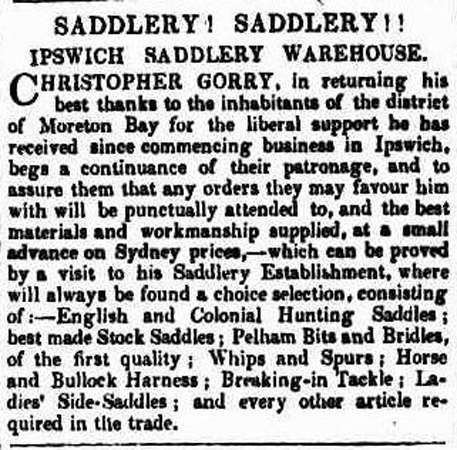
Advertisement dated 1848
As stated in the above advert, Christopher Gorry and his employees were already making saddles fully described as "best made Stock Saddles" in 1848. Unfortunately no illustrations can be found of the Stock Saddles, however as was common around that era, a padded rounded knee pad would have been sewn onto the outer flap in a lowered position, with possibly extra dees around the back of cantle and over the pommel.
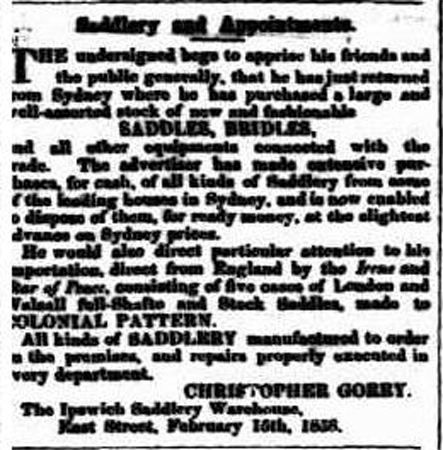
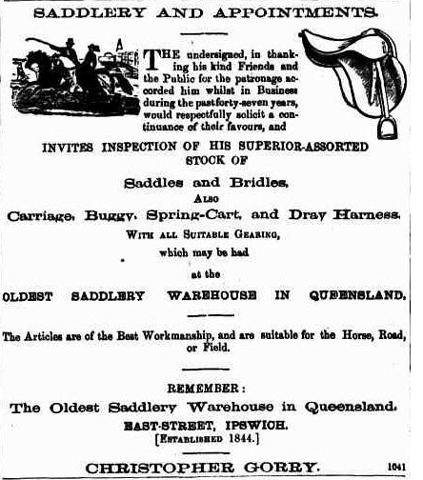
Gorry was continually importing from England, as well as manufacturing, well into the 1880's.
In his younger days Gorry was an enthusiastic sportsman, being an active member of the old North Australian Jockey Club, and latterly he had been a member of the Ipswich Turf Club. When Ipswich was constituted a municipality, in 1860, Mr. Gorry was elected a member of the first Council, his fellow aldermen being Messrs. John Murphy (Mayor), J. Johnston, Charles Watkins, Donald Bethune, J. M. Thompson, John Pettigrew, F. North, and Thomas Stanley.
Mr. Gorry was, too, one of the first persons in Ipswich appointed a justice of the peace, and was also selected as a member of the first Licensing Authority constituted here, both of which positions he held up to the time of his death. He was also one of the trustees of the Queen's Park, in company with the Hon. Geo. Thorn, B.A., and Mr. P. O'Sullivan, M.L.A., and it is worthy of record that the last document he signed was the transfer of the care of the Park to the Municipal Council.
In January, 1873, he was appointed a trustee of the Ipswich cemetery, took his seat at a meeting on the 3rd of February following, and had ever since regularly discharged his duties in this capacity. Amongst the many offices which he held was that of a member of the committee, together with Messrs . R. Gill and S. Shenton, of the Mechanics (now Ipswich) School of Arts when it was first founded here.
It should also be mentioned that in 1882 he, together with the Hon. Arthur Macalister, and Messrs. Benjamin Cribb, George Thorn, John Panton, and F. A. Forbes, were elected as the first trustees of the local Boys' Grammar School, and survived his other five co-trustees. Mr. Gorry had, moreover, been a member of the Queensland Agricultural and Pastoral Society for many years, and was one of its most active committeemen; he was likewise a consistent exhibitor of saddlery at the annual shows of the association, and held several prizes which were awarded to him for his displays at these expositions. Up to the time of his death he was a member of the board of management of the Ipswich Hospital, in which institution he always evinced the greatest interest. Gorry was a devout Churchman. He, the Rev. Father McGinty, and Mr. P. O'Sullivan were chosen as the trustees of the money raised for the building of St. Mary's Church, and he himself rendered valuable assistance in the erection of the sacred edifice. Since that time he had subscribed handsomely towards the maintenance of the church, and he at various periods liberally donated large sums of money to convents and schools throughout the colony, having always had at heart the welfare of the institutions connected with the Roman Catholic Church.
As an employer, Mr. Gorry was always fair and just, testimony to which is borne by those who worked for him, all of whom had nothing but words of praise to utter respecting him. No greater proof of the attitude of Gorry towards his workmen could be adduced than the fact that Mr. R. Wilson had been in his employ for thirty-six years, while the late Mr. John Foster held a position in the same establishment for upwards of eighteen years - right up to the time of his death - and other tradesmen were with Mr. Gorry for very long periods.
In the Queensland Times, in March 1893, Christopher Gorry's passing was reported as follows:
Death of Mr. Christopher Gorry, J.P. "THE FATHER OF IPSWICH" PASSED TO HIS REST. A LARGELY ATTENDED FUNERAL. It is with extreme regret that we have to chronicle the death of one of the oldest and most respected residents of Ipswich, to the person of Mr. Christopher Gorry, J.P., of East-street, whose demise took place shortly after 9 o'clock on Tuesday evening last, at the ripe age of seventy-three years. The deceased gentleman has been ailing for some months past, but it was not until a few weeks ago that the state of his health gave cause for any alarm. It seems that, during the recent floods, he exerted himself to a considerable extent in endeavouring to rescue his books from the inundation, at times wading in water several feet deep. At his time of life, and in his weak state of health, these exertions appear to here over taxed his strength, and a few weeks subsequently he was compelled to take to his bed, from which he never again rose.
Although Mr. Gorry was always a quiet, unassuming man, he had, during his long residence of close upon fifty years in Ipswich, ever been alive to the best interests of the town, and had taken an active part in its advancement, and in its development from a small centre of a few dwellings which could be almost counted upon the fingers of one hand to its present dimensions and importance. He had, at various times, held office in connection with many of our local institutions, and for the welfare of these he did all that lay in his power. He was an upright and honourable citizen, and was held in the highest esteem by the townspeople generally and by an ever-widening circle of friends. As a colonist of old standing-having resided in what is now Queensland for fifty-two years-and a townsman for just upon half a-century, he was in-variably referred to for information respecting occurrences in the early days, and he was, of course, quite an authority on matters connected with our early history.
The cortege moved from the church shortly after 4 o'clock, and the continuous line of vehicle after vehicle, and horseman after horse-man, which was viewed by hundreds of persons who had assembled at points of vantage all along the route, was a solemn and, at the same time, an imposing sight. As the mournful procession entered Brisbane-street, the doors of the several shops were closed, and were kept so until the last horseman in the line had passed. Besides those who were walking some seventy-two conveyances and fifty-one horsemen followed the hearse. The two surviving sons of the deceased gentleman and a few other very near friends walked immediately behind the hearse, and following them came the well known faithful horse of the deceased, drawing the buggy in which Mr. Gorry himself, with that feeling of respect for others which was characteristic of him, had followed nearly every funeral, irrespective of the creed or nationality of the departed one, that has passed through the streets of Ipswich for many a year gone by. A sad day indeed for the town of Ipswich.

East Street in 1860 where Mr Gorry conducted his business from 1844 - 1893
The town was originally known as Limestone until it was renamed Ipswich