
The Australian Stock Saddle
and the Saddlers that made them
ROBERT BECHTEL nee ANDERSON 1864 - 1931
Born in South Australia, Robert Anderson was orphaned at an early age and adopted by a kindly German family of the name Bechtel, who gave him their name. Having learnt the trade as a saddler in South Australia (master unknown) he moved to Western Australia in 1888 on board the “South Australian”.
In 1890 he started a shop in Hay Street called the "Eureka Saddle and Harness Works". Business prospered, and all the prospectors used to come to him to be equipped. Bechtel invented and patented a combined riding and pack saddle for camels with inlaid enamel water containers which prevented the water saturating the leather and become increasingly heavy in areas for the animal. He also fitted out Bayley with the saddles and gear for the horses that took him into Coolgardie, for that great discovery that woke the world. The gold lure enticed Robert Bechtel to the fields in February 1895, and he just missed being one of the early shareholders in the Great Boulder. Circumstance, which seems to have been frequently against him, willed otherwise. And circumstance seemed rarely to be on his side. He came back to Perth in 1900, and under the name of Bechtel and Co., and later (under his own name Anderson) went into business again.
The local Inquirer and Commercial News, Perth ran an article on Friday 20 July 1900 stating that a well known saddlery establishment was sold to a former saddler of Perth.
A PIONEER SADDLER.
An announcement which will doubtless be of interest to very many people appears in another column. It is from Mr. Bechtel, the well-known pioneer saddler of this colony, who has just purchased the business of Robert Smith and Co., of Barrack-street.
Mr Bechtel was recognised as a most capable handi-craftsman. It was he who did the most of the fine work in connection with the fitting out of the various prospecting parties which then went into the interior. He is replenishing the large premises in Barrack-street with a splendid stock of harness, saddlery, etc, and has engaged a numerous and skilful staff of workmen. The elaborate machinery will be driven by a first-class electric motor, and there will not be anything equal to it in the colony. In all branches of the business Mr. Bechtel is determined to still excel. He will be able to turn out any order promptly, in the most masterly manner, and at the lowest price consistent with the production of the highest class work and material. It will be well for people interested to pay attention to his operations.
Two years later in 1902 the Daily News informed the locals of the success that had been undertaken by the firm of Bechtel & Co. It read:
THE FIRM OF BECHTEL AND CO.
Situated at 121 Barrack-street, in the heart of the business portion of the city, is R. Bechtel and Co.'s Pioneer Saddle and Harness Works, an establishment of so many years' standing that its location is now as well known as the Town-hall clock. It is with the attractively-dressed windows that the majority of folk are most intimate, but the firm's thousand and one customers are also particularly well acquainted with the inside of the front shop and the complete stock of every article in the leather line associated with the riding and driving of horses contained therein. The up-to-date firm quite lead the way in respect to the manufacture of every sporting leather requisite, and the innumerable necessaries connected with the up-keep of a stable. This was made thoroughly manifest to a representative of this journal upon paying a haphazard visit of inspection to the shop and the work-rooms at the rear yesterday afternoon. To deal with the work-rooms first, in the main large room the gear connected with the installation of a 4 h.p. electric motor used for driving machines first attracted notice. This power is availed of by the two lady machinists in executing ordinary sewing upon all kinds of leather work, and delicate fancy pattern work upon saddles, harness, etc. No less than five sewing machines are connected with the motor power, executing black and white and other coloured stitch work. A decided novelty was found in Husham and Brown's English (Exeter) make trace cutting machine, the only one of its kind in the State, imported here by Mr. Bechtel. It is equal to cutting leather in strips of any length, up to seven feet in width, and its practical use for making traces and leather belting for mine and mill machinery working is inestimable. The precision with which it cuts, and the simplicity of its mechanism and method of working, excite great interest. The many smaller machines, each and all perfect in their line, include eyelet punchers, splitters, drillers, saddle web-straining apparatus, and creasing and stamping, machines. Mr. J. L. Canny is the foreman of the large work-room, and an hour spent in listening to his description of the machines accompanied by practical illustration of the uses of each, proved very instructive.
Over thirty hands are employed in the main work-room, including five collar-makers, six saddle-hands, eleven harness-makers, two machinists, a general overseer, a saddle-hand, and four apprentices. So continuously heavy are the orders entrusted to Messrs. Bechtel and Co. for execution, that the full staff is constantly employed, and to quote the words of one of the workmen, they 'get top wages'. Log prices of pay are given, and the piecework rates rule. The firm claim their senior collar maker to be the best in his line in the State. The best of selected straw, of which the firm always carry over 50 tons in stock, is used for the stuffing of the collars, so that each collar turned out is of the first quality. Of cocoanut fibre, too, the firm carry a big stock, and this much used article for saddlery stuffing purposes, is also of the best. To enumerate the Hundreds of requisites manufactured in the large work-room would be difficult, but a few may be particularly referred to. Saddles of every description, from the heavy buckjumping saddles to racing saddles, weighing only one and a half pounds, and ladies' French cut-back saddles, are all made on the premises, and stocked for sale in finished form. These are manufactured upon the best English stock saddle-trees, and others worked upon daily include exercise trees, ordinary cart saddle trees, patent cart saddle trees, and pack saddle trees An air of life and genuine business characterises the whole of the work-room and the competent staff therein employed. Messrs. Bechtel and Co. have held the bulk of the Government contracts for some time, and they are the Government contractors to the Public Works Supply Department, up to 1903.
They secured the highest certificate awards at the Melbourne Exhibition in 1893 (the saddlery and packsaddle portion of their leather exhibit being specially commended), and at the National Show of Products in the Queen's-hall, Perth, in March of the present year, for an exhibit of harness. Their shop windows in themselves provide quite an exhibition of every line of saddlery. The large model horse is trapped in handsome gold and rubber harness, made on the premises.
The excellence of the firm's saddlery work was best attested to by the Commandant of the local forces, after the firm had executed the order from the Government for the whole of the saddlery for the W.A. contingents for South Africa. The Commandant reported that the committee of experts who had examined the saddlery supplied by Bechtel and Co. said it was quite the best quality sent into the field— high praise indeed, yet, evidently deserved; don't you think so?' queried Mr. J. Pearse, the energetic accountant and manager of the shop business, from whom these facts were gleaned, and the answer was in the affirmative. Everything in the firm's shop, as in the work room, is of the best quality. 'We stock nothing shoddy,' remarked Mr. Bechtel, 'only the best of everything, in the line of leather— and there's nothing like it.' In the saddlery and harness lines the prices placed upon their first-class goods by the firm speak for themselves as particularly reasonable. To the question 'How is it you don't charge stiff prices?' Mr. Bechtel tersely replied, 'We manufacture everything ourselves — there's the secret of the quantity and quality of our stock, and the prices.'
And the large stock of manufactured goods in the Barrack-street shop does appeal to all customers as something quite out of the ordinary. The articles stocked and catalogued are: Backhands (with and without shaft tugs), braces; bags, buckets, muzzles, belts, belting, belly-bands, breast plates, breechings, bridles, brush bags and straps, collars, cruppers, cushions, collar checks clothing for horses, winkers, fronts, garters, gloves, girths, harness of every description, head stalls, names, leggings, purses, pouches, reins, Tugs, saddles (40 lines), strapping, surcingles, traces, thongs, tugs, whips and valises. To fulfil the daily requirements of their factory Messrs. Bechtel and Co. require to stock a heavy lot of prepared leather, and for this purpose they use a large shed at the rear of the factory. Here is stored a large quantity of the best oak-tanned bridle and harness leather, and belting hides for making all kinds of machinery belts of all sizes. One especially fine hide shown to the writer was an English ox hide showing (as is the case with English hides). no brand. It is considered by the leather expert that the Australian practice of branding cattle on the rump spoils the best part of the hides which would otherwise be of such good use for belting. They are worth, it is stated, from 3s. to 4s. more each if not branded. Considerably over £1,000 worth of leather (well covered by insurance) is stocked in Messrs. Bechtel and Co.'s store. The firm's Perth business is directed solely by Mr. R. Bechtel, and the successful condition which it has attained serves as all sufficient testimony to the expert nature of his control of the work.

The W.A. Contingent marching down Barrack Street, Perth in 1900. Bechtel made all the saddles for the sixth contingent for the Boer War.
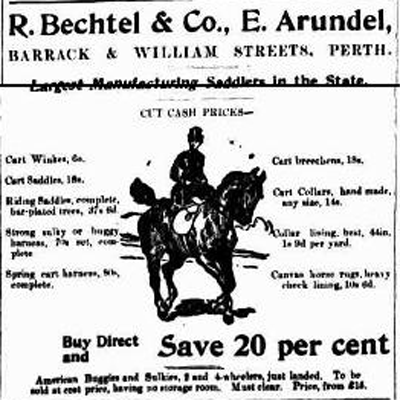
In 1916 in the West Australian newspaper an advert was run which read: I, ROBERT ANDERSON commonly known as Robert Bechtel; do hereby announce my adopted name of Bechtel, and from henceforth will use and wish to be known as Robert Anderson. ROBERT ANDERSON. 67 Raglan Road, North Perth
More than twenty years later, Robert Anderson (formerly Bechtel) had gained enough wealth to purchase a pastoral holding in Norseman. At the time of the below story he had obviously closed his saddlery trade in Perth and had permanently moved to the Norseman property.
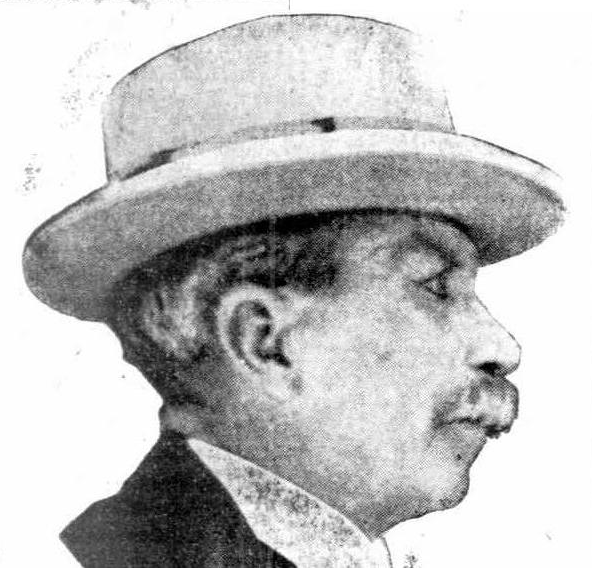
Mr Robert Anderson (Bechtel) pictured
in 1927 aged 63 years
In December 1927, Mr Anderson the saddler, formerly known as Mr Bechtel found himself in front of the courts defending his innocence. The Mirror in Perth scribed the following:
Probably no other person in Australia has had a similar experience to that of Robert Anderson. In two consecutive days he has faced two separate charges of wilful murder. At the close of each day the jury returned a verdict of not guilty. And late on Thursday, after the second trial had ended, Robert Anderson walked from the shadow of the dreadful dual charge a free man again.
Elsewhere in this paper is given the story of the trial of Robert Anderson charge of shooting two men on his lonely farm at Norseman. After it was all over a 'Mirror' representative approached him to know if he had anything he wished to say. The man who has just emerged from the double ordeal is vastly different from the type one would expect to see in the dock ON ANY CHARGE. He is sixty-three years of age, slim and spare, with dark, scanty hair, dark soft eyes, dark moustache, and bronzed features. In many respects he is almost a facial double for Sir George Pearce, and time and again he has been mistaken momentarily for 'Western Australia's' distinguished representative. ln manner he is just a quiet, elderly business man, soft spoken, restrained and reserved; the last man in the world one would picture as taking up a gun unprovoked. 'No. There is nothing I wish to say he said politely. 'I am deeply deeply grieved at what has happened, but it was not my fault. All I had to tell I told, to the detectives and to the court. It is the truth. Those who know me know that 1 have always scorned to lie either in or out of a court, and I have not taken to lying now. I am an old man, sixty-three, and I have been forty years a resident of Western Australia. In the New Year I am going up again to the Norseman property to control the work that this tragedy interrupted. Everybody has been fair to me.’ And there was little else about himself that the quiet spoken, soft-eyed man would say; But those who know him, and he seemingly has many friends bear out his claim to be a truthful man and a reserved man. They can also testify that his life has been CRAMMED WITH INCIDENT during his forty years in the West and that, but for bad luck, he should be a rich man to-day.
He came back to Perth in the early years of this century and under the name of Bechtel and Co., and under his own name went into business again. Prosperity came to him and he acquired valuable property. Then he went on the land. But here again ill-luck dogged him. Part of his land was poison country and he struck the lean year of 1914. In five years he is said to have LOST THIRTEEN THOUSAND POUNDS in farming. He plugged on, but about three years ago serious ill-health struck him, and he was said to be in a bad way. Something told him that the fields would GIVE HIM HEALTH AGAIN and he went to Coolgardie where he almost recovered. Then in his travels he came upon wonderful pastoral country around Norseman. After much difficulty he secured the present holding. Here he lived mostly alone, but full of enthusiasm for the project. Then circumstance frowned again - came two men to his door - tragedy - and for the first time in his life Robert Anderson stood in the dock of the criminal court. To-day he is once more a free man after the most remarkable experience that could come to any human being. He is proud of his word. Robert Anderson always was, and still is, a strict churchman. The block on which a suburban church stands to-day was donated by him some years ago.
Now he is going back to the lonely Norseman property to live out the remainder of his destiny. 'I am deeply, deeply sorry,' he says in his quiet, reserved way, 'but my conscience is clear.' And the verdict of two juries endorses what he claims.
Four years later Robert Anderson was recorded as passing away in Perth, 1931.