
The Australian Stock Saddle
and the Saddlers that made them
JAMES A HOLDEN 1836 - 1887

James A Holden upon becoming a JP in 1874.
Photo Credit: State Library, S.A.
Some information on James Holden is drawn from the Neil Pogson summary
James A. Holden aged 19, decided to try Australia, so headed to South Australia to join his cousin Edwin Smith who had travelled out to the colonies two years earlier. Holden arrived in Adelaide on 14 February, 1855 having travelled the three month journey on the “Tiberias”.
Having unsuccessfully tried a number of positions James A Holden branched out advertising himself as a Coach and Saddlers’ Ironmonger on 8 September 1859. His contacts in England would have assisted in this line of business, as no doubt he was dealing with his brother in Walsall.
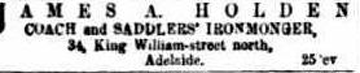
In October 1859 Holden was advertising a complete guarantee of wholesaling only, all the saddlery goods arriving on ships from England, assuming, once again, using his family contacts.
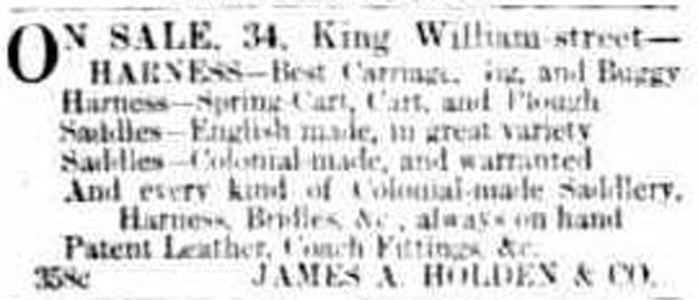
On January 1863 the first advertisement appeared where it actually read James A Holden & Co. Advertising for the 34 King William St business continued until 18 January, 1865; the first advertisement for the new Gawler Place store appeared the following day, on 19 January, 1865. The new business still traded as James A Holden & Co.
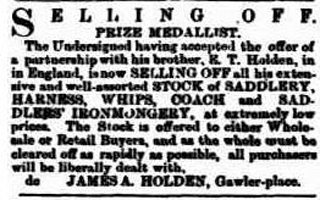
On 28th December, 1867, James placed an advertisement (as above) declaring that he had accepted a partnership with his brother, E.T. Holden, and was returning to England. This advertisement ran until March, 1868, when the notice changed to say that James had been unable to sell off his stock in bulk or the premises, and this meant he had to remain in business in the city of Adelaide, thereby relinquishing the offer of the brother's partnership.
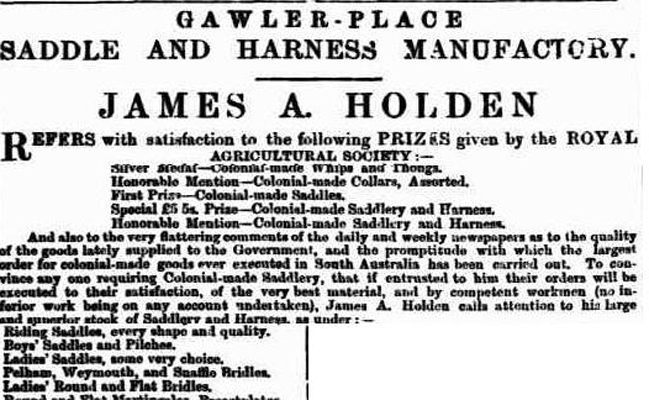
Mr Holden (above) in October 1870, spruiking about his accomplishments in the colonial state of South Australia, including securing the largest Government contracts for colonial-made goods.
In August 1872, James was one of 15 men appointed as Commissioners for South Australia “for the purpose of taking all such measures as may be necessary to ensure the effectual representation of the products of South Australia at the International Exhibition to be held in London in 1873.”
Holden decided to attend the Melbourne International Exhibition which was to be held from 6th November 1872 to 8th January 1873. James and his wife travelled by ship to visit the Exhibition so as to gauge what was required for South Australia to present these displays with credibility and honour.
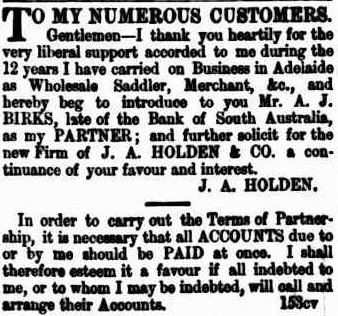
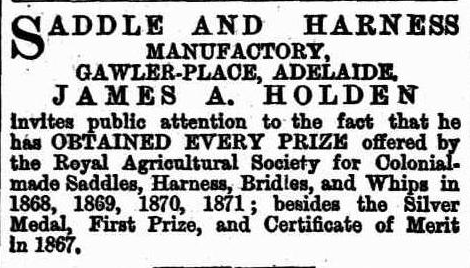
Two advertisements run in the local newspapers in 1871
Birks unfortunately passed away in early January 1874 and the partnership was dissolved later that same month. Also in 1874 a very small boxed advertisement appeared on 30 May, stating that Mr. H. A. Frost (late of Port Wakefield) was admitted a partner in my business from 1st May instant.
On 28th January, 1878, James advertised that his Gawler Place premises were for sale, then on 1st February, 1878, leased new premises in Grenfell Street, for 99 years. The Gawler Place premises were eventually sold on 16th July, 1878, to Thomas Elder and Robert Barr Smith.
Holden announced a clearance sale at the Rundle Street store on 5th April, 1879, on account of the forthcoming relocation to Grenfell Street.
An advertisement on 3rd May, 1879 proudly announced J. A. Holden & Co “have removed from Rundle Street and Gawler Place to Grenfell Street, next to the Sturt Hotel”.
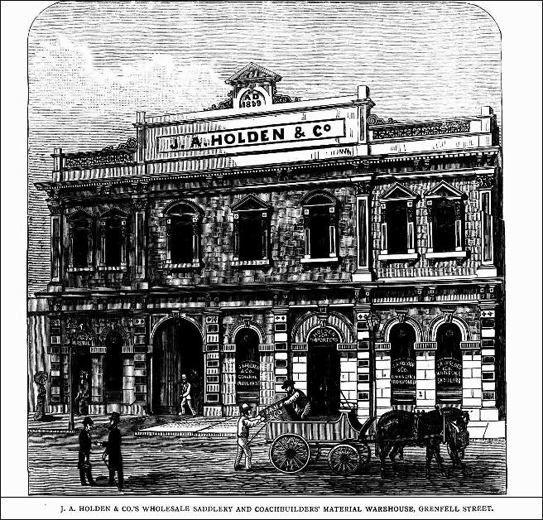
These warehouses have frontages to Grenfell-street of 67 feet, by a total depth of 103 feet. Access to the rear is gained through a large archway 10 feet wide. At back of warehouse the workshops, out-houses, and bulk stores are erected; the former being about 55 feet long, by 19 feet wide, consisting of two floors each about 125 feet in height, and the latter about 52 feet long, 22 feet wide, and 23 feet in height, the yard being enclosed by a stone wall 24 feet high and 18 inches in thickness. The architect was Mr. D. Garlick, and the total cost of the buildings was about £6,000.
In early 1878, although James' oldest son Henry was only 18 years old, James decided that it would be advantageous to send him to England to gain a broader knowledge of business practises and the leather trade, and to work in the old Walsall family business with Uncle Edward. Due to the failing health of James, in 1879 a call was made to Henry to return immediately to Adelaide to assist in the running of J. A. Holden and Co, which he did.
It is said that James was so grateful that he renamed the business J. A. Holden & Son. However, this name seems to only ever appear in one short series of advertisements in May 1884, and three small news items on prize presentations in July 1885. In all likelihood there was no formal name change of the business at all. All other advertising throughout the whole time was still in the name of J. A. Holden & Co.
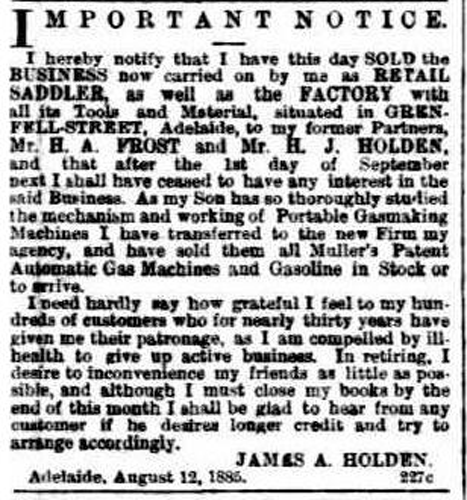
After the reins are relinquished by James, Henry J. Holden becomes the senior partner in the firm Holden & Frost in 1885. Goods manufactured include harnesses, saddlery, travel goods, gun cases, whips, crops and vehicle hardware.
1887 brings the death of James A. Holden. James died in Semaphore Hospital on 1st June, 1887, of tuberculosis complicated by alcohol abuse. He was fifty two years old. His body was moved to the house of his son, Henry James Holden in North Terrace, College Town to be interred in the Clayton Church Cemetery after a day of lying in state.
Holden & Frost becomes a major supplier of harnesses, saddlery, belts and other Boer War equipment under government contract. The firm also continued making quality colonial saddlery, some pictures are below.
Mechanically ingenious, Henry set up rows of machinery in a rented shed, personally trained the workforce, and developed large-scale, low-cost production methods. When Frost died in 1909 Holden bought his interest and extended the firm's activities to include motor-body trimming: it produced hoods, upholstery and carriage hardware, and painted bodies for steam and petrol cars. Batches of motor-cycle sidecars were also manufactured.
H. J. Holden, a self-made entrepreneur, enjoyed a close patriarchal relation with his workforce. He fostered generous social welfare arrangements and good labour relations, using a factory consultative council. His passion for quality caused him to slash poor work under the noses of his workers; but he reputedly knew each personally and was remembered as a generous employer.
In 1905 a third generation Holden, Henry’s eldest son, Edward W. Holden, joins the business. In 1910 Holden & Frost open a motor trimming department, the products marketed as Holdfast Trimmings. This is the beginnings of the iconic Australian motor vehicle marketed under the name "Holden". Quite a story - from saddlery to motor cars.


1894 Holden & Frost S.A. made mention of a Mexican Saddle (Cowboy Saddle) made for the Australian market in their yearly catalogue.
Holden & Frost Stock Saddles - 1894 Yearly Catalogue

Staff outside Holden & Frost 1898 - Note white horse above on balcony

Holden & Frost - Saddle Showroom 1898

