
The Australian Stock Saddle
and the Saddlers that made them
WILLIAM ANDREW MITCHELL JNR 1839 - 1896
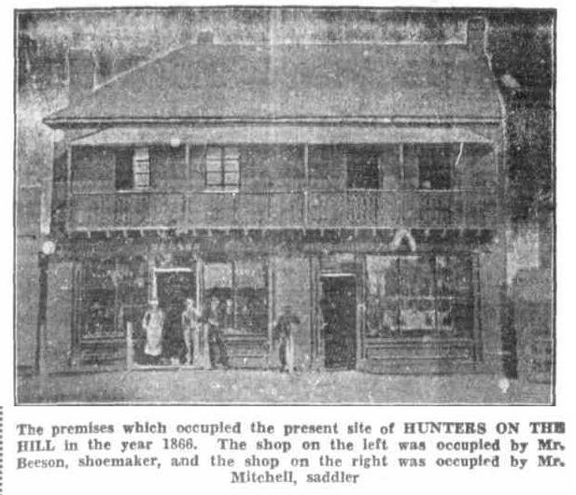
As per usual, with very important saddlers in the colonial years, their history is blurred however this particular saddler, William A Mitchell Junior, was still being talked about well into the late 20th century. His father, William Stewart Mitchell was born in Ireland and emigrated to Australia in 1840. He too was a saddler and set up his business initially in Camden, NSW.
The Honourable James Gormly reminisced the early days of the Wagga district to the Cootamundra Herald in 1917. 'I was using a light snaffle bridle and a saddle that weighed only about 13lbs. The saddle nails had Mitchell, Maker, Camden stamped on the heads. W. S. Mitchell, before he set up business in Camden had been a saddler to the Enniskillen Dragoons, and was probably the best saddle maker that ever came to Australia'.
In 1860, after leaving Camden, Mitchell settled in Wagga. The saddles made by Mitchell Snr. and his apprentices established such a reputation, that the Wagga saddles were extensively used in Victoria and Queensland, as well as in this state. Known apprentices at this time would have been his son William A Mitchell, Denis Bergin, and a couple of years later John J McGrath as a 15 year old (who in later years was loathe to disclose his tenure with Mitchell Snr., as he had commandeered the "Wagga" saddle brand name and purportedly retailed it as his own).
Mr William S Mitchell's past (even in the town of Wagga) was fairly obscure, through research, as it was not known if he continued to trade once his son left his shop in 1863, nor when Bergin left to set up his own saddlery business. We do know, however, that he was put in the management of his son's former business in 1869 under the ownership of Jim Price, then was found in Albury for about six months working for his son's father-in-law Thomson. In late 1874 he was found back in Wagga working for his former apprentice, however the saddles he made commanded the attention of the [Wagga Advertiser] who wrote a small article on his work: 'We have been shown a saddle manufactured by Mr. W. S. Mitchell, at Mr. Bergin's warehouse, which is quite a work of art. The seat and knee-pads are beautifully inlaid with flowers on a white ground. We were also shown two model saddles, for men and women, and they looked models indeed, indicating that Mr. Mitchell knows what saddles should be.'
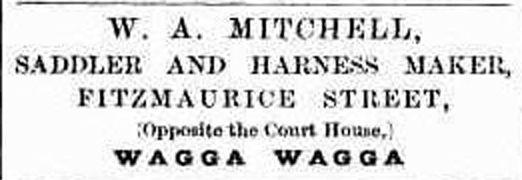
However Billy (as he was known) had commenced his business in Fitzmaurice Street, Wagga in 1863, at age 24, with the full knowledge on how to make a very good saddle. Perhaps he tweaked the "Wagga" design further, or invented it wholly on his own, but he was more effective in retailing this type of saddle than his father, by making it a "must have" with stockmen. A young Jim Price had joined Billy at the inception of the business. Billy's first advertisement in the local paper, however, was not until 1868, but this could have been instigated by trading problems and what would occur in the middle of 1869.
In 1868 the Maitland Mercury ran a small article which confirms the demand of the saddle made by Billy. 'It is stated by the Express that a demand for Wagga Wagga made saddles exists in Melbourne, many gentlemen there, not satisfied with the productions of their own city, are sending to Wagga Wagga to procure saddles from the local maker.'
Below is a discussion with a group of men from the saddlery trade dated 01 September 1936, all members of the Saddlery Sporting and Leather Goods - An Illustrated Technical Journal for Saddlers, Sporting and Leather Goods Makers. The discussion was headed “The Australian Riding Saddle” and is as follows:
“Raising the question of the origin of the Australian riding saddle by a reader of this Journal recalls an interesting discussion which took place in this Journal some years ago.
One writer whose experience went back to 1866 said that at that time the Australian type of stock saddle was unknown in Victoria. A year later, 1867, he saw for the first time at Albury a saddle with the present style of knee pads. These came from Wagga. There was no doubt in the mind of this writer that Mr Mitchell, of Wagga, was the originator of the Australian stock saddle.
Quite a number of correspondents joined in the discussion, and the majority seemed agreed that Mitchell of Wagga made the first Australian stock saddle, with its low strain under the head of the tree, the round or frying pan formation of the seat, skirt all round and solid leather to the knee pad with its position on the thigh much as it is today. One writer said that, up to about 30 years ago, he had never seen a true stock saddle that had been built anywhere excepting at Wagga.
Another well known member of the trade of that period who is still very much alive said that, there was no doubt, in his opinion, that the original of our stock saddle came from England, and from these imported saddles improvements had been made from time to time by various people in the trade to meet the needs or fancies of customers. He said: “No individual saddler can lay claim to the title of inventor in this particular line. These English saddles, to which I refer, were usually all-over hog, with quilted knee pads and small thigh pad, flat seated on an 18” tree. The first man whom I saw putting in a leather pad front was old John Knox in Sydney, and it was not till some years later that the skirt all round was made in Wilcannia on the Darling. There is not, as a rule, much rain to keep out in that part of the country. Mitchell of Wagga, made quite a lot of difference in the then type of saddle by using a shorter 16” tree, sweepier seat, shortening the flap two or three inches and keeping his pad right up to his spring bar. He struck oil with this, and unless a boundary rider had a Mitchell saddle, he was looked down on by the fancy as a common Jackeroo. This saddle was copied everywhere, and it is from this pattern that the northern break saddle of the present day has evolved by the combination of ideas before mentioned.
‘Nearly all the old-time firms had styles of their own. The usual price for a best was 12 pound 12 shillings which contained a nice wad of profit” “I hold that nearly all the later improvements in stock saddles have originated north of Sydney and not in Melbourne. Styles are changing always and we are going back to longer trees, wider bars, and longer flaps, as in the Roma’s and Wieneke’s of today, in nearly all ordered or custom work. The old style tree, with pinched bar that rocked on the wither had to go. The man-out-back will not have them, so wider bars are used, and better backs are the result. The short panel often seen of late years is as old as the hills, but has only lately come as a new idea, although a much better panel than the padded strap bearing.
“Old timers like Elis, Mitchell, Murphy, Knox, McGrath, Kerr and Hill stand out as the men who assisted to make the stock saddle of Australia what it is today, and right along the line others have contributed improvements, and are still doing so. I feel sure that no individual will have the presumption to call himself the sole inventor and patentee”.
As you can see by their comments he was considered a front runner in the improvement of the Anglo-Australian saddle with the raised knee pads up to the spring bar, shortened and skirted seat. This design attracted a great deal of attention from both customers and his peers, to the point it was copied widely and many saddlers chose to use the “Wagga” brand name to attract sales. A long time saddler in Wagga, a Mr Cassins, took full advantage of the brand name by advertising in 1879 that his "celebrated WAGGA SADDLES, fitted with Extra Gullets, are now being sold; at rates, usually charged for ordinary Stock Saddles", however the saddles may have been on consignment from Billy Mitchell himself, located at a saddlery in Emerald, Melbourne.
A well-known saddler, Mr Jarman, moved to Brisbane in 1878 and purchased Costin's business in Queen Street and he advertised he was bringing his "Wagga" pattern saddles with him. Jarman had worked in the Wagga area so the saddle design was well known to him. Mr Smith from Tenterfield NSW, was also advertising a "Wagga" style saddle for sale in 1905. It is interesting to note that Robert Smith, Perth supplied military style saddles to the Amir in Afghanistan in 1898 and they were typically shaped in the "Wagga" style. It was then discovered that Jarman had moved over to Perth in 1896, so Smith may have been made aware of the design through that gentleman.

A "Wagga" style saddle - this is the Robert Smith saddle, made in Perth in 1898 and sent to the Amir of Afghanistan along with 7 other saddles.
Held in the museum collection Pic Credit: Lorenzo Paolini, Italy
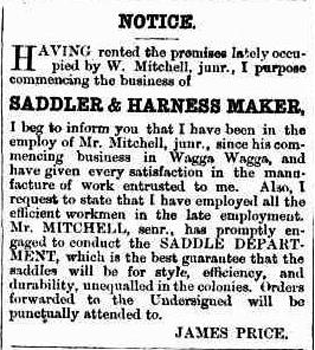
In July 1869 a notice from the Insolvency Court under surrenders, listed William Andrew Mitchell of Wagga Wagga, saddler. Liabilities £1622 19s. 9d. Assets, £785 17s. 2d as bankrupt. This led to an advertisement stating that a former employee James Price was to take over the saddlery, having worked for William Mitchell since the inception of the business in 1863. It was interesting to note that James Price held all the current staff under Billy Mitchell, plus Mr Price secured Mr William Mitchell Snr. to “conduct” the Saddle Department. Mr Price closed the saddlery and left Wagga in late 1873 and another resident saddler, a Mr Bergin, moved into the Fitzmaurice Street shop to continue trading some time later. As a matter of interest, Denis Bergin was born at Menangle on the Macarthur Estate, and at 16 served his apprenticeship with Mr. W. S. Mitchell Snr., saddler in Camden and came with his employer to Wagga in 1860.
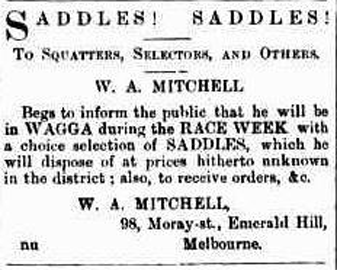
1879 Advertisement in Wagga Wagga Express
Billy Mitchell must have left Wagga as he placed an advertisement in the local paper in 1879 stating that he would be would be in Wagga during the race week with a choice selection of SADDLES, which he would dispose of at prices hitherto unknown in the district; also, to receive orders, W. A. MITCHELL, 98 Moray St., Emerald Hill, Melbourne, this address being the residence of his father who died in 1880, at Emerald Hill.
Billy continued to supply his famous Wagga saddles to a number of saddlery stores in the district, however he was found in Dean Street Albury in a partnership with Billy's father-in-law Mr. R. C. Thomson in approximately 1881. It is interesting to note that Thomson also took on Billy's father for approximately six months in early 1873.
Thomson was in court a couple of times with bankruptcy issues so at a later date Billy partnered with Watson & Chenery, the commencement date of partnership unknown. In 1893 a mention was made in the local paper that the partnership was dissolved and A Chenery would continue running the saddlery. It is unclear as to where Billy was practicing his trade until his untimely death.
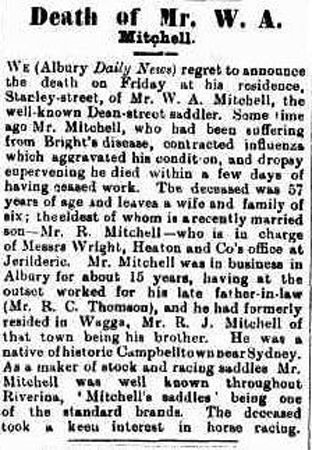
On 01 December 1896 the Albury Daily News placed a story in their newspaper announcing the death of William Andrew Mitchell on 27 November. Their notice revealed some snippets of unverified information on his past. His saddlery partnership with this father-in-law Mr. Thomson in Albury, had been unknown, plus his brother Mr. R. Mitchell remained living in Wagga.

The above catalogue was from an English supplier in the 1890's. They were quick to hone in on the "Wagga" name as per A2112 and A2113
In 1925 a Mr Cox from Wagga wrote on the hardiness of the “Wagga” saddle. His recollection is as follows:
An incident that I knew of in the 1860’s portrays the strenuous hunts of wild horses of that period. It happened at Troy's (Toole's Creek). A wild mare that had been run in from the hills fell over with one of the boys and got clear away back to her mob carrying a nearly new saddle and bridle with her. The stock saddle, made by Billy Mitchell (Jnr) of Wagga, in those days was a model of neatness, strength, and durability. It was afterwards called the Wagga saddle. The mare was sighted at various times, carrying the saddle under her belly, held by a strong leather girth, but every effort to capture her failed for a period of about two years. Eventually she was yarded, and the saddle recovered, but it was found that the girth had cut into the flesh of her back. The back had healed perfectly, the flesh growing over the girth, which flesh had to be cut in order to release the girth. Strange to say the saddle, which was so roughly carried through the hills through winter and summer months, was only slightly damaged, and after a little repair, was afterwards used for many years.

Advert in Tenterfield Intercolonial for Anthony Hordern's Wagga Saddle in 1908