
The Australian Stock Saddle
and the Saddlers that made them
ROBERT SMITH 1856 - 1902
1887 - The majority of saddles are made of cowhide, for although a covering of pig skin considerably enhances the appearance of the article, yet the former material is far better suited for rough bush wear. Mr. Smith points out that it is better for a horseman to order his saddles from the manufacturer than to buy an imported one, because he can then have it made to measure — no small recommendation to a rough rider, whose life often depends upon the saddle he uses.
Robert Smith was the eldest son of Mr. James Smith, of Dundee, Scotland, and was born on the 8th March, 1856, at the country residence of his parents at Longforgan, Perthshire. He was educated at the village school of Longforgan, afterwards completing his education at the Royal Academy, Dundee. Leaving school he was apprenticed to his father, who was one of the largest saddle and harness makers in Dundee. During this period of his apprenticeship he continued his studies, and with such success that he passed the Indian Civil Service Examination and obtained an appointment in Ceylon. His health failing, he was obliged to return after a residence of a few months in that lovely island; and on his arrival home he resumed work in his father's trade, but his health still continuing delicate he was advised by his medical men to try a voyage to the colonies.
Accordingly he sailed in the ship North American for Melbourne in 1876; landing there, he entered into the employment of Mr. Altson, the well-known saddler of Bourke Street, remaining in his establishment until 1880, when he decided to try Western Australia, thinking there would be more scope for his energies. His first employment in this colony was with the late Mr. J. Summers, with whom he remained for five years until that gentleman's passing.
The Inquirer ran an advertisement in November 1885, making known Robert's intention to commence a saddlery and harness shop on his own.
Opening Announcement! ROBERT SMITH, SADDLER AND HARNESS MAKER (Howe's Buildings,) BARRACK-STREET, PERTH.
(For the past 5 years in the employ of the late Mr. John Summers.)
BEGS to notify to the inhabitants of Perth and the Colony generally, that he has opened in the above line in all its branches, and has in stock a Large and Choice Assortment of the best English and Colonial Saddlery and Harness and all other requisites for carrying on a first-class Business, including Ladies, Gentlemen, Boys and Girls' Riding Saddles and Bridles, Pack Saddles, Double and Single Carriage and Buggy Harness, Trap and Spring Cart Harness, Cart and Leader Harness, Whips, Rugs, Horse Clothing, Brushes, Sponges, &c., &e. Having had a large experience in this Colony, the neighbouring Colonies, and in England, R. S. is confident that all orders entrusted to him shall give the utmost satisfaction, and will be executed with care and despatch. Repairs neatly executed. R. S. trusts to have a liberal share of public patronage.
Two years later, Robert Smith had come into prominence in Perth as both a successful local Councillor and saddler in his own right. The scribe at the Inquirer spent a good deal of time with Mr Smith and the following article was printed in August 1887.
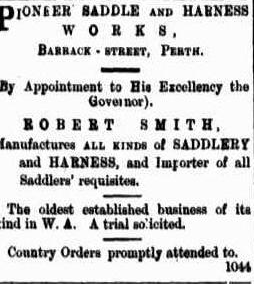
MR. SMITH'S PIONEER SADDLE AND HARNESS WORKS.
'Allow you to look over my place?' says Mr. Robert Smith, repeating our modest request, 'Certainly, sir. I am sure you are heartily welcome to see and learn all you can ; but you see you have called at rather an awkward time, as I am just in the middle of moving into my new premises.' And, judging from the crowded state of the little shop, it would strike the most careless observer that more elbow room was certainly a desideratum. It is not a grand looking building, is Mr. Smith's shop, by any means. The low one-storied brick house in Barrack-street forms one of a set, and has nothing to distinguish it from the other small shops on either side, save that over the front hangs a large board informing the general public that Mr. Smith is 'Saddler and Harness Maker to his Excellency the Governor by Appointment.' Mr. Robert Smith is an intelligent, brisk, cheery looking man, of rather under the average height and apparently about thirty years of age. How long has he been in the business? Well, he tells us that he started on his own account in a small way about two years ago. How many hands did he begin with? ' Only my own,' is the quiet reply; and yet in the short space of about a couple of years he has succeeded in building up the largest saddle and harness manufactory in Western Australia, by the exercise of dogged perseverance and unflagging industry. The proprietor of the establishment shows the large and varied stock he has on hand with justifiable pride. Here are to be seen beautifully finished saddles of every description — from one of the English racing pattern innocent of pads, to the Hispanic-Australian bush saddle suited to the use of a rough rider in breaking in a regular buckjumper. Beautiful specimens of harness, resplendent with brightly burnished silver or brass mountings hang round, while every imaginable variety of whips and other horseman's paraphernalia are stacked away in the smallest possible compass to make the most of the limited amount of available room. Mr. Smith replies to our numerous questions in the most cordial yet modest manner, and without the slightest reserve. He tells us, in the Western Australian vernacular, that he came to this Colony from the 'other side.' When he arrived here he found that nearly all the saddles, harness and other horse trappings were imported from England, America, or the Eastern Colonies; and he sagaciously thought an excellent market existed for home made articles. Thereupon he started in business about two years ago on his own account. At first he had serious difficulties to surmount and many prejudices to overcome, but he patiently struggled on until at last his efforts were crowned with success. Being a skilful workman and possessed of an intimate practical knowledge of every branch of his trade, Mr. Smith soon proved that he was able to successfully compete with imported manufactures. He was careful not to turn out anything but the very best article of its kind; and squatters, bushmen, farmers, horsemen and drivers soon discovered that it was to their advantage to deal with him instead of the importers. Gradually, but steadily, his connection increased; his manufactures became well and favourably known in the local market; he had to engage skilled labour to assist him in filling the numerous orders be received; and now he has in his constant employ two collar, two saddle, and eight harness makers, in addition to a couple of apprentices who have been placed under his care. Mr. Smith invites us to inspect his new premises, into which he was busily engaged in moving at the time of our visit. The new establishment is situated at the corner of Murray and Barrack streets, and consists of a spacious show-room admirably suited for the purpose of displaying harness and saddles to the best advantage; a commodious and well ventilated workshop, affording ample accommodation for over a dozen workmen; while in the back-yard are detached buildings in which hair teasing and other dusty, fluffy operations of a similar nature will be carried on.
Although Mr. Smith had not removed the whole of his extensive stock into the new establishment yet his journeymen had commenced work therein, and we were afforded an opportunity of seeing how saddles and harness were made. Mr. Smith tells us that, with the exception of the patent article, all the leather he uses is of Western Australian manufacture, which he declares is softer and better in every respect than that imported from abroad. Messrs. Stanford &, Simpson, of the Perth tannery, and Messrs. Pearse, of the Fremantle tannery, have an excellent customer in him; and some idea of the extent to which his business has developed may be gathered from the fact that his purchases of leather average over £100 a month. Upon looking round the workshops we notice a couple of large sewing machines, capable of being either worked by hand or driven by steam. But Mr. Smith informs us that the machines are seldom used, as all his saddles and the greater part of the harness he turns out are hand sewn. 'Machine work,' he says, 'will not compare with hand sewing, and if you want a good, thoroughly reliable article it must be put together by hand.' We then turn our attention to the saddles, being curious to see how they are made. Here are some men at work upon them — there is a great pressure upon this department just now — so that we see saddles in every stage of manufacture. The iron frames (trees) are imported, for Mr. Smith informs us that there are no frame makers (tree) in the Colony as yet. The frames are made to his order in accordance with his specific instructions, the peculiar feature being the bows, which are made in a certain way so as to ensure the maximum amount of strength combined with the minimum of weight. The frame is neatly covered with a lining of soft material, which is then stuffed with curled hair. This hair is first passed through a teasing machine which thoroughly removes all dust and dirt. The process of teasing is by no means a pleasant one to superintend, and when a person has witnessed it he can quite understand without explanation why it is carried on in a separate apartment. The flaps and pads are made on small bent frames, on which they are carefully tacked to dry and set in the required shape before they are attached to the foundation of the saddle. A journeyman can, by working overtime, turn out three saddles a week; in which case his wages will average between £14 and £16 a month. The majority of saddles are made of cowhide, for although a covering of pig skin considerably enhances the appearance of the article, yet the former material is far better suited for rough bush wear. Mr. Smith points out that it is better for a horseman to order his saddles from the manufacturer than to buy an imported one, because he can then have it made to measure — no small recommendation to a rough rider, whose life often depends upon the saddle he uses.
In another part of the large workshop two men are busily engaged in making packsaddles and water bags, in which Mr. Smith does a large trade. On the other side of the room the collarmen are at work, and it is a curious sight to see a workman engaged in stuffing a collar. He sits on a low stool with a heap of straw around him. The man has a stout stick about four feet in length, with a small notch or grove in the end. Picking up a small wisp of straw, the operative twists it on to the notched end of the stick, thrusts it into the collar through the end left open for that purpose, and rams the straw well home by hammering the stick upon the floor with all his might. The operation is necessarily a very noisy one, and appears to be also a very tedious one; but the men employed on the job are so skilled in the work that the process is performed with astonishing rapidity. But how are we to describe the system of harness making? for to the untutored spectator the very names of the numerous tools used in the work are confusing enough. But we see the harness of every description in the process of manufacture. There are the brown and the black kinds of harness, each handsome enough in its way; and Mr. Smith says that; although the price of each is about the same, he would advise us if we want a set of harness to go in for the black description, as the brown kind soon gets discoloured, and as it is not so thoroughly suppled as the black harness it will not wear so well. He also points out to us a most ingeniously contrived machine for making winkers, by which a pair of those articles are turned out in a very short time.
But the most attractive part of the work to a visitor is, perhaps, seeing the headstalls and other portions of the harness ornamented with varnished looking indentations in set patterns. The work is all done by hand, and with a rapidity that seems marvellous to the unskilled on-looker. Questioned as to the present prospect of his business, Mr. Smith frankly acknowledges that — despite the prevailing dullness of trade — he has as much work on his hands as he can well get through. 'You see, sir,' he adds, 'it's not only the orders I get from up-country customers, but I do a lot of work in the repairing line; and, even if up-country orders sometimes slacken a bit, I have plenty of work to keep my men in constant employment, as I now supply the storekeepers in Perth and at Fremantle with harness— especially collars. They have at last found out I can make collars for them cheaper than they can import them, and of a far superior quality; for it would be foolish on my part to send a bad article out of my place, for with us, sir, it is that sort of thing which injures a man's business reputation.'
Asked if he thinks there is room in this Colony — more particularly in Perth — for the further development of the saddle and harness manufacturing industry, Mr. Smith at once waxes eloquent as he descants upon the prosperity Victoria has achieved by adopting Protection as her national policy. 'Look here, sir,' he exclaimed, 'if a proper protective duty were placed upon all saddlery and harness imported into this Colony, not only should I soon be able to more than double my business, but others would soon follow my example and start manufactories as well.' And he then went on to point out the advantages that would accrue to the community. The failing industry would be stimulated; employment provided for skilled operatives; opportunities would be presented parents of getting their sons taught a respectable and well paid trade; and the money which is now sent away to England, America, and the eastern provinces of Australia would then be kept in the Colony. At any rate Mr. Robert Smith has proved that a manufacturing industry can be established in Western Australia — and be properly carried on, too, in spite of the want of (what he would term it) a proper amount of Protection. Mr. Smith's outspoken expression of opinion represents the feelings hundreds of working men entertain upon the subject — feelings which will no doubt be very practically expressed through the ballot-box under the new constitution. But be that as it may, here is a man who by the exercise of dogged perseverance, unflagging industry, self-reliance, indomitable courage, and being spurred on by a laudable ambition has raised himself from the position of a journeyman to that of the employer of over a dozen skilled operatives — in place of earning 8s. or 10s. a day by the work of his hands, be now pays away wages at the rate of over £25 a week; he has built up a business that requires him to always keep a stock in hand to the value of considerably over £1000 — and by establishing a new industry in the Capital he has materially added to the future prosperity of the Colony at large. It is men of this stamp who will develop the manufacturing industries of the country, and therefore it is to be hoped that many mote of the same sort will soon settle in Western Australia.
In September 1887 the Western Australian printed a request from Mr. Smith. It stated:
We have been requested by Mr. R. B. Smith, the proprietor of the Pioneer Saddle and Harness Works, to draw the attention of the public to the removal of his establishment to the premises many years ago occupied by the Working Men's Association in Goderich Street, opposite Mr. Liddelow's butcher's shop. Mr. Smith's premises are very commodious, and additions to the rear of the building are contemplated which, when finished, will largely add to the accommodation required for the further development of the business. The factory, which adjoins the .wholesale and retail department, is fitted out with the necessary plant, and gives employment to fully a score of hands, while the anon is largely stocked with saddlery and harness of various descriptions for bush and town use.
In July, 1886, upon the resignation of Mr. F. M. Stone, Mr. Smith was elected Councillor for the East Ward of the city of Perth, and was re-elected last November. During his term of office in the Council, Mr. Smith had strongly advocated the construction and repair of roads, and was largely instrumental in obtaining the last loan of £10,000 for roads and repairs. He had also, at every opportunity, urged the necessity of street lighting, and, whilst giving every attention to the requirements of his own ward, had advocated all measures tending to the welfare of the city of Perth.

Mr Robert Smith, photographed in 1888
On 26 August, 1898 the Inquirer wrote an article on some special saddlery made by Robert Smith. It read:
EXPORT OF SADDLERY
Mr. Robert Smith, the well-known saddler of Barrack-street, is sending in the G.M.S. Oldenburg eight saddles which have been ordered by the Ameer Abdul Rahmann Khan of Afghanistan, and which will be placed under the charge of Faiz Mahomet, who is revisiting his native land. Of these saddles, which have been specially manufactured for use in hot climates, two are buckskin-seated, and the remainder are made of the best colonial leather. Some of them are military saddles, fitted with staples, which will enable them to support all manner of 'swags,' and with holsters for carrying revolvers and ammunition. The bridles as well as the saddles have been manufactured on Mr. Smith's premises.
Some little time ago Mr. Smith exported several camel-riding saddles and pack-saddles of his own manufacture, with pack-bags complete, to the Secretary of Agriculture at the Cape. It is believed that this was the first occasion on which any such export was made from Western Australia. Evidently there is hope that the reproach that this colony can export nothing but gold and timber will cease to be in accordance with facts. Mr. Smith employs about forty-five workmen in different lines, some of whom have gained experience in South Australia in connection with the camel trade. An expert is employed for the manufacture of light saddles and trotting-boots for fast trotters.
Mr. Smith admits that there has been a slight slackness in the orders of late, but at the same time he has no difficulty in keeping all his men employed, and there is no mention of any 'retrenchment' in his department.
In October 1900, Mr. R. Bechtel, who carried on a large saddlery business Perth a few years ago, announces in this issue [Northern Public Opinion and Mining and Pastoral News] that he has returned to Perth, and that he has acquired the business so long conducted under the style of Robert Smith and Co. Mr. Bechtel had a good reputation for the class of goods he turned out when in business before, and patrons who favour him with an order now are likely to find that he is determined to maintain the high character of the goods sold from his establishment, the address of which Barrack-street, Perth. Mr Bechtel also took over the trading name of Pioneer Saddlery and Harness Works when he purchased the business.
However in September 1902, Robert Smith was back again announcing a return to the saddlery trade and trading under the name of Robert Smith and Co. and in a brief space of a couple of months developed an extensive factory, Starting with two men in their employ to-day, reported the [Northam Advertiser] they employ thirty hands at their workshop in the basement of the Empire Building. "Their old customers and the public recognise the excellent workmanship of the goods manufactured by them and are supporting them liberally."
Then devastating news sounded out around Perth, with the demise of Robert Smith in December 1902, at the young age of only 46. The Western Mail reported:
A painful sensation was caused in the city on Wednesday when it was reported that the body of Mr. Robert Smith, the well-known saddler of Murray-street, had been found in the river. The body was found by Mr. J. Boor, draper and clothier, one of whose business places by an odd coincidence adjoins that in which the late Mr. Smith had been trading since the pile of buildings was erected. In reporting his discovery to the police, Mr. Boor stated that while riding along Mount's Bay Road on Wednesday he noticed a body in the river, near the Swan Brewery. He obtained assistance, and then got the body out of the water. On the arrival of the police deceased was conveyed to the hospital mortuary.
Deceased was one of the leading business men in the city, and was one of the first saddlers to open here. It is said that he owned a considerable amount of property in Perth, including Smith's Buildings in Barrack-street and the Ozone Hotel. He was highly respected and much regret was expressed last evening when the sad tidings of his untimely end gained circulation. People who spoke to him at the end of last week, state that he was, then, in his usually good spirits, and gave no indication that he was in any way embarrassed.
The saddlery traded on until approximately 1925, gaining many awards for the saddlery at various Exhibitions and shows. A Mr. W. T. Flynn was the proprietor for the saddlery for many years. The below pictures are dated 1908 (top) and 1913 (bottom).


A private museum has secured one of the "military" style saddles that were made in 1898 for the Amir of Afghanistan by Robert Smith. The saddle was discovered at the Kabul bazaar, Afghanistan in 1975 by Mr Lorenzo Paolini (Italy) who very generously decided to sell the museum this very rare and precious saddle. Pictures below. Note the inscribed designs on the saddle.


Pics Credit: Private Collection