
The Australian Stock Saddle
and the Saddlers that made them

William Henry Simpson
1834 - 1922
'Is the stock-saddle an Australian invention?'
'Yes; but the stock saddle, or Queensland saddle, as we used to call it, has altered very much since it was first made. The pads used to be much lower down to get the knees under, not right up, for the thighs. It seemed rather surprising to me that while saddles like these were found necessary, the horse in Australia was ridden with a much less severe bit than in England. I suppose, though, that that's because the English horse as a general thing, is much more highly fed, and needs more holding.' W. H. Simpson, 1910
William Henry Simpson was born at Warrenpoint, County Down, Northern Ireland in 1834 to Ebenezer (1795-1855) and Sarah Simpson (1796-1878) and arrived with his parents (aged 4) in Australia in 1838 aboard the ship Parland. At Newry in Ireland, Ebenezer had been a master tanner and so when he arrived in Australia with his family, settling first at Windsor then at Richmond, he worked for Wright’s tannery in Parramatta.
In 1843, his father commenced a tannery business at Camden, NSW. While William’s brothers, Ebenezer (Jnr) and Alexander, were to become tanners and join the family business, William was apprenticed as a saddle and harness maker to William S Mitchell of Camden, (father to William A Mitchell, "Wagga" saddle fame) for the period from around 1848 until 1855. Emerging from his indentures in 1855, William entered into a partnership in a saddle making business with Thomas Davis. Davis died in July 1855 and the partnership in the name of Simpson and Davis first saw the light in July 1856.

Sydney Morning Herald Advert - 16 July, 1856
It appears that William initially worked with Davis but on his death, which took place soon after William joined the saddlery, he entered a business partnership with Thomas’ widow. The saddlery was situated in 16 Pitt Street North then moved to Number 40, and finally the 179 Pitt Street address, (William described Pitt Street as it "being a lot of little white-washed cottages") but from January 1859, William had no partner. In 1861, he entered a partnership with James David Jones at 385 George Street with the business name of Jones and Simpson. This partnership continued until 1863 when Simpson assumed sole ownership of the business which became W H Simpson, Saddler.
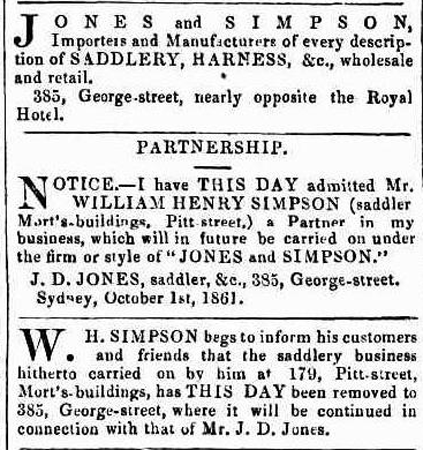
William continued with both local manufacture of saddlery and importing from England. It was found that he competed against his peers at the Sydney Royal and the Intercolonial Exhibitions with mixed success.
In January 1877 an advertisement in the Sydney Morning Herald announced the partnership of William Henry Simpson and his son William Walker Simpson. The business name was to become synonymous with the supply of quality saddlery in early colonial Sydney. By 1896, their signature saddle became the "Bushman's Dreadnought" which was widely distributed throughout NSW and Queensland. Unfortunately no illustration could be found of that saddle.
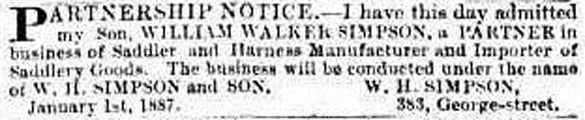
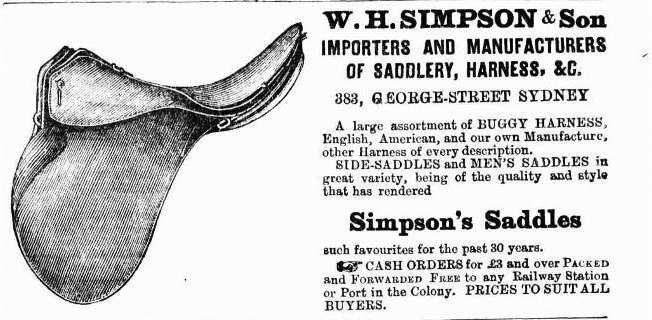
Business obviously boomed in the father/son partnership as in 1897 the saddlery moved into premises designed and built to expand even further. The scribe at the Sydney Morning Herald wrote the following article in December.
W. H. SIMPSON AND SON, 385 GEORGE-STREET
The unsightly buildings of old Sydney promise very soon to be known only through prints, for one after another disappears, to be replaced by modern, if not always artistic, edifices. The building, however, erected by Messrs W H Simpson and Son in place of their old premises in George-street is both artistic and imposing The saddlery business carried on therein is one of the oldest in the colony, Mr Simpson having taken it over from the firm of Rogers and Sons so far back as 1855, and for 40 years or more he has not only retained but increased the deservedly high repute in which the business was even then held Messrs Simpson and Son keep every description of harness in stock, from the stylish pair horse Landau sets to the light sulky turn out Every description from the most ornate to the most homely for rough country use are on view, together with saddles, whips, &c, in all varieties They also manufacture the Van Buskirk, Magic Bit and a splendid safety stirrup which prevents dragging when thrown. In novelties suitable to the season Messrs W H Simpson and Son provide special hues of leather bags, purses, wallets, bicycle bags, ruling whips, etc. , in great variety, and their window facing the Strand proves an attractive feature to all passing it.
They must have been on a roll, as across the street another building was erected by the Simpson's. In October, 1897 Freeman's Journal reported: "The latest and most attractive-looking cycle depot in Sydney is that just opened by the Massey-Harris Company, Limited. This well-known Canadian firm have secured the new and handsome four storied premises built by W. H. Simpson and Son in George-street, opposite the Strand Arcade. Old stereotyped lines have been altogether departed from, and instead or entering a shop with a row of bicycles of all makes and grades ranged along the wall, the Massey-Harris Company have made their show-room more of a parlour, with sample machines only mounted on various heights and styles of stands, which at once relieves the stiffness one is accustomed to meet with in the ordinary bicycle show-room. To make the parlour even more attractive, settees and chairs are provided for the accommodation of patrons. The premises are brilliantly lighted with electricity, and the effect produced in the windows by the aid of mirrors is novel and, we should say, from a commercial point of view, very serviceable. Simpson and Son, who have at great cost made this welcome addition to the architecture of George-street— rebuilding their own shop as well — are carrying on their long-established and flourishing business as saddlers and harness-makers."

George Street, Sydney 1895
1899 saw a further article on their expansion which read as follows: "Comfort for the rider and comfort for the horse are the desirable results Messrs W H Simpson and Son, of George-street, successfully strive for in the manufacture of their saddles, and durability and a good fit are the noted characteristics of their harness Large stocks of both Saddles and harness are to be seen in the fine George-street shop, and everything else connected with their special trade There are fancy leather goods, too, and some beautiful riding whips and walking sticks A novelty in the latter extremely useful to men attending large sales or agricultural shows is a walking cane containing a measure and spirit level for measuring horses' heights This would in like a most useful and hand-some presents for a gentleman whose pursuits are connected with horses A new drenching bit too, is a novelty, and Messrs W H Simpson and Son display many new attractions in their line of business which will commend themselves especially to country visitors."
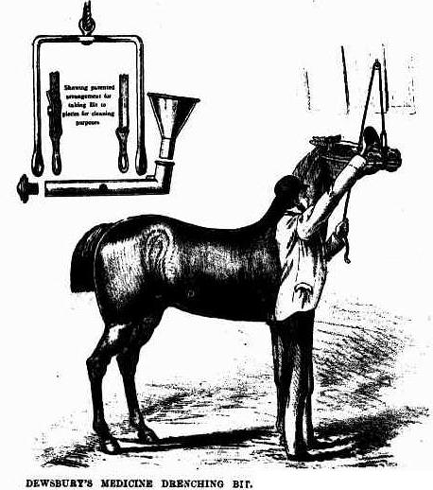
A 1909 article confirmed their continued success. "W. H. Simpson and Son, the old established and well-known saddlery firm of George Street, Sydney, have been catering for the Saddlery and Harness requirements of New South Wales and Queensland for upwards of sixty years. Simpson's stock saddles are known throughout these States, and being faithfully built of best quality materials, they are eminently fitted to stand the hard wear incidental to country life. The firm aims especially at comfort both for the horse and rider. Mrs. Stace and Mrs. Elliot, the champion riders at the Royal Sydney and country Shows, both use side saddles purchased by them from Simpson and Son. These saddles are known as Mayhew's style of ladies' hunting saddles. Ladies astride saddles are fast coming into general use, and the firm can supply them in all sizes and qualities. Children's saddles for either boy or girl are also kept in stock, and their polo training and race saddles are low in price and best in quality. The firm also supply racehorse clothing in linen material or in serge and worsted in various colours and qualities; trotting requisites, such as boots, trotting and pacing hopples and bloomers ; stallion bridles, leading bars, reins and rollers; bridles, spurs, whips for every purpose, travelling and hand bags and trunks. Simpson's sulky harness may be seen on every road in the State, and is the best advertisement the firm has. Once used, 'no other need apply.' Consistent good workmanship, the employment of best materials and reasonable prices have done this. Simpson's pair horse country harness in brown or black leather is also much in evidence in our country districts. Pony harness is a leading speciality of the firm, and it is made in all sizes. All the mountings in harness are either solid white nickel or solid brass, and will never rust."
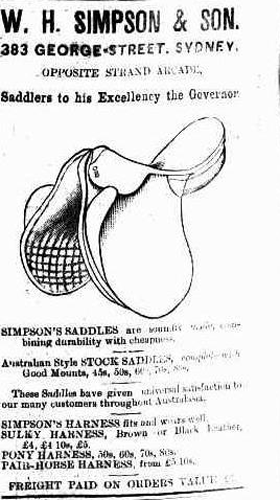
1901 Advertisement stating Saddlers to his Excellency the Governor, granted in 1896
1910, two men named Oswald Charles Walther and George Stevenson bought the long running saddlery (55 years) named W H Simpson & Son at 383 George Street, Sydney. They traded under the famous name of Walther & Stevenson, Saddlers Sydney.
1922 saw the announcement of William Henry Simpson passing away. His obituary is re-printed here:
The death occurred yesterday, at the age of 88 years, at Waverley, of Mr. William Henry Simpson, for many years a business man of Sydney. He was born at Warrenpoint, County Down, Ireland, in 1834, and his parents came to Australia in 1838 in the ship Parland.
Mr. Simpson entered business as a saddler in 1855, on portion of the site now occupied by Dalton House, and later removed to George street, where, with his son, he carried on business until 1910, when he retired. Mr. Simpson had a long connection with the Masonic order in Sydney, and before the creation of the New South Wales Grand Lodge was associated with Lodge of Australia, under the English constitution. When the United Grand Lodge of New South Wales was established he became a Grand Lodge officer, holding first the office of treasurer, then of deputy grand master. A resident of Waverley for 45 years, he took an interest in municipal matters, and for 27 years was connected with the local council, occupying the Mayor's chair for five years. For 26 years he was hon, treasurer of the Local Government Association of New South Wales. At the time of his death he was president of the Deaf and Dumb and Blind Institution, and had sat on the committee of management for more than 20 years. He also was an office-bearer of St. Mary's Church of England, Waverley, and his funeral will leave the church for the Waverley cemetery shortly after 2 o'clock this afternoon.
William Walker Simpson, (his son) died in July 1932.