
The Australian Stock Saddle
and the Saddlers that made them
JOHN (JACK) JULIUS WIENEKE 1863 - 1947
Let us start the story of Jack Wieneke in his own words, when interviewed in November 1941 by the Qld Country Life. They paid 80 year old JACK WIENEKE a visit who recalled his early years to the scribe.
“Perhaps the best way to become a good horseman is to have your mother carry you on the front of a saddle for the first two years of your life!” he claimed. At all events, that was the cradle which Jack Wieneke, known far and wide for his saddles, knew for the first two years of his life, and he became one of the State's best horsemen. He was born in a bullock wagon in Toowoomba, and his mother carried him on her saddle for two years. His cradle was a blanket and a pillow arranged by his mother on the pommel of her saddle, for she rode in the bullock wagon convoy beside his father.
Though he is past the stage when he could take on anybody's bet where a horse was concerned, he has no complaints against the rough life of the pioneering days which made a man as much master of a horse as the average boy of to-day is master of a bicycle!
"It is a refreshing experience to talk to this 80 year old Queenslander - there are not too many Queensland-born pioneers of that age for the spoken word is more vivid in the pictures it paints than the written" said the reporter.
He was born in the rough shelter of a bullock dray on the eve of 1863. His father, who came to Australia in 1853, owned a bullock team, and his mother, who came out in 1856 knew as a home the wide stretches of bush which lay between Toowoomba and the outposts to which the drovers and their teams took supplies. When he was three years of age Jack Wieneke's parents settled in Roma, the town which he always refers to as his home town. He became the eldest of 13 children, and he had a sister with 13 children. Of his early life, J. Jack Wieneke says that it was one in which there was little schooling and a lot of the hard work that goes with the carving out of a living in a young land. His parents were kindly and ambitious, and by hard work his father was able to get on in life.
"Our first home was a bark hut, one room, flat roof of bark, and walls of bark, earth floor, and it was not even ant-bed. At that time education was not free, and an old man named Warden had a little school in a bark hut. At four years of age I was sent to this school, my mother paying nine pence per week. Slate and pencils had to be bought. Before I was seven years of age I was taken on the road to drive the spare bullocks. In 1868 my father had acquired a second team. When 11 years of age (1873) I was driving one of the teams, which was yoked and unyoked for me. I never had an opportunity to go to school after six years of age."
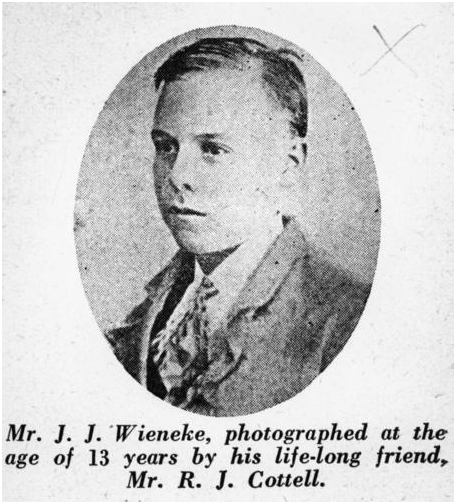
His father had a hotel at Yuelba when Jack was old enough to start work, which he did as an apprenticed saddler, at the age of 13, to Charles Arnold of Roma. With this man, the young apprentice, following the practice of those days served three months on trial without wages. "The indentures to-day,"' says Jack Wieneke. "do not give the boy a chance. I had to learn the arts and mysteries of saddle making in all its branches. The master was as bound to me as I was to him. To-day, a boy is taught only one branch of the business." For five years the young saddler, who was later to become the leading man at his craft in the State, worked and learned, on a wage which rose yearly by 2/6 from 5/- to an eventual £2/5/- a week. A few months after he had come out of his apprenticeship, a telegram came to Arnold from F. J. D. Simpson, of Tambo asking him to send a general hand whom he could recommend at £3/5/- a week. Arnold said that he knew a good hand who could come at £3/10/- a week. Jack Wieneke got the job, and from then on he was always able to command considerably more than the ruling rates of wages for his trade. Research has not been able to find how long Jack stayed with Simpson at Tambo.
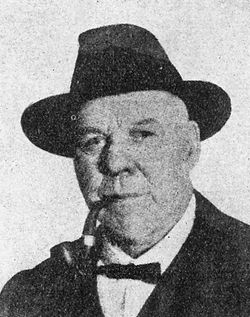
To his athletic prowess, Jack Wieneke owed the opportunities which permitted him to start in business on his own account, and to bring into being the first genuine Wieneke saddle, and the other improved items which figured his craft. A list of the events which he has won in every part of Queensland foot races, high and pole vaulting jumps, broad jumps, rough riding, and other feats of horsemanship, would fill the page of an average sized newspaper. Jack Wieneke selects one as the most important event in his life. In 1885, when he was 22 years of age, he had arrived at a point when, whenever men sat around a convivial bowl or gathered in the billiard rooms which were their clubs in those days, any reference to athleticism brought the name of Jack Wieneke to the fore. Mr. J. Burrell. manager of the Bank of Australasia, in Roma, was discussing the coming Queen Victoria's birthday sports one day in 1885, when the name of a champion runner W. T. J. Gollan was mentioned as a competitor. Mr. Burrell decided immediately that Jack Wieneke was the young man who could upset the Warwick "meteor" and though Jack was not present he was backed for £150 aside to race Gollan over 150 yards.
The race took place on the banks of Bungil Creek, Roma. A rope separated the two contestants to prevent jostling, and the track was just a stretch of unprepared heath with a slight sideways slope. Jack lost the toss, was placed on the downside of the rope by his opponent's choice, and the epic was run to the cheers of the crowd and the well-merited satisfaction of Jack Wieneke, who won by inches. Mr. Burrell privately informed the winner later that from £800 to £850 changed hands in bets just prior to the race. Says Mr. Wieneke now: "Can you imagine such a bet as that being laid in a country town to-day."
This £150 decided Mr. Wieneke to commence business as a saddle maker on his own account, when he bought out his master, Charles Arnold in Roma. According to Wieneke, up to that time (1886) saddles were rather crude affairs, and during the years that he had spent shaping and stitching them, Mr. Wieneke's ability as a rider, had suggested to him that he could incorporate many improvements. He set about the task immediately he started out on his own, and, in his own words, he "revolutionised the saddles of the day!"
In Roma, about 1898 a very refractory horse was brought into the town, and a rival of Jack Wieneke's who would never harm him, but was always willing to get the better of him, sought out Jack to bet him that he could not handle the nag. A bet of £10 was arranged, and the rough ride took place in the Corporation Saleyards, after every one, who had tried to dissuade the intrepid Jack, had gathered to see him taken of a certainty to hospital. Jack shoved one of his own saddles on the brute, and taught it all the tricks of a riding master with one lesson.
In Richmond (N.S.W.) about 1900, a troupe of American cowboys was travelling the rounds with a bad bunch of buckjumpers. They issued a challenge, and as he was on his way with a saddle to the order of Mr. Thomas Rowan, Jack Wieneke accepted the bet, and used the saddle. The crowd was amused at the idea of the stranger being able to beat the Americans' worst animal, but half-way through the effort the rider said: "It's alright, gentlemen. I am quite safe because I am riding one of my own saddles, a genuine Wieneke." Several of the crowd knew the name and quite a number requested to try the saddle out. One man said: I'll back myself to ride a cannon ball in this!" And in riding contests of a similar nature, too numerous to mention, the man who has made Queensland a saddle-maker instead of a saddle buyer learnt the needs which every horseman knows, and which Jack Wieneke was able to put into effect. Hence, a valuable lesson was learned by Mr. Wieneke; self promotion was a very profitable venture. He continued with this tack, up until his dying day, and the word "famous" became synonymous with the name of Jack Wieneke, mainly through his entrepreneurial talents. However let it be said that the real J.W., to understand his lovable personality, and to appreciate his process in just the mention of horses, rodeos or saddles, and the blue eyes twinkle. Furthermore there's a humorous chuckle, and then you'll hear about the days or real sport.
The saddlery business flourished, with Mr. John Wieneke's saddlery emporium being one of the leading features of Roma, reported The Queenslander. It is said to be the largest business of its kind in Western Queensland, and his annual turnover of saddlery is something considerable. A trial shipment of saddles was forwarded to South Africa by Mr Wieneke some few months ago (early 1895), so much that they were appreciated that a large order for further supply is now pending.
Mr. Wieneke said that in 1889 he had the honour of being the largest exhibitor at Roma show, having entries in jumping, trotting, and saddle and harness horses, also a big exhibition of saddlery and harness. In those years the saddler's shop was part of the show, and he and his staff of about 14 were kept going night and day completing orders. The squatters had to drive in with four-in-hand relays, and of course generally, spent the week in town. He had helped put Roma on the map, not only as an athlete, but with his saddles, which had been sent to South Africa, Western Australia, North and South America, and England and Ireland. An exhibit of six of his saddles had been prominent in the world's largest exhibition at Wembley, England.
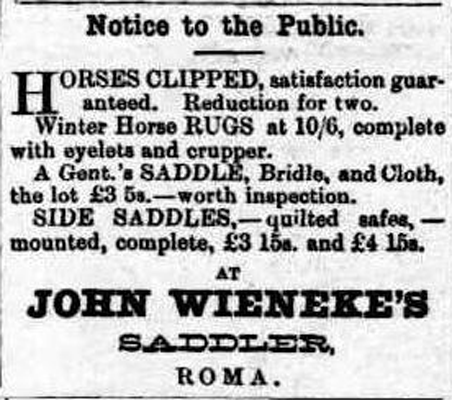
Advertisement in May 1900, Roma
However in December 1900, bad news came by way of the Western Star, stating that Mr. E. O'Connor will offer, for sale at 11 o'clock this morning the whole of the stock in-trade of Mr. John Wieneke, saddler. Following this sale Mr. O'Connor will offer Mr. Wieneke's household furniture, &c., at his residence in May-street. A sigh of relief must have been heard throughout Roma as Jack's brother George advertised the following three weeks later, again in the Western Star:
Important Notice.
I BEG to notify the Public generally that I have PURCHASED from the Mortgagees, Messrs. Brace, Windle, Blyth and Co., of Brisbane, the SADDLERY BUSINESS including the Stock-in-trade, Book Debts, and Plant, recently carried on by my brother, John Wieneke, of Roma. The business will be, in future be conducted by myself, and hope that by strict attention to business to merit, a fair share of public support. Constituents may rest assured that the well-known " WIENEKE" Saddles will still be turned out as heretofore. Persons owing accounts standing in the books of J. Wieneke are kindly requested to pay same only to the undersigned or to Mr. E. O'Connor, whose receipt shall be sufficient discharge. Geo. WIENEKE.
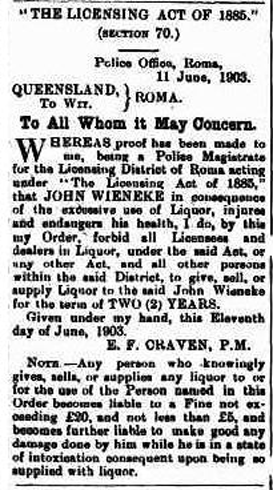
As far as the writer is aware, Jack remained in Roma and, though it cannot be confirmed, possibly worked under his brother in his former business. This must have created a great deal of pressure on the previously successful man and an advertisement placed by the police would not have helped with his mental health. Perhaps after this episode with the police, it was then that Wieneke moved down to Brisbane, to assist in George Schneider's shop at Petrie Bight, as it was discovered that Jack did work for Schneider sometime during 1901 and 1905.
Good news was received in November, 1905 when notification was given of the discharge of insolvency.
Mr. Fletcher (of Messrs. Morris and Fletcher) applied to Mr. Justice Real, in the Supreme Court, on Wednesday, on behalf of John Wieneke, of Roma, saddler, an insolvent, for a certificate of discharge. The insolvent was adjudicated on 27th January, 1906, in forma pauperis. The liabilities to Unsecured creditors amounted to £188 14s., and the assets to £1 l6s. The causes of insolvency were set down as loss of trade, in consequences of the drought, pressure of creditors, and sickness. The report of the official trustee, showed that debts proved amounted to £78 10s. 10d., and that nothing had been realised. A meeting of creditors was held on 12th October, 1905, when a resolution of creditors was passed, enabling the present application to be made under section 167, subsection 2, of the Insolvency Act. His honour granted the Certificate.
A few months after the insolvency discharge in 1906, John Julius Wieneke was back in business in another part of town, however details are not to be had as to the size of the business or whether he had journeymen working for him.
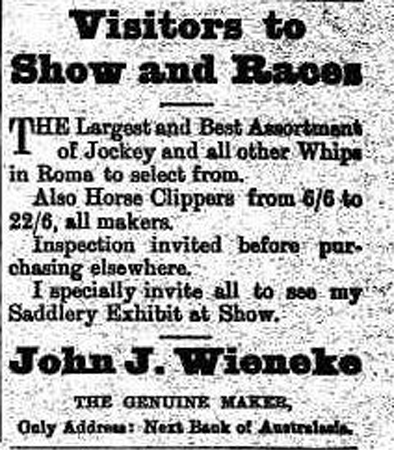
Most of Jack's history in Roma is fairly sketchy after 1906, however a long time employee of Butler Bros., George Lane believed that Jack was working at Schneider's for a time, then we have him being newly employed at W. H. Stevens, Brisbane Road, Ipswich in 1913. According to court records Jack, in about 1914, entered the employ of Edward Butler and Sons Ltd., where he designed and built a saddle called the 'John Wieneke Poley' but in 1915-1916 carried on business on his own (location not known). Wieneke then worked for Butler Brothers (Australia) Ltd., a rival concern and in no way related to Edward Butler's. It was at this time that Jack designed seven different saddles (six poleys and one stock saddle) named the Ace, Charleville, Roma, Augathella, Tambo, Yeulba and the Mitchell Break stock saddle. 1918 finds him re-employed with Edward Butler & Sons, Brisbane. This partnership propels him forward with respect that Edward Butler's and partners John Brush, had a large advertising account, far greater than Jack's small business or his counterparts could ever hope to secure. His name, from this time, was soon to become very well known.
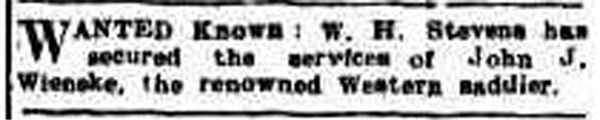

Advertisement on behalf of W H Stevens, 1913
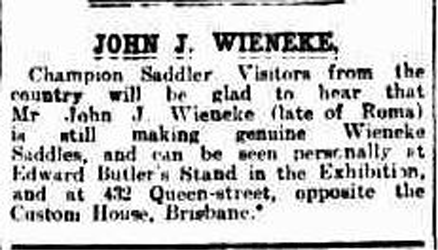
Edward Butler & Sons advertisement in 1918
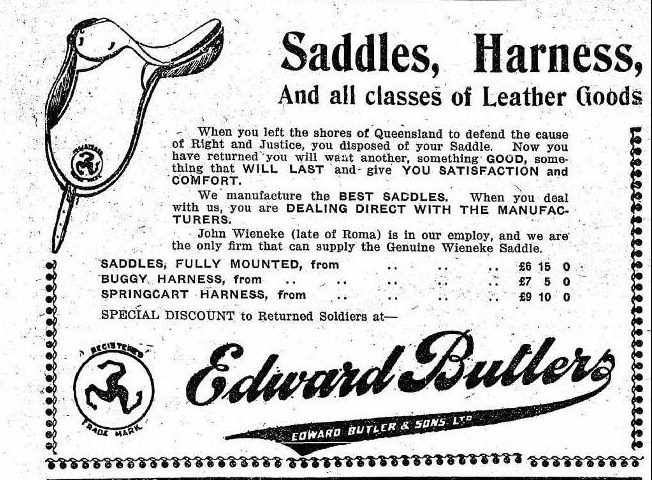
1919 Advertisement above and 1920 below
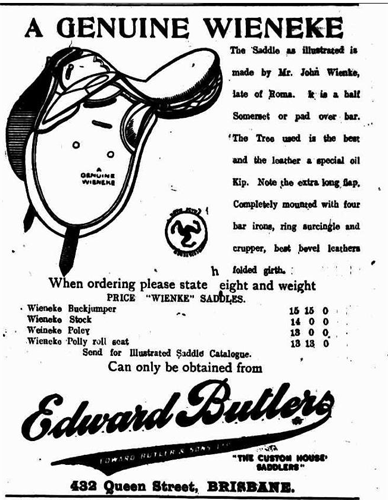
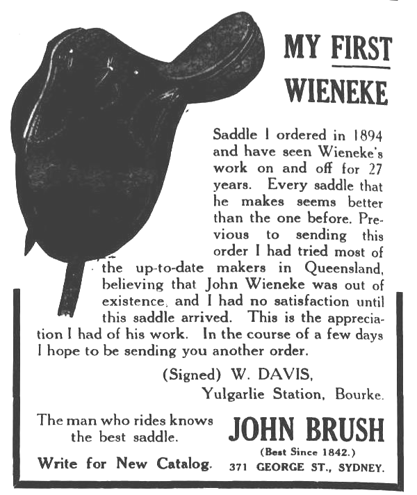
Advertisements - 1922 above and 1924 below
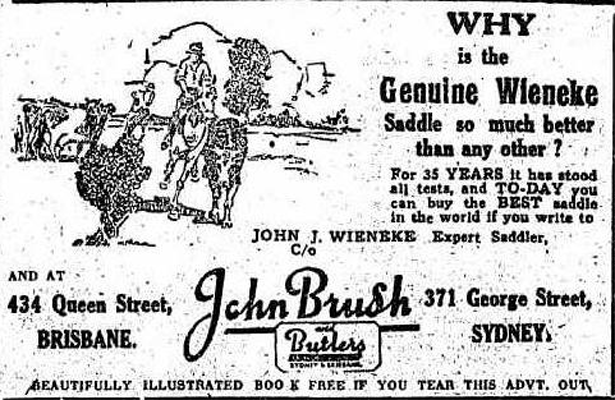
In March 1926 there appears a Trade Mark Application, possibly instigated by Edward Butler, given as to what is to occur in 1938, though it is odd that they mention Edward Butler as a predecessor in business of the applicant company. Advertisement below
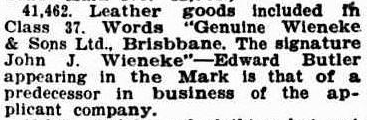
What follows below is a range of advertisements up until 1935, that appeared in newspapers along the east coast, either weekly or monthly, depending on the state. This saturation of the market led to the Wieneke name becoming so "famous", plus obviously, customers were satisfied with the turnout of his saddles/equipment. A clever ploy on behalf of Jack, as his income stream could never have afforded marketing campaigns like these.
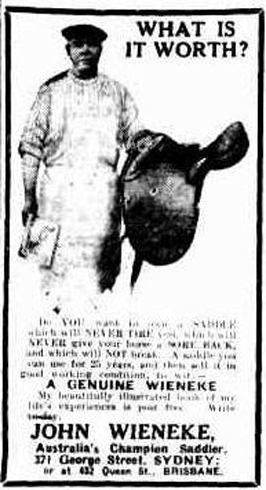
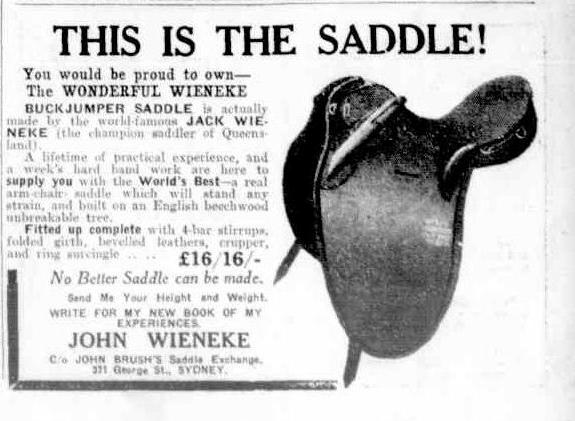
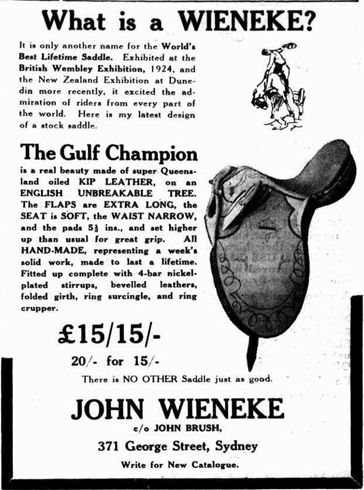
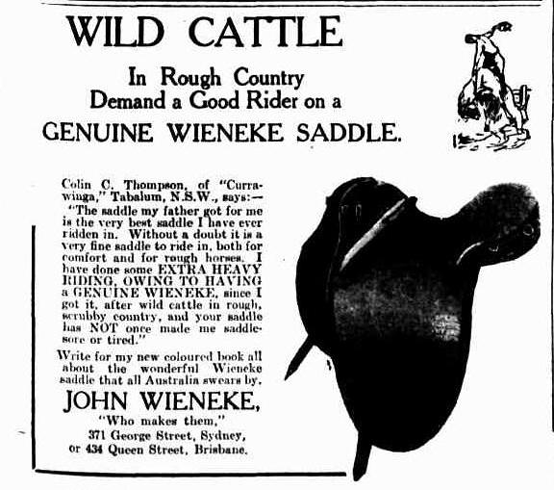
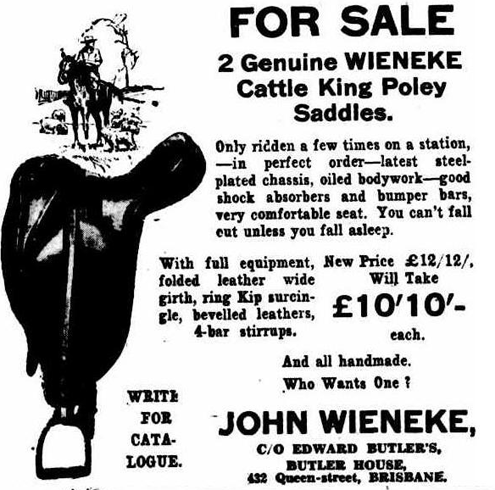
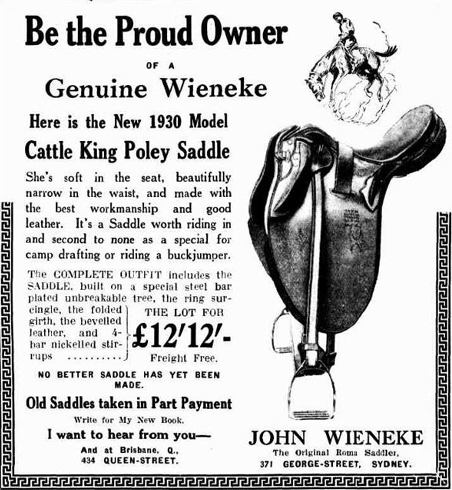
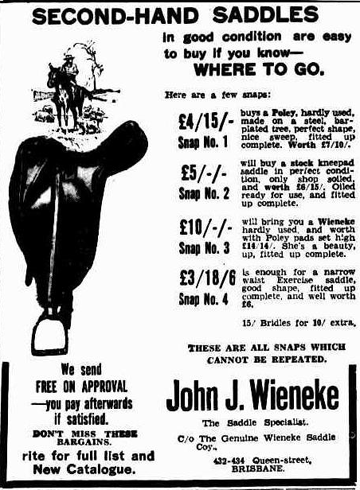
The above 1930 advertisement is particularly interesting, as Jack was still connected to both John Brush and Edward Butler but lists the business as "The Genuine Wieneke Saddle Coy", however it has been discovered that Edward Butler registered this trading name.
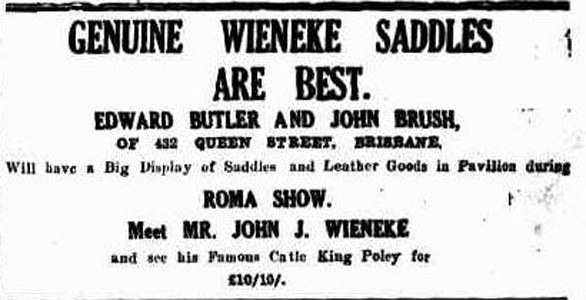
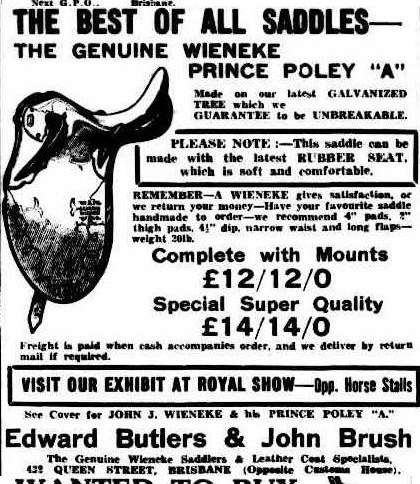
After a sustained partnership, a matter of trademarks reaches the courts in May 1938, and is reported as follows in the Courier Mail:
MARKINGS ON SADDLES
Injunction Continued
On the application of Edward Butler and Co., Pty., Ltd., of Brisbane (plaintiff), Mr. Acting Justice Hart yesterday made an order continuing until the trial of the action, an Interim injunction granted on May 5, restraining John Julius Wieneke, of Ascot, saddler, or his agents, from infringing applicant's trade mark No. 41462 for the manufacture of saddles, and from using in marking or advertising saddles made by or for Wieneke, the words 'Wieneke,' 'Genuine Wieneke,' and 'John J. Wieneke,' either alone, or with other words. Mr. E. T. Real said that Edward Butler and Co. had formerly employed Wieneke, and had acquired the trade mark from predecessor .firms. Opposing the application, Mr, Macrossan (for Wieneke) said Wieneke was the original maker of the Wieneke saddle, which attained international fame about 50 years ago. Wieneke had always been a saddle maker. If the injunction stood in its existing terms the man could not make a saddle, and could not earn his living, because he would be forbidden to use his own name in his business. He submitted that Wieneke had not infringed the trade mark.
By consent, his Honour listed the case for the sittings beginning next Monday but directed that it be not heard before May 30. He continued the Injunction, subject to the usual undertaking as to damages, and ordered costs to be costs in the cause. Mr E T Real instructed by Messrs Tully and Wilson appeared for the company, and Mr. N. Macrossan (instructed by Messrs. O Shea, Corser, Wadley, and Scanlan) for Wieneke.
In July 1938 the Telegraph followed up with a further report:
Injunction Claimed Over Manufacture Of Saddles
The name of a Queensland saddle which attained international repute was mentioned in the Supreme Court to-day when an injunction was claimed over an alleged infringement of copyright; Before Mr. Acting Justice, Graham, Edward Butler and Co., Pty., Ltd., of Queen Street, Brisbane, proceeded against John Julius Wieneke, of Allen Street, Ascot, seeking an injunction to restrain him from infringing the company's registered trademark No. 41462— "Genuine Wieneke," "Wieneke" and "John J. Wieneke" — either alone or with other words, in the manufacture of saddles, or from passing off his saddles as of the company's manufacture. An accounting of profits was also sought, or else damages, and the delivery to the company of saddles so marked. Mr. E. T. Real (instructed by Messrs. Tully and Wilson) appeared for the company and Mr. Neal Macrossan (by Messrs. O'Shea, Corser, Wadley and Scanlon) for Wieneke.
ALLEGED USE OF NAME. Mr. Real said that Edward Butler and Co. Pty. Limited was successor to an earlier company, Edward Butler and Sons, Limited, which in 1913 or 1914 employed Wieneke. In 1925 Wieneke consented to the registration of the trademark , (his name. and the signature "John Wieneke") and continued in their employ. About 1933 there was reason to believe that Wieneke was making saddles and disposing of them on his own account. An agreement was reached, and Wieneke continued in the employ of the company until 1937, when his services were terminated. Later, apparently, Wieneke decided to start on his own, and he used the name "Jack Wieneke Famous Saddles." It was claimed also that he used the words "John J. Wieneke," "Genuine Wieneke," and "Wieneke" in his business. This, was calculated to deceive the public into believing that saddles made by him were made by the company.
THE DEFENCE. In defence Wieneke said that for many years up to 1913 he carried on business as a saddler at Roma, and acquired an international reputation. About 1914 he entered the employ of Edward Butler and Sons Ltd., but in 1915-1916 carried on business on his own, and then for Butler Brothers (Australia) Ltd., a rival concern. Thereafter he was again employed by Edward Butler and Sons Ltd., and their successors, Edward Butler and Co. Ltd., for many years. When Edward Butler and Sons Ltd. in 1925 lodged application for registration of "Genuine Wieneke" and the signature "John J. Wieneke" as a trademark, he claimed, it was agreed that this was only to be while he was in the employ of the company, and that the use of his signature was to cease if he were no longer employed. He never parted with his own goodwill, and received no consideration for the use of his name. Wieneke admitted that Edward Butler and Sons Ltd. registered the trademark for 14 years, and that they and their successor extensively used it, but did not admit that his name was used except in connection with saddles made by him or under his supervision. He denied, too, that saddles made by the company had become known to the trade or the public by the trademark or the name except through the sale of saddles made by him. He admitted having made saddles and branded them "Jack Wieneke Famous Saddle," but said he had expressly disclaimed any connection with the business of the company, and that the name "Wieneke" or "Jack Wieneke" was a bona fide use of his own name. Part heard.
Two weeks later on 29 July, 1938 a decision was made which would have no doubt pleased John Julius Wieneke.
Saddle Trademarks Case
Right of Maker to Use Own Name Upheld by Court
Finding that the use which John Julius Wieneke, saddle-maker, of Ascot, sought to make of the reputation which his name indicated to the public was a bona fide use of his own name, and stating that he was unable to form the inference that Wieneke had attempted to filch the business of Edward Butler and Co. Ltd., Mr. Acting Justice Graham in the Supreme Court to-day dismissed the company's claim for an injunction. The company alleged, that Wieneke had infringed its trade-mark rights in the words "Wieneke," "John J. Wieneke." and "Genuine Wieneke," granted to them by Wieneke in an agreement while he was in the company's employ, and sought an injunction to restrain him from using the name Wieneke claimed that he retained the right to use the name, when no longer employed by the company, admitted that he had branded saddles made by him Jack Wieneke Famous Saddle, and urged that he was making bona fide use of his own name. The company sought also to prevent Wieneke passing off saddles made by him as having been made by the company. Wieneke denied having done so. He was represented by Mr. Neal Macrossan (instructed by Messrs. O'Shea, Corser, Wadley,and Scanlon). Counsel for the company was Mr. E. T. Real (instructed by Messrs. Tully and Wilson).
THE JUDGMENT. No witness was called by Edward Butler and Co. Ltd., to Repose that he was been induced or invited to purchase goods made by Wieneke: in the belief that they were made by the company, said his Honour in giving judgment, and considering all the exhibits— advertising matter and letterheads— he was unable to draw the inference, that Wieneke had been guilty of any attempt to filch the company's business. Wieneke used his words "Wieneke Saddles" which the company claimed it had by its advertising indissolubly associated with its business. .It was clear that the company spent money advertising a Wieneke Saddle, but it repeatedly and emphatically informed the buying public that it was an article made by or under the supervision of Wieneke. Any attempt by the company to sell Wieneke Saddles of the description offered by the company up to 1937 would be a sale under a false description, and Wieneke might reasonably have a cause of action against the seller. The company's predecessors always claimed in effect that they were selling the products of Wieneke’s skill, and could not now be heard to say otherwise. Moreover, his Honour thought that there was ample evidence that Wieneke saddles were well and favourably known as the product of Wieneke long before he joined the Butler Company.
TRADER'S OWN NAME. The use of a trader's own name for trade purposes was rarely held, apart from fraud, to be passing-off, even where such name was attached to particular goods. Orders restraining the use of a name descriptionally, as in Wieneke Saddles, were only to be made in the rare and exceptional cases where it could be found that a personal name had become so identified, by use in a widespread and well-known business, with a particular trader, as to be necessarily deceptive when used without qualification by anyone else in the same trade. As he was of opinion that the name Wieneke Saddles had always been associated with the name J. J. Wieneke, rather with that of the company, or its predecessors, he did not feel justified in making any order restraining Wieneke from using the words Wieneke Saddles on the ground that such a use constituted a passing-off. His Honour found from the evidence that an agreement made between Wieneke and the company in 1933 was only made for the period during which Wieneke was employed by the company. To hold that the undertaking as to Wieneke working at his trade, was for his lifetime would be to impose upon him without his knowledge a burden which the company had no moral right to impose, and which was never intended. If he were wrong in this view, and the document did impose a lifelong obligation, his Honour was of opinion that the agreement was bad and contravened the rule.
"BONA FIDE" "I regard the use sought to be made by Wieneke of his own name as bona fide, said his Honour, whether he uses it as a maker of saddles or in the business of approving of saddles made by other persons. Neither the company or any of its predecessors have ever failed to connect those saddles with the personality of Wieneke. They advertise his ability, skill and knowledge, and I think that the use he seeks to make of the reputation for ability, skill and knowledge which his name indicates to the public is a bona fide use of his name, even though that reputation has been greatly enhanced by the actions of the company and his predecessors in title. I think, therefore, that all the company's claims fail, and I dismiss the action and direct the plaintiff to pay the defendant's costs of the action to be taxed."
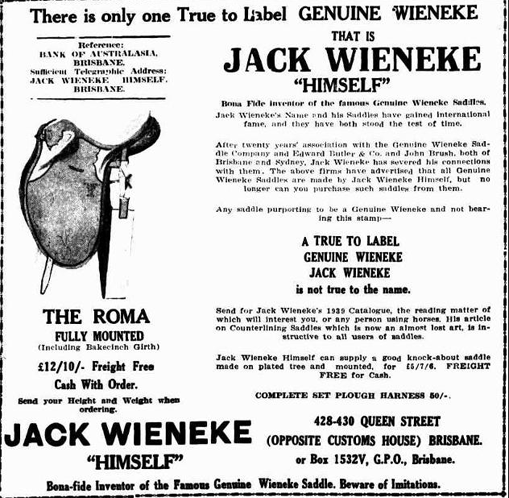
Jack obviously set up shop just down from Edward Butler, and made it known to all and sundry that he had severed his connections with "The Genuine Wieneke Saddle Co." (a trade name that Edward Butler had registered - see 1930 Advert above) Edward Butler and John Brush, Brisbane and Sydney. Above is a 1939 advertisement and below are two advertisements that he published in 1940.
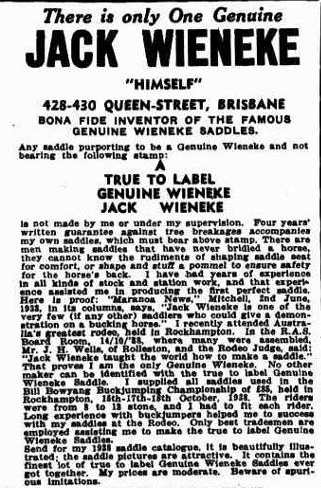
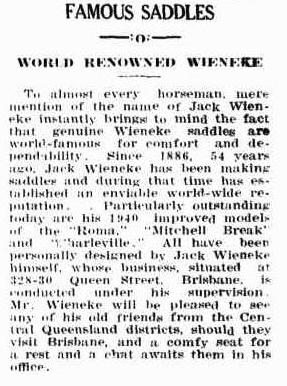
Whilst carrying on the business of saddlery, Jack loved to keep abreast of the times through the newspapers. In 1946 he wrote an interesting story on the origins of the Condamine Bell which is set out below:
John J. Wieneke, who is 84 years of age, writes as follows: When I saw the first contribution to the 'Track,' written by D.B.C. re the Condamine bell I became interested. The above contributor asked any reader to explain where the first bell came from, or, who was the first man to produce it. I felt sure this would bring many replies, and so it has. I decided to wait until all had their say, then I should say something. This I hope to give you later when my hand is sufficiently fit to write all I know about the famous bells, and I know more than any living man. Some of the contributions are incorrect, in fact none of them are correct. One contributor says the Condamine bell was made by C. Anderson in Miles. Miles township was unknown when S.W. Jones first introduced the only real Condamine bell in Condamine township. True, the first bells were made from pit saws, but never from circular saws. Jones later took on sheet metal, and the brazing was the secret of success. I notice not one of the contributors have mentioned a monogram which was stamped on all the real Condamine bells, about one inch below the staples. The monogram, S.W.J., was really hard to decipher. Many old carriers in the Sixties often called: "Here Jack, find the monogram on this bell." My eyes always found it. This monogram took not more than a half inch space. Christy Andersen, not Anderson, as spelt by contributors, was a Dane, as the 'e' in Andersen would indicate. He was one of the finest old chaps I have ever met in my life. I spent hundreds of pounds with him when he was making bells in Miles. I then had a large business in Roma. The Andersen bell was a good imitation of the Condamine bell. Miles, being only some twenty miles from the old Condamine township, caused Andersen's bells to be known as the Condamine bell. The price of the bells was— Jones Condamine, 4/6 per lb., Andersen's, 3/-per lb. A Jones bell weighing 4lbs would be at least 5lbs. of Andersen's and the side split for the overlap midway from top to bottom of the bell. The Jones bell had an upward cut for the overlap. Old Christy Andersen died at Alderley, Brisbane, when 87 years of age. He was making bells up to the time of his death. When he died his son took on making bells at Alderley, and continued doing so until he went to the war. He has now returned and has started again making bells at Alderley. Dear old Christy Andersen, when he visited the city from Alderley never failed to give me a call, and we never failed to have a few rums at the Gresham Hotel. Vale, Christy Andersen.
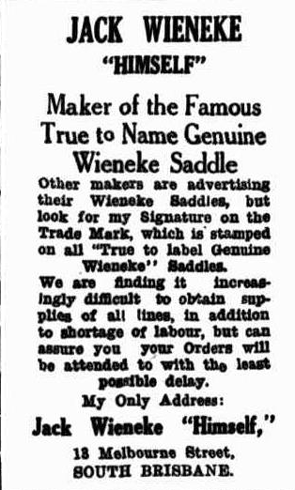
The above advertisement ran in the newspapers up until June 1948, (a year past his death). Research has not proved favourable as to whom was still trading at the same address and using Jack's name, however the company making the "True to label Genuine Wieneke" saddles was Butler Bros. Brisbane pre and post his death.
In June 1947 the sad news of the death of this very popular colonial saddler rang through Brisbane and Western Queensland alike (if not Australia wide).
The death of Mr. John Julius Wieneke occurred at Brisbane on Monday, 9 June 1947. The late Mr. Wieneke was the eldest member of one of the very early pioneer families of the Maranoa. His father was a carrier from Toowoomba in the 60's of last century, and he was born while his parents were on the road with the team between Dalby and Roma. Later Mr. and Mrs. Wieneke senior conducted a hotel across Bungil Creek, what was then known as China town, and later a hotel at Cattle Creek for many years. The son, John Wieneke, was apprenticed to the saddling trade, and later commenced in business for himself in Roma and he became one of the largest employers in Roma, his saddles earning wide reputation not only in Queensland but in many parts of Australia. As a young man he was also an outstanding athlete and competed successfully at sporting fixtures in various centres in Queensland, and had many successes in local athletic contests. He was also a keen lover of horses, and owned a number of racers and hunters. He and Mrs. Wieneke had been residents of Hamilton, Brisbane, for many years, and on a number of occasions until recent years he had been a regular visitor to his old home town, to take a look at the annual Show, at which function he had been a prominent exhibitor in many sections in the early years. He possessed a very retentive memory and wrote interestingly of early days in the Maranoa, and greatly enjoyed a chat with old friends over the early events. He is survived by his wife and two married daughters, his two sons, George and Charles, having predeceased him.
John Julius Wieneke set out to make his name "famous" and as he is still talked about today in the 21st Century, I believe he achieved that goal. May you rest in peace Jack.
One of the many poems written about Jack and his saddles:
THE OUTLAW BAY.
"He's thrown dozens of riders, he's been away with the saddle for days.
And his beat is away in those ranges, up where the brumbies graze;
So I wouldn't advise you to try him, for as sure as the sky is blue
We'll be tracking him up in the ranges after we've picked up you.
But still if you're over anxious, I suppose you have every right
To try this outlaw bay of ours, but I warn you to sit tight."
These remarks were passed by the head sarang of a station way out back,
Where I was attending the muster with my cobber, Barney Black.
"Well now," said Barney, "as you fancy the colt, perhaps you'd perhaps you'd like a bet
About this outlaw bay of yours that hasn't been ridden yet.
My mate rides in a Wieneke poley, and I've a fiver here to say
That with one hand free and the bleeders in he'll stay with that little bay."
The stake was covered there and then, by the head sarang, of course,
And said if we wanted to bet again he still would back the horse.
The station hands came trooping down, with their women folk, and all.
To see their outlaw score a win, and his rider get a fall.
I passed the Wieneke through the rails, for Barney to saddle him up,
And as I fastened the understraps on my spurs someone wished me luck.
But I knew that genuine Wieneke was built by a rider of fame,
And once into its wond'rous seat I wouldn't disgrace the name.
The saddling job was a nasty one, but that veteran Barney Black
Showed those stockyard riders how we saddle them up outback.
He saddled him unaided with no blind fold on his eyes,
While those station hands and jackeroos looked on in surprise.
He held him as I mounted, and said "Now stay there Jim,
For back home on our station you've mounted worse than him."
I sprang into the saddle, but before I got my seat,
That equine ball of fireworks started bucking pretty neat.
He did the corkscrew nicely, with a side kick in the air.
But in that genuine Wieneke I always seemed right there,
With its narrow grip to help me, and the pads that fitted tight,
That outlaw bay had Buckley's chance, and our fiver seemed all right.
But when he flew out through the gateway, propped and bucked clean round,
'Twas that genuine Wieneke poley that kept me off the ground :
I cantered him up the roadway, turned and hacked him back,
As the audience from the stockyard were trooping down the track,
Though never a word was uttered as I rode their outlaw past.
Still they all were satisfied he'd met his match at last.
So that was the end of the outlaw bay and that boss's five pound note,
But he took it in a sporting way and treated it as a joke,
But said when next he backs a horse to throw a rider of fame,
He'll make quite sure the saddle he uses doesn't bear Wieneke's name,
I'll give them a six-inch kneepad stool, or a cart if they can tie it on,
But if you mention a Wieneke poley your chance of a bet is gone.