
The Australian Stock Saddle
and the Saddlers that made them
CECIL EMANUEL BERCENE (BERCINI) 1904 - 1990
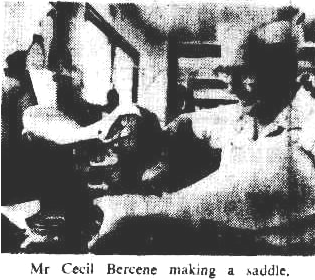
at Hiscock's Saddleworld, Canberra in 1974
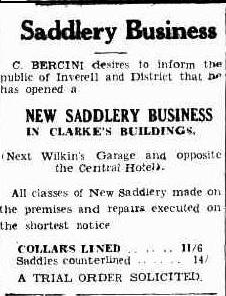
Cecil E Bercene (Bercini) was born in Inverell and became an apprentice saddle maker as a 13 year old. As there were more than three saddlers in Inverell in 1917, it is difficult to say who he was indentured with. Research shows that the Bercini's had moved from Inverell to Texas in the early 30's however, by 1936 Cec had decided to venture out on his own, and advertised that he was to commence a new Saddlery and Harness business back in Inverell.
His business venture may not have succeeded as he was found working in Talty's Sydney of an unknown date. His work, however must have been exemplary as Talty offered him a job looking after one of his stores in Bourke, NSW.
Again dates are blurred in these events, however a short write up in the Bourke newspaper finds him relinquishing his position at Talty's and starting up on his own in another part of town, in 1942. It is also interesting to note that Cecil changed his surname spelling from Bercini to Bercene and was known by that until his death in 1990.
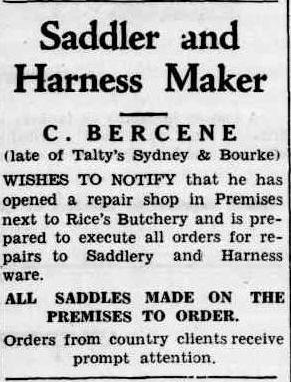
The advert above continued throughout 1942, however nothing else was found on Cec in Bourke. Over a period of time, Cecil moved to Bombala on the NSW coast, and found employment with Hiscock’s Saddleworld, doing repair work. He then went on to secure the position as senior saddler with this firm, which prompted a move to Queanbeyan. Cecil continued working for Hiscock’s until his retirement.
An article was run in the Canberra Times 1974 with input from both John Hiscock and Cecil Bercene. An excerpt reads as follows:
The most expensive piece of equipment for the pony will be a saddle. Second-hand saddles, when available, cost an exorbitant price. I have seen saddles in appalling condition bring well over the $100 mark at clearing sales.
But if a new saddle is sought then it more than likely to be made from Hiscock's Saddley, a family firm dating back to the early 1900s run by two third-generation brothers, Mr. John and Mr. Ken Hiscock. The firm operates a workroom, warehouse and retail outlets in Queanbeyan and Canberra, specialising in leather goods, travel goods, leather and fur garments and equipment for horses and Many of the saddles are hand-crafted in the firm's workroom, others are made by the Brisbane saddlery firm of Syd Hill acknowledged as the largest manufacturers of saddles in Australia, while yet others are imported, from overseas, from England, Germany and South America.
The art of making saddles could be lost within 20 years, according to Mr John Hiscock, who was apprenticed to his father John, when the Family firm operated in Cootamundra before coming to Queanbeyan about 12 years ago.
"Saddles made in Australia are pricing themselves out of the market", he said. "Because of cheaper labour overseas, and also because of the reduction in tariffs, we are able to import copies from South America of the prized German and British saddles, mainly the dressage and all-purpose styles, which are almost identical in quality and workmanship. The originals have to be sold at about $300 each while the copies can be retailed for about $185, a substantial saving".
The Australian-made pony club saddle would cost about $129 while the imported copy would sell for about $95, The one saddle which overseas saddlers did not seem able to copy satisfactorily was the Australian Poley saddle, the stock saddle, and one of these, handmade from start to finish would cost about $250, he said.
As Mr Hiscock and the firm's senior saddler, Mr Cecil Bercene, explained, there are about 25 different steps in the construction of a saddle. Production is limited to about six a week from the Queanbeyan workroom and the final cost is dictated by the time required plus the cost of materials.
Most saddles are made from cowhide. A side of leather will cost about $20 and as with a side of beef the best part is on the rump. More expensive saddles have pigskin or suede trims while others can be made entirely of pigskin or suede. Mr Bercene has been a saddler for 57 years, having been apprenticed in Inverell, in northern NSW, when he was 13. There are three young apprentices in the Hiscock workroom but Mr John Hiscock is pessimistic about the dwindling number of qualified saddlers in country areas.
"Often we hear about men who are supposed to be wizards at the craft of making and repairing saddles but after a day or two in the workroom it soon becomes apparent that they have had no grounding in the craft and their work is nowhere up to our standards", he said. Apart from making and repairing saddles, the workroom produces bridles and strapping for horses. Two beautiful old side saddles were awaiting repair and work was being done on the rebuilding of a cavalry saddle which was made in 1919.
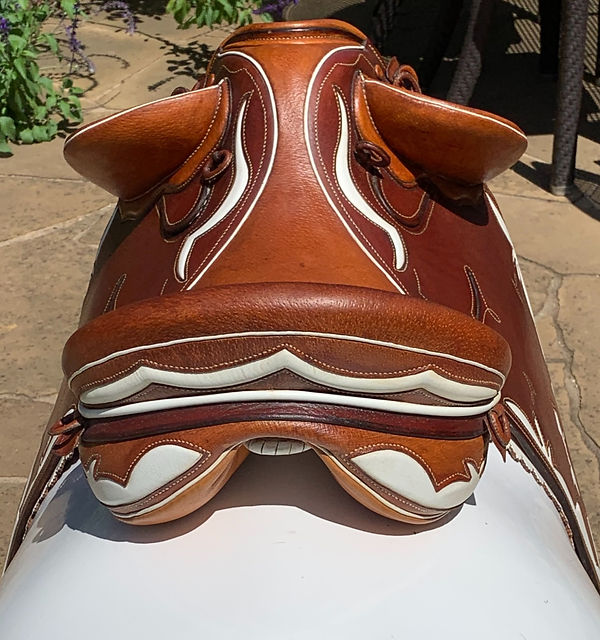
Cecil made the below pictured saddle as a gift for John Hiscock, with a pledge that the saddle never be sold.


Pics Credit: Private collection, Melbourne