The Australian Stock Saddle
and the Saddlers that made them

TERENCE W. PURDUE 1826 - 1911
T. W. Purdue was born near the River Shannon, Ireland, in 1826. It was on the November 29, 1841 that Terence Purdue, was apprenticed to Michael Sherd, in the harness-making trade in Roscommon, Ireland. The indentures of the apprenticeship document, sets forth that Terence Purdue “doth put himself apprentice to Michael Sherd, the sum of £22 10s being paid to Sherd as an apprentice fee for Terence Purdue to learn his trade, and dwell and serve with Michael Sherd for seven years, during which time he shall faithfully, serve his master and his secrets keep. He shall not contract matrimony within the said time, he shall not play at cards, dice, or tables, or any other unlawful game, nor shall he haunt or use taverns, ale houses or play houses, etc." Mr Purdue delighted in showing his indenture to people as they formed a striking contrast to the freedom permitted apprentices of the early 1900s.
Soon after the expiration of his term of apprenticeship expired, Mr Purdue at 21, emigrated to America, and remained there for fourteen years. He subsequently, came to Australia, and in the early 1850's took up his residence in Ballarat, where he founded the business T. W. Purdue, Saddler in c1860.
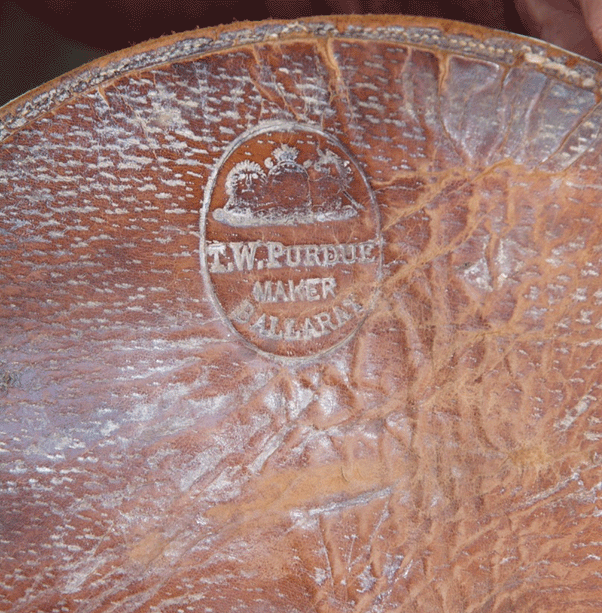
In 1865, an advertisement was run in the local Ballarat Star to announce to the district, that Messrs. Killmister & Purdue had purchased the Stock-in-Trade of the late Mr Dugald Grant, saddler, of Ballarat, and will carry forward the saddlery business in the old shop, in Lydiard Street. Over the next couple of years the saddlery thrived and many saddles and harness sets were entered into Exhibitions with numerous prizes awarded for their entries. Due to the upcoming visit of Prince Alfred, Duke of Edinburgh, the men offered to supply carriage harness for use by the Prince, during his stay at Ballarat, and this offer was accepted by the Reception Committee. The firm supplied the harness for four horses, and provided it with the necessary additions for two postillions. The harness was of a very elegant description, and was sure to impress. In 1867, Mr Purdue, who was in the Light Horse, was one of the escorts to H.R.H. the Duke of Edinburgh during his Ballarat visit. Needless to say in 1868 Messrs Killmister and Purdue received a letter from the Hon E. Yorke, equerry to H.R.H. the Duke of Edinburgh, intimating that they were to be appointed saddlers, harness makers, &c., to his Royal Highness Prince Alfred. Did this appointment come from the Duke’s observance of the elegant carriage harness or the fact that Terence Purdue was riding by his side during his visit, in his own hand made tack, or both?
Sadly in very early 1869 the partnership of Killmister and Purdue ceased with Mr. Killmister stating emphatically “another new and startling fact will be brought to light. All saddlery to be sold at the Lydiard Street shop with no connection with the business lately carried on by Killmister and Purdue”. It did not appear to be an amicable split. James Killmister continued on a saddlery business in Ballarat advertising himself as the “original and practical maker”.
Considered one of the pioneer racing saddlers of Ballarat, Purdue made, to special order, a racing saddle in which the horse Nimblefoot owned by Mr. Walter Craig won the Melbourne Cup in 1870.
In early 1871 Terence Purdue partnered up with William Ditchburn, and this business partnership appeared to work very well. Mr. Purdue was in charge of the saddlery side of the shop and Mr. Ditchburn the harness section. By 1874 Messrs Purdue and Ditchburn were given credit “for the enterprising spirit shown in bringing industries into active vigour which, but for them, might have been latent for years to come.” Some of their innovative ideas mentioned were systematic management. The different departments are all separate, and distinct —Mr. Ditchburn supervising the harness-making branch, while Mr South, an old veteran well-known in the trade, had charge of the saddlery department. There was no need, however, of an overseer, each workman having a book in which he entered the time engaged on each job, and when, say, a set of harness, is returned to the shop, the cost of material, together with the value of the labour employed in its manufacture, is checked and ticketed upon the article, and the usual trade profit added, so that, as Mr Ditchburn pointed out, the public actually had the benefit of the labour of their staff of trained workmen .This system worked well, and the appreciation of the work turned out by the firm, resulted in orders to New Zealand, Queensland, New South Wales, and Western Australia, with even several saddles for the sister colonies.
The business continued to flourish and in 1879 it was reported that the firm had developed a full size jockey saddle described as such: “A curiosity in the shape of saddles has just been turned out by Messrs. Purdue and Ditchburn of Ballarat, and consists of a full-sized jockey's saddle, for one of the Cup horses, the entire weight of the saddle, including girths, surcingle, stirrups and irons being only 1 lb. 14 oz. It may be stated that the materials are of the finest description, the seat being made of sealskin, the girths of silk, and the packing of pulu, a description of cotton grown on the Sandwich Islands.”
Even though William Ditchburn died in 1880, (at an early age of 47) the business continued to trade in the name of Purdue and Ditchburn, for some years to come. In 1883 the firm prepared to be next represented at the approaching Calcutta International Exhibition. The enterprising firm manufactured for exhibition at the great show, no less than 24 riding saddles, and an equal number of sets of harness. The former, which were composed of doeskin and hogskin, were splendid specimens of the saddler’s art, and reflected the highest credit on their able tradesman. How disappointing for Mr Purdue to be informed by a letter from the secretary of the Victorian Commission at the Calcutta Exhibition, that all his consignment of goods would be returned as foreign saddlery, and could not compete with the cheap labour produce of India. A letter from Mr James Thompson, the Victorian secretary, stated: “I am sorry to say that it has been necessary to ship the whole of your exhibits back to Melbourne. The Calcutta people showed not the slightest disposition to purchase; in fact, they would not give one half of the amounts fixed by your invoice. Here they have some splendid saddle and harness establishments, in which the native workmen receive only 1s per day, so that with the aid of first-class machinery, it is useless to attempt competition. Some of their work is really excellent and wonderfully low priced. Even the English goods which came in here free have no chance; and so, finding it quite hopeless to attempt a sale, save at ruinous rates, I have been reluctantly compelled to repack the whole of your consignments for return to the colony”. Upon arrival of the returned saddlery to Ballarat it was found that the goods were in such a state that 100 Australian pounds had been deducted from their value. Mr Purdue complained that in re packing them they were thrown indiscriminately into the cases, and were partially destroyed. A rat had apparently been fastened up in the case and cut an eight guinea saddle to such an extent as to necessitate its recovering. When despatched from Ballarat the exhibits were covered with specially made cloths, but none of those had been returned.
To add further insult to injury he received a reply from the Calcutta Exhibition Commissioners to his complaint of damage to his goods in packing them for return. The letter stated that the exhibits have not received more damage than might reasonably be expected after a double voyage, and the exposure in a trying climate like India. A small consolation to the Calcutta Exhibition, was a bronze medal, won as a prize for saddlery exhibited.
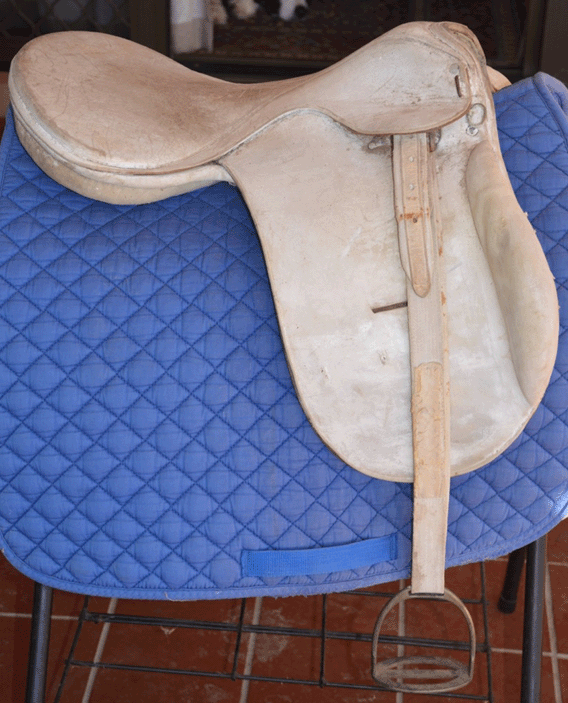
In 1895 the Ballarat Star reported that “Mr T. W. Purdue, the well-known saddler of Lydiard Street, has just finished a handsome white doe-skin steeplechase saddle for presentation to the rider of the winning horse in the Grand National Steeplechase, to be run at Flemington to-morrow week. The style of the saddle, which is beautifully mounted and bound (seal skin), is the latest, and the material and workmanship the best obtainable. The trophy, which cannot fail to be highly prized by the winner, will be presented on the course by Mr Alf Purdue (son), immediately after the race. The saddle will be on view at the shop for the next few days.” It is believed that the saddle held in the Drapac Collection is this saddle. (Jim Barbour was the winning jockey on the horse Daimio. Mr Barbour was killed in a race 14 years later).
Mr Purdue continued on with his saddlery business and the new business name of T W Purdue & Sons reflected the addition of his sons Val and Alfred officially to the firm. In 1911 the news of Terence Purdue’s death was received with general regret throughout Ballarat, where the deceased gentleman was widely known and generally beloved on account of his sterling character, genial disposition, and kindly attributes. Mr Purdue, who had reached the advanced age of 85 years, began to fail in health with a heart affection which caused his relatives some anxiety. He was for half a century one of Ballarat's best known business men, and he retained almost to the end a wonderful virility and capacity for work.
The saddlery business continued on for a number of years with the death of Alfred in 1915, however Val Purdue left the name as T W Purdue & Sons. An advertisement in 1925 had Val Purdue as the registered trading name, however it could not be found as to when the business closed its doors. Valentine Purdue died in 1970 aged 88 years of age.
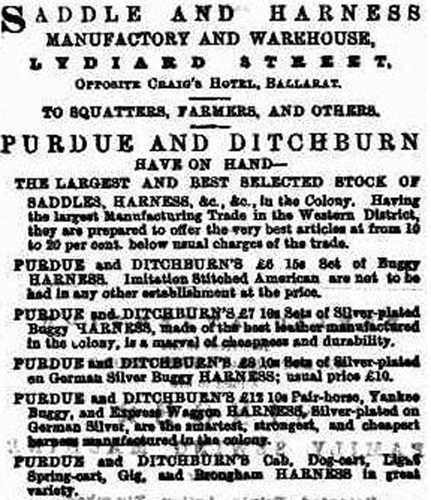
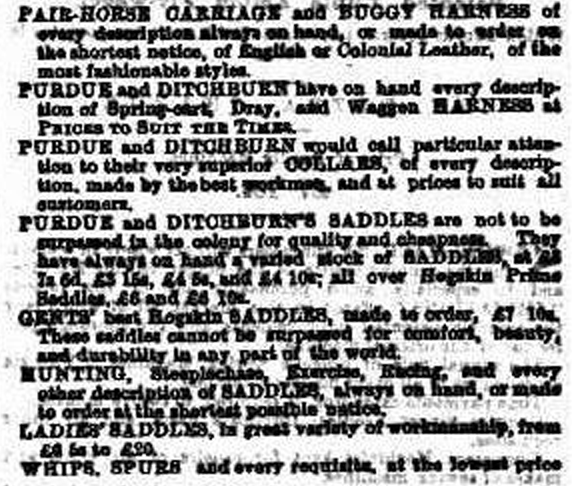
Advertisement in the Ballarat Star - 1879

Mr Terence W Purdue - 1826 - 1911
White doeskin saddle with frying pan seat and knee rolls in the style of the old "Park Saddle" design. Believed to be the trophy saddle for the 1895 Grand National Steeplechase, Flemington.
The Purdue maker's mark showing their royal appointment to HRH Prince Alfred as saddle and harness makers.