
The Australian Stock Saddle
and the Saddlers that made them
Sourced from: [Perth Gazette and Independent Journal of Politics and News, 11 September 1863]
THE AUSTRALIAN SADDLE-HORSE. (From the "Yeoman")
The following letter has been addressed to The Argus, and in it, as will be seen, the statement is made, that in the earlier days of the colony, when there were many splendid saddle horses, "the larger part was the progeny of Arab sires." The writer, however, does not name the sires. As a matter of fact we believe the statement is wholly wrong. It is perfectly true that in the earliest days of the colony first class saddle-horses were numerous, and that they could, when occasion required, perform astonishing feats, but we believe it is a fact that the great majority of those saddle-horses claimed as sires the imported thorough-bred horses named by the writer referred to further on in his letter. The subject of horse-breeding is an important one, and it may be desirable to introduce Arab blood, if any of the high-class breed can be obtained; at the same time, justice should be done to the thorough-bred English horse whenever his merits are discussed. After all that has been said, it appears that the great cause in operation to produce those wretched-looking weedy, large-headed animals which are every year increasing in numbers, is injudicious breeding. Cattle and sheep are yearly being improved by proper selection of the best animals, whilst the " culls" are consigned to slaughter. Horses and goats, however, are considered as fit for breeding purposes.
The Argus correspondent says :
" Sir, - The attention of the public has been much directed of late to that important equine variety-the Australian hack or saddle-horse. His family history, his personal character, his advance or retrogression as a type, have undergone research; and more recently Mr. Curr's able, thoughtful, and original book, has classified ideas and suggested action.
As a pre-Victorian colonist, who has bred and broken his own horses, who has ridden many a long and lonely journey, and who has considered the subject much, apart from turf proclivities, I offer a few of the results of many experiments and of long experience.
There can be little doubt, as Mr. Curr asserts, that the Australian, from his habits, of life, is the man to whom the highest type of saddle-horse is most vitally necessary-by whom such a horse is most thoroughly understood and most intelligently appreciated. It is no longer necessary in England to perform long journeys on horseback ; and, rejecting the condition of distance, no sure test can be applied to the merits of the saddle-horse.
I believe that the climate and the pastures of Australia are capable of producing a very high type of saddle-horse. I know well that such a type has been produced. It will be in the recollection of many men, owners and lovers of good horses, that in the early pastoral days of Victoria, saddle-horses of great value were comparatively plentiful.
The horses of which I speak were compact, powerful, fast, handsome, hardy, and high-couraged; difficult to overweight or to over-ride; impossible to "put wrong" (as the stable phrase runs) in saddle or in harness. They performed with ease the rapid and violent work "of the period," fed only on the natural grasses, and unsheltered from winter-storm or summer-sun. Most of them at need would have carried a heavy weight a hundred miles in a day. Some had been known, on good evidence, to have exceeded that feat. In all trials and exercises to which well-bred horses are thought to be adapted, except those of the modern race-course, they stood unrivalled.
Of these matchless saddle-horses not so highly prized as they would have been had it been known that no similar generation was arising to supply the places of the old favourites-the larger part was the progeny of Arab sires; whether of high or of low caste cannot well be known. If the latter, as would seem to be most probable, it is certain that, from climatic influences, the nature of the pasture, or the " hit " of the cross with half-bred English mares, their descendants, whose performances I was in a position to verify, were sufficiently "high caste" to satisfy the most exacting horseman. It was commonly held among those well-qualified to judge, that they combined the docility, the courage, and the stamina of their Eastern sires, with the bulk, the power, and the stately height of their southern dams.
All the celebrities of that nearly extinct tribe were not of Arab paternity. Many owned sires of pure English blood, either imported or bred in Australia. They were not inferior in vigour or brilliancy to the half-Arab, or I had almost said, to any horses under the sun. If there was a shade of difference, perhaps the half Arab had the advantage in hardihood and longevity as a worker. But he would have been hypercritical who found serious fault with the stock of Peter Fin, Wanderer, Whisker, Hector, Camerton, Traveller, Romeo, or Cornborough-in the qualities which go to the making of a good saddle-horse in all countries. And it must be remembered that the English blood sires, imported to the colonies in the earlier horse-breeding days, were as a class much more closely allied in shape to the saddle-horse they were expected to produce, than is the interesting invalid known as the modern thoroughbred.
Horse-talk is difficult to keep within bounds, so luxuriantly suggestive is the subject. But considering the claims of space, I must content myself with affirming, as far as my judgment goes, Mr. Curr's idea of creating a breed of Australian Arabs to be sound as well as original. I would also put forward a plea, though apparently opposed to the former principle, in favour of colonial bred sires-not thorough-bred-but known to be exceptionally talented as saddle-horses. By such an application of the natural laws of variation and selection, the American trotter has been produced, now a distinct and successful type. Why not the Australian saddle-horse? It may be questioned whether it be desirable that a horse should be able to trot a mile in less than three minutes. But the American public desire such a horse, and the American horse-breeder has produced the animal to order.
Now here we have the fastest trotting horse in the world, high in quality and sufficient in quantity. How is he bred? I think if we examine the evidence we shall find that-" wanted a horse low in the two thirties," or likely to trot a mile in two minutes and thirty seconds, or less-our American cousin, possessing a mare of provincial celebrity as a trotter, does not secure the services of a "clean thorough-bred" sire, whose ancestors have long abandoned trotting as low, and who could not himself trot ten miles in an hour to save his life. No, he selects Black Hawk or Ethan Allen, as the case may be, who has trotted his mile in two minutes and twenty-seven seconds. The foal, so descended, takes to trotting as a pointer pup to the indication of partridges, with a resistless natural aptitude only needing practice to develop into talent.
In spite of the great English dogma, as applied to all sorts of horse-breeding, "blood is everything," I think that we might in some respects modify our creed with advantage as to the production of the saddle-horse-an animal likely to rank with extinct forms, "and we take not the better heed."
"HIPPODAMOS"
1850 photo of a racehorse in early Australia by Francis Niven
Photo Ref: Uni Melbourne Arch

Sourced from: [Shoalhaven News, Nowra, 17 July & 24 July 1940]
THE STOCK SADDLE'S STORY (BY "FREELANCE") Part 1
“Hiding along till the day is dead,
And a million stars shine pale,
I list to the night birds overhead
(As they chant a dirge for the day that's dead)
And the fierce-eyed dingo's wail.”
I was going to say I was born in a town called Warwick in Queensland, but, as a matter of fact, I was not born, I was made there. One day a lanky drover, followed by a blue cattle dog with a white patch on its back, walked into old Tom Morgan's saddler's shop in Warwick. Tom has made saddles for rough riders and stockmen all over Queensland, and the owner of a first class Warwick saddle made by Tom was never afraid to have it overhauled, for it was the last word in saddles. "Say, Mister," said the drover, "1 want you to make me one of the best saddles in Australia. At least, Dusk here (pointing to the dog) wants you to make it." Old Tom had met all sorts and conditions of men in his day. Some were properly haywire, others, as Tom used to put it, didn't get their right change, and so he looked the newcomer over intently, without answering. To his surprise he saw two brown eyes looking steadfastly into his, and a face that said Man—with a capital M—as plainly as possible. Then he looked at the dog. "Funny marked critter," he ventured, sparring for an opening. "Yeah!" replied the drover. "He's bin up against it, and he wants to pay back a little of the debt he owes to a young chap who stuck to him when he was down and nearly out. He's earned good money the last twelve months, and he wants to buy a saddle that will be better than any other in Australia." . "It’s a tall order," slowly remarked the old saddler. "I guess you'll pay cash for it." "No! Damn it all," returned the drover, "didn't I tell you Dusk here is ordering the saddle, and HE'S going to pay for it. He earned every penny of the money himself. Course you know, mister," he went on, "sort of confidentially, I look after it for him, because sometimes he goes away spending his money foolishly, and some of those pom flappers, or other flash females, will take him down for it. So I look after it." The old saddler smiled. ."What sort of a saddle does he want?" he risked, "Well, mister, it must be the best in Australia, and as you say that's a tall order. The tree must have the biggest sweep you can get, and it must be one of the best. The seat must be hogskin. No imitation, mister, with bristle marks made by a punch, and which’ll wear off after a month or so. It must be a 'gen-u-ine' English hogskin. The flaps must be the best English leather, and the naps the best English leather, and the flaps over the stirrup bar must be fancy stitched. The skirting along the cantle must be two inches wide. The pommel D's must be of solid brass, with a brass plate to stop the flap from lifting over the D, and they must be riveted through the tree, so that even Old Scratch himself couldn't pull 'em out. The rings for the breastplate straps must be brass, and stitched firmly to the panel in front. The knee-pads must be medium sized, and as hard as a bull's forehead, and so stitched that they won t get soft when they're wet. The stirrup leathers must be the best English leather, with a brass buckle; and solid brass runners. The stirrup irons must be three bar solid nickel, while the girth must be a folded one, and the surcingle must also be of the very best English leather. Everything must be hand stitched throughout. The lining must be the best, and it must be stuffed with baked curled horsehair, that'll spring in and out when you press it. "And how much do you expect to pay for a saddle like that?" said Tom. "Why, stone the crows, didn't I tell you I don't expect to pay a damned penny," laughed the drover. "This blooming dog is going to pay for it all, aren’t you Dusk ? " The dog replied with a bark. "Well, " answered the old chap slowly, "I make a first class saddle for seven pounds, and it’s seldom that anyone wants a better one. "
But a saddle as you have described would be worth fourteen pounds." "Make it fifteen," said the drover, and to the astonishment of the old saddler, he peeled two five pound notes off a bundle, and gave them to, Dusk, telling him to hand it to Tom. The dog went up, and putting his forepaws on the old saddler's knee, waited for him to take the money. When he did so, the drover said, "He's giving you this as a deposit, and you can make out a receipt in his name." The old chap began to see the light, and as he wrote, "Received from the dog, Dusk, ten pounds deposit for a saddle to cost fifteen pounds," his eyes dimmed, for he could how see that this was a debt of gratitude. "Here y'are, old fellow," he smiled, when Dusk put his front paws back on the old chap's knee to take the receipt; and taking the dog's head between his toil-worn hands, he continued, "You can bet your last shilling that the saddle that beats the one I'll make for you will have to be some saddle." Dusk barked his thanks, and then the young fellow asked, "When'll we call for it?" "'Bout a month's time," said Tom, as he watched the two depart. Sitting down, he smiled as he said to himself, "Well, I never made a saddle for a dog afore, but now I’m going to make one of the best in Australia." So next morning I was begun. Tom looked over pieces of leather here and there, and chose only the very best. What he didn't have, he sent for to Brisbane. Each day I grew more and more, till the time came to put in the stuffing. Old Tom's apprentice always teased out the curled hair, but the old chap had become so absorbed in his task that he wouldn't allow anyone to touch a part of me. Piece by piece he sorted out the baked hair, choosing a bit here and rejecting a bit there. At last I was finished and put on a saddle stand, and old Tom stood back to admire me. "Dusk’ll be tickled to death," he laughed under his breath He stamped his name deeply on the saddle flap. He had lots of offers for me, and when he told one big burly squatter a dog had ordered me, the squatter walked out saying, "Poor old Tom: he's gone upstairs."
But old Tom and I knew all about it, and when a lanky drover and a blue cattle dog with a white patch on his back, walked into the shop, both of our hearts skipped a beat. ... The young, chap handled every bit of me, inch by inch, and then turning to Dusk, said, "Struth! But he did it; yes, he did and there's not another saddle like her in Australia.' Then, pulling out a five pound note and handing it to Dusk, he said, "You'd better square up and thank Tom." The dog seemed to sense that the old man's heart was full, for he crept up softly and rubbed himself against the old saddler's legs as would a cat, and then, putting his two paws gently on his leg, waited for him to take the money. As he did so, the old fellow said slowly, as he once more took the dog's head between his two hands, I hope your friend gets as much joy out of that saddle as I had in making it" The drover looked on, but never spoke for some time. He seemed to be revolving many memories. At last he said. "Would you do me a favour please? I want; you to write these words on a label, and tie it to the D of the saddle: 'To my old pal, in memory of bygone days I earned every penny this saddle cost Dusk. Slowly the old fellow wrote out the message on the label, and tied it on to me. "Would you mind telling me the story? " the old saddler said. 'That is if it’s not a personal one. Every stitch I put into that saddle made me wonder. "
"Well", replied the drover, "I couldn't tell the whole of it, for I lost Dusk for three years, but 1 heard he was the wonder dog of those parts. I was helping to bring a mob of stores to Gundowadah Station, and after we crossed the border at Brenda, we made on to the Bree and camped. Here I got typhoid fever, and had to go to the Goodooga hospital. Though I was delirious for a good while, my dog stuck to me, and would sneak under my bed at every chance. They chased him out repeatedly, but he'd sneak back. Then some Hun scalded him, and he crawled to where we had been camped, on the Bree to die. That's what put that white patch on his back. Another mob was on the road, and Bluey, as I called him then, crawled up one evening at dusk to a young lad who was lying asleep on his waterproof, and licking his hand, woke him. To make a long story short, the young fellow looked after him, and called him Dusk, because he came to him at dusk. Bluey was with him for three years. Then, one day, near Whichione Station, I happened on to the outfit he was with, and the dog went wild with delight when he saw me. The young fellow pleaded to keep him, and nearly persuaded me to let him; but as Bluey was also my mate, I couldn't let him go. He offered me money and a stockhorse and had me so cornered that at last we agreed to go out on the plain about a mile or so from the camp, and the one he followed was to keep him. Neither of us was to speak or make a sign. I'd rather not recall what happened, and what that dog did, mister; but in the long run, he followed me, and ever since I have always called him Dusk. "Sometimes, when the twilight softly gathers, and the shadows creep round, and the dusk deepens, he sneaks up and licks my hand, and whimpers, and gives little short howls, and I know he is thinking of the chap who stuck to him when he was down and out. He rests his head on my knee, and looks up wistfully, and, mister, I guess he's been trying to tell me he wanted to send his old pal some little token to show that he was not an ingrate. We had a good run this year, and the other night we talked it over, when he whimpered more than he was accustomed to do, and at last we decided to use the money Dusk had earned and buy a saddle." Then, thanking him, the drover picked me up and walked down to the big store. There he bought a packing case, and carefully put me in it, with straw packing, so that I couldn't get scratched. Then he got the storekeeper, to address me to a young chap on a station called Bullawalla in New South Wales. Taking me to the train, he paid the freight, and insured me for fifteen pounds, much to the surprise of the porter, who said he'd never heard of a saddle worth that much. I felt very lonely in my dark house, and wondered what the people in my new home would be like. I arrived at Bathurst in, New South Wales, and carrier Fred Hodges loaded me on to his horse-waggon, along with other loading for Bullawalla, saying, "I wonder what in 'ell's in that case? She's not very heavy." Then, two days before Christmas, which fell on a Sunday, I arrived at my new home. All hands and the cook gathered round to help off with the goods, and when Hodges said, "I don't know what's in this case. She's pretty light, but it's for the young fellow, " eager hands soon had the case open, and when they pulled me out, bursts of admiration came from everyone! My young master caught sight of the label, and when he read it a change came over his face. As did the drover when the old saddler talked to Dusk, so he stood revolving many memories. Pulling the label off, he took it inside and pasted it in a big scrap-book. With the back of his rough hand he wiped away a tear, and I knew why, for had I not heard part of the story that lay behind it all. Charlie Hunt, the head stockman, said, "It's the best saddle I've ever seen, or likely to see again," and when my young master came back, and looked me over, he said wistfully, "Isn't she a beauty?" I felt very proud, and when the rest of the stockmen reckoned there never was my equal in Australia, my cup of happiness was full. After dinner my young master said "I'll break her in right away." I didn't understand what he meant, but I soon found out. With a sopping wet rag he wet the hogskin seat and the top of me till I was saturated, and then, putting me on a horse, got on and rode along for miles with his feet out of the stirrups. This was so that I should "fit him," as he put it. When he got back home I was dry. Then he got a tin half-full of neatsfoot oil and mixed it with a similar portion of goanna oil, and rubbed every bit of me with it, and put me away on a special saddle peg. On Sunday he gave me another good coating of oil, and putting on an old pair of pants rode about till the oil was well dried into me. After several dressings I began to change colour, and became a rich brown, and now I was indeed a thing of beauty, and the envy of all the horsemen in the district. Every time after I was used, my master, when at home, put me on a special saddle peg, and covered me with a cloth, on top of which was put the felt saddle cloth. And so my life, which has been a very varied one, and part of which I hope to tell you next time, began. It has been grave and gay, happy and sad, and my master and I have ridden many trails across the furrowed tracks of the gray old world. When headstrong youth would have its way, I have watched him when he has done those things which he ought not to have done, and left undone those things which he ought to have done. But in later years I have heard him say,
Forgive, O Lord, the wrong I've done or said,
Or when I thoughtless erred or turned aside;
Guide me, O Lord, along the unknown trail ahead,
That stretches upwards towards The Great Divide.
Part 2.
"Twas pleasant in the rosy dawn,
Amongst the gleaming grass,
To wander as we've wandered many a mile,
To blow the cool tobacco cloud,
and watch the white wreaths pass,
Sitting loosely in the saddle all the while."
And now I shall relate some of the happenings in my journey down the trail. My first experience on the road was a trip with old Bill Woods's outfit from Mitchell, in Queensland, to N.S.W. Retrospection brings pleasant memories of night watches, and camps 'neath the wondrous glory of the everlasting stars. When the weather was hot, I was often used as a pillow by my master, for then most of the men took to the open. I hope you won't think I am trying to set myself up as a know-all, but I have seen hundreds of men use their saddles for a pillow, and not everyone used them the right way. The correct method to make a saddle-pillow is to turn the saddle over, with pommel and back of saddle touching the ground. The pommel must be furthest from your head, for the cantle is used as the pillow. A coat or small log is placed against the flaps on either side, to keep the saddle from rolling sideways. A folded coat is placed in the cantle, and there you are. I have seen men use the saddle the other way round, and sleep between the flaps, but those who have tried both ways vote for the cantle as a pillow. I must modify this statement, for it has just occurred to me that I have seen my master use the saddle the wrong way, when he had only a small piece of mosquito net. Then the flaps kept the net off his face, but he would say, "My oath, it's hot!" While I am talking of cattle camps, have you ever seen the whole of a mob down at one time? I have followed behind many mobs of cattle, and watched them bed down on a camp, but in all of my experience I have never seen every beast down at the same time. I have seen some clever scrub dashers in the forest country, or where the gidgee or myall was thick, when there were scrubbers to yard. When I first started at this scrub dashing, my heart missed a beat as the knee pad just flicked a sapling as we dashed past. How often have I heard Charlie, the head stockman, say, "All a man has to do is to keep his head. No horse, unless it has defective eyesight, will dash into a tree, but if the rider tries to pull a horse off a tree, that he THINKS the horse is going to hit, it is on the cards the horse will hit another." The great danger is from an overhanging branch. As long as the horse can go under it, he does not think about the rider above him. I remember once being in a party that was searching for a young fellow who had been out after a mob of brumbies near Warialda. The men tracked the shod horse amongst the hoof-marks of the brumbies, till it got too dark. So we camped. Shortly afterwards we heard a dog bark only a quarter of a mile away, and when the men went over, they found the young fellow dead, while his faithful cattle dog was barking at a native cat up a sapling, that he had driven from the dead body. His horse was lying dead not twenty yards away. It had evidently misjudged the height of an overhanging limb. I can recall a little incident that happened to me, and which caused my young master much annoyance. A mob of bullocks had been put into a two hundred acre paddock bordering the Macquarie River. It was a lush season, and a crop of variegated thistles grew, reaching seven feet in height. The cattle were in good condition in a couple of months, but it was impossible to get them out of the forest of thistles, and so willy nilly, they had to stay there till the thistles died down. When we went to get them, we took about fifteen coachers. Amongst the mob was a big piker. Do you know what a piker is? He is a bullock with horns so long that he cannot get through the scrub. 1 have heard men call others pikers, because they wouldn't come up to the scratch. They would say, "Oh, he's a piker. He won't come through." After we got the rest of the mob out, we drove the coachers back to get the piker. Then, for the first time, I saw a bullock thrown by the tail. Riding at the bullock, and making him break into a gallop—the faster the easier to throw—my master caught him by the tail, and over he went. Which-i-one propped dead, and throwing himself off, my master had the bullock's legs tied above the hocks in a twinkling. Then he couldn't get up. Do you know why? Well, a beast always gets up on his hind legs first. He must spread them apart to get up. When his hind legs were tied, he had to stay put. A horse gets up on his forelegs first. I have heard my master say there is a picture in the Sydney Art Gallery showing a country scene in England, and it shows a cow getting up on his front legs first. We then drove the mob of coachers up to the piker. My master, with his horse close by, undid the strap, and was back on his horse in two shakes of a lamb's tail. The piker jumped up, but no sooner had he done so than he charged, and with his long horn put the ugly six-inch scar which you can see on my flap. Other men soon quietened him with their whips, leaving my master looking at the scar, and I am sorry to say he used some language that is not in common use, and cursed the piker back to his great great grandmother. Personally, I am proud of that scar, for it shows what a close call we had. I can call to mind another bit of bad luck. Gundowadah was holding a big sports meeting for the funds of the Bathurst Agricultural Society, and had staged a big rodeo. Ten pounds was the prize for the best buckjump rider. I was all of a dither when my master's name was called to ride The Sky Pilot. Carefully I was put on him in the crush, and I trembled a little as I felt my master getting his seat. The gate flew open, but bad luck dogged us. The Sky Pilot fell on his knees, and my master accidentally touched me. I secretly hoped that no one had seen it, for he rode the horse, but my heart sank when the barker announced that my master was disqualified for touching me. I will relate one more incident before I tell of happier times. One dark night my master rushed in, grabbed me, and threw me on to Which-i-one's back. Charlie's—the head stockman —wife was dying. "Take the bridle track." someone shouted as we dashed off fourteen miles to Hill End for a doctor. Don't you let anyone persuade you that horses can gallop twelve to fourteen miles. It just can't be done. I have been on the backs of some good horses, but I think I must give the palm to Which-l-one. He tossed his lean, game head as my master said, "We must do the trip faster than we've ever made it before, old pal." Up the hills and down the ranges the game horse forged on in a long lope till the lights of The Hill showed. We brought the doctor back, but Charlie's wife had reported at The Great Head Station.
And now for something more pleasant. I hope my master will not mind my telling this, and that he will pardon his old pal. He was only a youth, and like most youths was a bit vain, He was fond of dressing well. One day he put me and some clothes, etc., in a big bag which he called his roadbag, and we took rail to Dubbo and caught the coach for Coonabarabran. We got out at Merrygoen—a little wayside village. When we arrived at the pub kept by Tom Richardson and his wife, the latter showed my master to his room. Carefully he put me under the bed and locked the door. Tea was ready in the big dining room, and as the weather was cold, a big log fire was blazing. After tea the three or four who had been there for the meal drew up to the fire. As it was Saturday night, numbers of men began to filter in about 7.30, for closing time was then 11pm.
As my master stood up by the fire, tie, collar and all complete, and looking as though he had just come out of a band box, a young red-headed chap who had happened in gave a low whistle, as he remarked, "Excuse me, ladies and gentlemen. I didn't know royalty was present." Mrs. Richardson, good motherly soul, who was sitting by the fire darning socks, looked up and said, "Don't you start any of your nonsense here to-night, Ned." Redhead replied, "I sure won't, ma'am; but you might have given us the tip that you were expecting royalty, so that I could've put on me glad rags." Sidling up to my master, he ventured. "You from the city?" Smiling, he replied, "Yes, how did you guess?" "Where you heading?" was the next question. "To Calga Station," my master answered. "Going jackerooing there, I s'pose?" continued Redhead. "Yes," was the reply, "but I'm dashed if I know how you found out." "Oh, I'm the Sherlock Holmes around these parts. Anyone can tell you that, and I'll give you a tip: Look out for the young gins up there. When they see you, they'll rush you like flies at a saucer of bullocky's joy. (Golden syrup). Quickly my master replied, "I was never told there were blacks up there, and I'll catch the next coach back. Redhead had scored. "And," he continued, "if you don't watch your step, some jealous buck black will sneak on you and spear you." Everyone but Mrs. Richardson and my master laughed loudly. "That settles it," my master replied, in a horrified tone. "I thought the worst things there were kangaroos; you know, the animals that carry their young ones around in a pocket." This caused a titter round the room. "Sure I know 'em," winked Redhead. "Why, only last week I was out with a posse hunting one down that had kidnapped a little black piccaninny which it stuffed in its pouch and carried away. It put up a great fight when we surrounded it, and when Big Bill here—pointing to a jovial faced man with a black beard—called on it to surrender, the damned thing rushed him, and it was lucky we had our guns. Ain't that gospel, Bill?" he asked. "Yes!" replied Blackbeard, amidst much laughter. "Ain't you got a gun?" continued Redhead. "No," replied my master in a frightened tone, "I didn't think I'd need one, but, er-er, you can be sure I'll go right back on the first coach." This brought more laughter. Kind-hearted Mrs. Richardson could stand it no longer. Getting up, she said to my master, "Come on, and I'll show you your room." Now she had already done this, but he guessed it was an excuse to get him away from his leg-pullers. When she got outside, she put her hand on his shoulder and said, "Lad, don't you take any notice of them," and then she explained that it was all rot. "Come here, missus," he said. "I, thank you for your goodness of heart, but look herie." Opening his room, he dragged his bag out and pulling me out, said, "I was born and bred on a station, and I earn my living in that saddle. I am going to Calga to pilot five thousand sheep through to my dad's place, for agistment. Moreover, I've lived amongst and worked with blacks since I was knee high to kangaroo rat, and I cut my teeth on a stockwhip handle. Someone from Calga will call for me to-morrow morning." I shall never forget the way they both laughed, and laughed, and laughed. When she got her second wind, she called her husband out and told him. Slapping his thigh he roared, "It's the best flaming joke I've ever heard." Then turning to me, he said to my master, "Where'd you get this?" I've never seen a man go into such raptures, and I was very proud. Now it happened that a chap called Mick had issued a challenge to run anyone half a mile, for half a tenner on a half-bred draught horse. Richardson had taken it up, and after asking my master to ride his horse, said, "This'll be the best joke ever, even if we lose. I needn't tell you to keep it up when you stroll over tomorrow morning at 9.30." The bush race course was directly in front of the pub. Handing three pounds to him, my master said, "That's all I can spare, but get that on for me." Next morning—Sunday—fifteen to twenty men had gathered on the course as my master turned up. Redhead and Blackbeard were there, but were too engrossed in an argument as to whom Richardson could get to ride his horse. He was too heavy himself, and the only other rider available was backing Mick's horse. Walking up, my master said, "If you please. Mr. Richardson, will you yet me ride him? I can stick a gallop, for I had a good few lessons at a riding school in Sydney." Blackbeard shook the ground around him laughing, and when Richardson said "O.K.," he shouted 2 to 1 against Tom's horse. Immediately Tom took it, and as much more as he could get. When my master brought me along, Redhead said, "Gawdamighty!" They gathered round me, while my master explained that his grander father had brought me from England, and had given me to him to go jackerooing on Calga. Carefully Tom put me on his horse, the while my master took off his coat, waistcoat, collar, tie and shirt. As he put on a pair of goose-necked spurs, the smile died from Blackbeard's face, for, to use Tom's words, "He smelt a mice." It was a hard race, but we won by a length. Then Redhead did his block. If you want to know the character of a man, just keep tab on how he loses. Going up to my master, he said, "You think you're damned smart don't you? I've a good mind to knock you down." "I wouldn't do that if I were you,' was the reply, "for the chances are I'll get up again." That tore it. It wasn't a fight, for my master won it in a quarter of a round: Jovial Blackbeard shook hands with him, and said, having heard the story from Tom, "The joke's on us, lad. Next time we put one over, we want to be sure it ain't on a bushman." My cup of happiness was complete when a chap drove up in a buckboard and shouted. "Is there a drover here named —?" and my master answered. "Right here!" The swift years have come, and the swift years have gone like leaf on the current cast, and it was a sad, day when my master, who is growing old, said to me, "We've camped and battled together for many years, old pal. Which-i-one has joined the last round-up, and our days on the trail have come to an end, for,
No longer doth the earth reveal
Her gracious green and gold,
I sit where youth was one, and feel
That I am growing old.
Cleaning me carefully, he put me on a peg with the quart-pot in its leather case on the off side of me, and the saddle pouch on the near side. Then he oiled the stockwhip, and hung it up near me. I am glad if this, for I often feel lonely at night.
"But most when the wailing curlews call over the dark lagoon,
And out of the ring-barked timber comes blazing the red, red moon"
Of times when the shadows lengthen my master sits and looks wistfully towards the setting sun, and I wonder what he sees on the far horizon, or on the other side of it.
"Does he see in fancy his childhood home,
Where the roses twine, and young feet roam?
Does he dream of lost youth, its steps retrace
Down golden paths where old age has no place?
Does he dream of dead loves, of soft brown eyes,
And fair faces that waken sweet memories?
Or does he dream of a golden strand,
Where meetings shall he in a better land?
Now what does my master dream?"
I have happy hours when he comes to work in my shed, at some little hobby and sings snatches of long-forgotten songs. It cheers me when I hear the old refrain,
"When the moon's behind the mountain,
Just before the day is born,
We will saddle up our horses and away,
And we'll yard the wild scrub cattle at the breaking of the dawn,
And brand the little calves the next day.
And so, with the stockwhip and my master,
Very wistfully we listen for the silent step to come,
Of Death, the boundary rider, by and by.
To put us o'er the border through the golden stockyard gate.
For The Great Head Station muster in the sky."
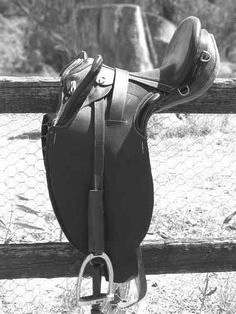

Sourced from: [Dubbo Liberal and Macquarie Advocate, 12 July 1932]
MY OLD SADDLE by J. A. Keating
Old saddle, true friend of the ranges,
You are covered with dust through neglect,
Unheeding the world and its changes,
Or the care, that your worth, might expect.
'Too old' was the message he gave me,
As I stood at the rails on my own;
Past deeds, if remembered, might save me,
But a glance showed how old I had grown
I lifted you then to my shoulder,
As for years I had swung you before,
Both saddle and man growing older
Till a day I shall need you no more.
He was new to the ways of a station,
One day was enough for old- hands;
He could talk on the wants of a nation,
But know little of cattle or brands
Old age seems a motion of censure,
To obey gives a wrench to the heart;
Still, tis said that all life is a venture,
And youth in due time must depart.
My route leads me still to the West,
On a track I am needing no guide;
Perhaps it is all for the best;
For some day must come my last ride.
I'm, leaving the station to-morrow,
A man in my place has been hired;
I leave you, old saddle, with sorrow,
Where I go, there's no saddle required.

Photo Ref: Widden Stud
Queensland Figaro and Punch (Brisbane, Qld. : 1885 - 1889), Saturday 25 August 1888
On the New chum.
By the Pilgrim from the Bush
THE new chum, as a rule, is produced in a country which he calls "home," and, when he arrives in the bush stone broke, he expects to make a rapid fortune. You may always know a new chum when he reaches the station to which his friends had consigned him, much as they would a case of damaged goods, by the material he brings with him. It would take four pack horses to carry this material which consists of gorgeous neckties, white waistcoats, and patent leather boots, ivory-backed brushes with his initials on them, and other similar luxuries of a bygone and barbarous age.
His first request to the boss is that a bullock waggon may be sent to the railway to bring up the rest of his luggage, and it is some time before he gets to understand that an ordinary "Bluey" must in future suffice for the carriage of his personal adornments.
On the night of his arrival he dresses for the supper under the bough-shed hut. When he discovers that an irate cook has swept away the dainties, annoyed at his delay, the fact reaches his soul that he has made an ass of himself, and he never repeats the ceremony.
The new chum speaks a language peculiar to himself, which is hard as Volapuk for a Pilgrim to learn, but he is always polite, and, later oh when he has mastered the Barcoo tongue, and has inadvertently let his end of a skid fall to the ground before the other man was ready, he will use as fiery expressions as the latter will.

But the difference may be noticed at once, for the new chum will tell the other "to aw bloomin' well go to aw Old Nick" in so sweet a voice that the on looker cannot but admire him.
When camping out for the first time he takes every precaution to see that the spot on which he lays his blanket is free from stones. The smallest pebble underneath the tender body of a new chum will disturb his rest, and, of course, he is idiot enough not to know the meaning of a "hipper". But after a few months he will lie down in the middle of an old sheep yard, and enjoy the sleep of the Righteous Pilgrim. This is because he is ever willing to accommodate himself unto circumstances.
So much is this readiness noticeable that there is a story told about a new chum who got bushed while out kangaroo shooting by himself. He was in a fenced paddock, and had a horse with him; but, when night came on and he reached a water-hole, he was satisfied. He did not see the use of travelling about farther in a vague manner—not he. He shot the horse, made some steak from it, and sat down contentedly to smoke his pipe until someone came to find him. When his boss raged at him, the new chum merely asked what the value of the horse was, and said he would write home next mail and ask for the money to be sent out. For my part I am inclined to discredit this yarn, for a new chum, as a general rule, is too fond of a horse to eat of it on so short a notice.
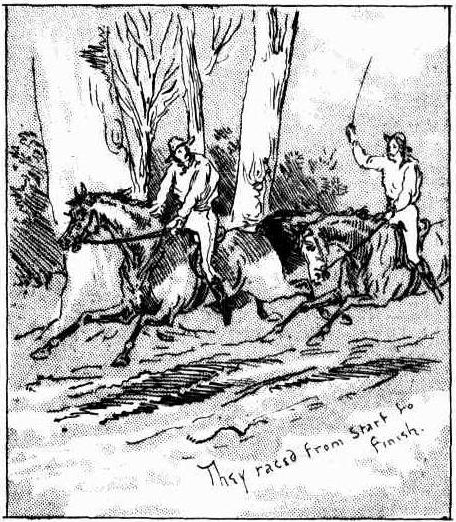
He is as fond of a horse as any bushman can wish for, and his great delight is in racing. Hence the careful station manager will never send two new chums out together, knowing that once out of sight of the homestead they will improvise a sort of miniature Melbourne Cup between themselves, and in their ardor for the sport will gallop from start to finish.
At first a new chum is very scornful while conversing on the topic of saddles, and will express derision at the knee pads of the colonial make. But when once he has come to grief while pursuing a wild bullock through thick scrub, being at the time on an English made saddle, he will forever after hold his peace. There is nothing like an experience of this sort to teach a new chum ordinary sense. It licks all argument into fits.
Almost always the new chum is a good shot with a gun, and, after three or four days of observation on the creeks, he will go out by himself on a Sunday afternoon, and by sundown will have brought home as many ducks as it would have taken the oldest hand on the run a fortnight's hard work to kill. The only thing which baffles a new chum at first is the turkey of the plains. He is always expecting the bird to take wing, whereas the wily object of his sport refuses to do anything but stride along through the grass. A new chum thinks it beneath his dignity to shoot at a bird before it rises. Nor is he very keen about possum shooting by moon light.
After a horse, the creature he is fondest of is a dog, and, if he is on a sheep station, he will insist on giving directions to the collies, no matter how much the old shepherd may storm at him. Should he be working on a cattle run, you may bet he will own a fox terrier of some species before long, and then, his delight will be in finding something for his favourite to kill. Even the overseer's cat will prove an object for this attention.
"When the new chum goes into the township for a spell, he will make himself agreeable to everybody (if allowed), more especially to the fair sex. You may see him dancing at a pub ball with the slavey or flirting with the P.M,'s pretty daughter, but, while enjoying himself he will not allow interference from others. A new chum is apt to be as ready with his fists as any shearer, and also six times as skilful. He also detests being addressed as "Sonny" or "Mister", but won't mind being called a "Silver tail" in the least. This is because he does not know the meaning of that word.
I could say a lot more about new chums but time will not allow. Some there certainly are who, hate a life in the bush and who drift into the towns, spend what money they may have at the bars, and then begin to abuse their luck and the colony. I don't admire this lot, but the general sort with or without an eyeglass is very different, and 1 am proud to say that I have met many a new chum in the bush whose hand-shake I have valued more than I would one from H.R.H. Prince Teddy. I have danced in their company, drunk with them, sung with them, camped with them, and to them would I now say,
"Dear chummies and Johnnies (1 believe that last word is genuine new chum language), so long."