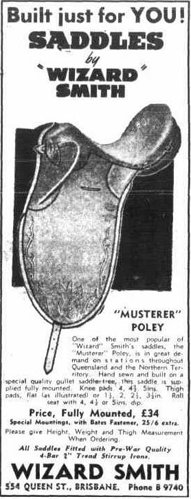
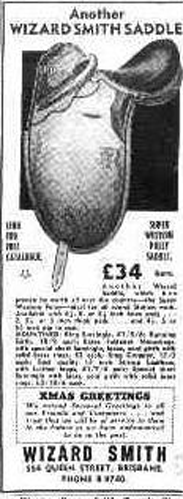
The Australian Stock Saddle
and the Saddlers that made them
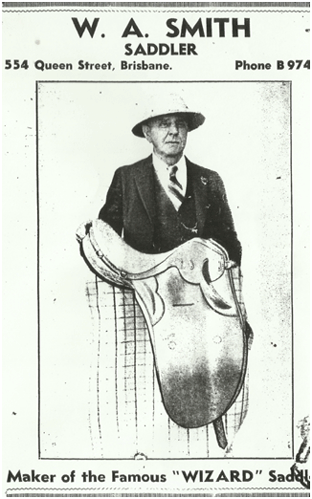
WILLIAM (WIZARD) ALBERT SMITH 1876 - 1956
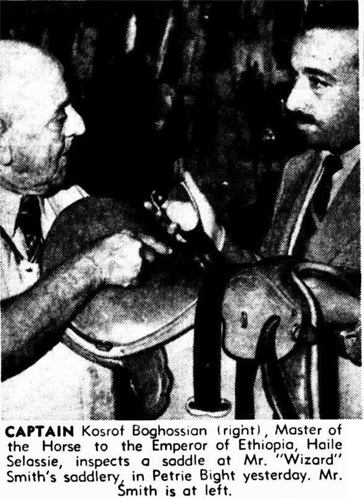
But his proudest achievement when in 1935, a saddle left Australia addressed to Djibouti. It was for Haile Selassie, Emperor of Abyssinia. It was a plain riding-saddle, and was made on behalf of Mr. Arnold Wienholt, well-known Queenslander, who went to Abyssinia during the war with Italy. The maker (Smith) did not know until it was finished that it was destined for the Emperor.
Little is known of the early years of William "Wizard" Smith, except that he reported in a later interview, he had started his saddlery trade at age sixteen. No mention was ever made as to who his master was, however his resulting success in the ensuing years meant that he had been taught well.
1906 finds a first mention of Wizard as a saddler in Clayfield. Two years later in 1908, he is trading at Hamilton (both northern inner city suburbs of Brisbane).
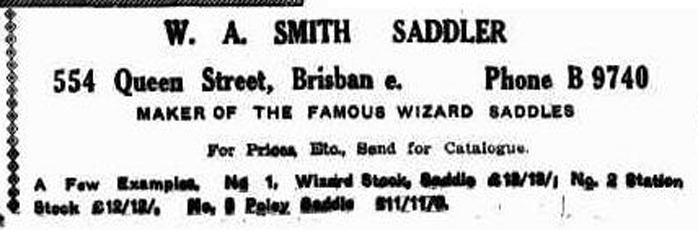
The first advertisement relating to 554 Queen Street, Petrie Bight as his premises was found in June 1939, however he had taken up this shop address much earlier, but unfortunately the start up date was never found. Smith remained at this address for the duration of his business career.
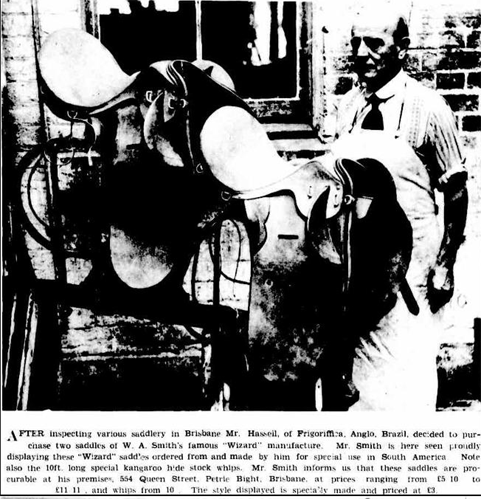
The Queenslander newspaper reported on Wizard Smith's export triumphs in May, 1936.
Brisbane Maker Supplies Saddles to Abyssinia and Brazil
WHEN Captain Wienholt, who went to Abyssinia as war correspondent for The Courier-Mail, took with him from Brisbane a specially constructed saddle for the Emperor, Haile Selassie, some regarded it as a "stunt," and would have laughed at any suggestion that it would lead to further orders. But so attractive was the saddle that it immediately caught the eye of Ato Adda Kassa Marou, of Addis Ababa, and he, too, wanted one. He lost no time in getting in touch with Mr. W. A. Smith, of Petrie Bight, Brisbane, the maker of the Emperor's saddle, and asked, that one should be made for him (cash with order). It was exact in every detail; to the one Captain Wienholt took, except that it had to be larger. As the end of the war is now in sight, however, it is only to be expected that the Abyssinian trade will fall off, but a new avenue that should result in more substantial order has been opened, up with an order from Brazil, South America. Mr. Hassell, who is connected with Vestey's in Brazil, visited Brisbane while on six months' leave, and placed an order with Mr. Smith for two "Wizard" saddles. Mr. Hassell is an expert, where saddles are concerned, and it was only after an inspection of the product of many other makers that he decided in placing his order with the maker of the Abyssian saddles. Not only was this a tribute to the workmanship of this saddlery firm but also the judgement of Kassa Marou in choosing a similar make selected by an expert. As a repeat order was received by Abyssinia it is only reasonable to assume that the Brisbane saddlery trade will receive a big boost when its products arrive in a cattle country like Brazil where there is a steady demand for horse equipment.
Journalist Allan Fleming from the Sunday Mail called upon Wizard Smith to interview him about his life's work in February 1939. Interestingly Mr. Fleming strolled further up the street the same day to interview Uhl's Saddlery.
The needle, the awl, and the razor-edged knife are not as busy as they used to be. The number of deft-fingered craftsmen who pull the black waxed threads through saddles and harness in the making is dwindling. But there are still horses and riders, and while there are horses and riders there will be saddlers. The ranks of the Brisbane saddlers, though depleted, are probably as lusty as those of any country.
BRISBANE craftsmen, as influential arbiters of fashion, are the Schiaparellia of the horsey world. The influence of their saddle designs is not confined to Queensland and the States of Australia
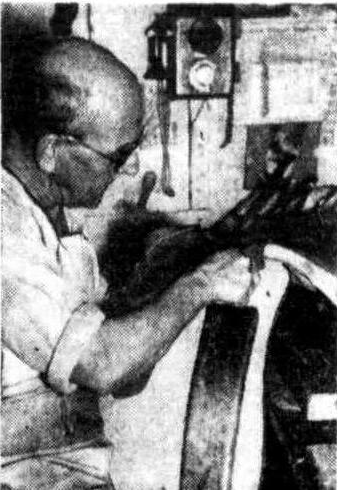
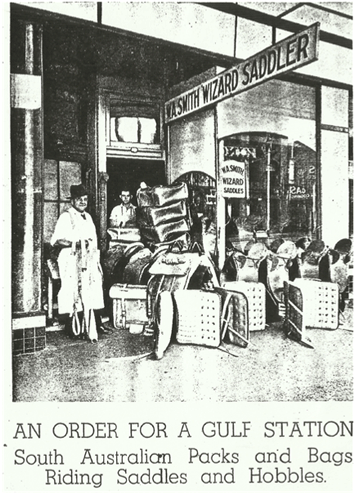
Someday soon one of the saddles in the first picture, taken in a Brisbane saddler's shop, may be bearing a long limbed stockman on the first stage of a droving journey half way across Australia. In the second picture the horse has not really come in to select his own harness — he is just a dummy that used to wear the latest harness he models in the shop.
Among them you can find a man who made a saddle that carried Haile Selassie, former Emperor of Abyssinia, in the midst of the Ethiopian war drama; you can find men who have sent saddles to North Borneo, Rhodesia, Ceylon, England, and the Argentine. You can hear fascinating tales of the grand old days when hansom cabs and coach harness had to be attended to as often as saddles. There are tales of the big men of the outback. One saddler has a vivid memory of the day he saw a man enter his shop wearing an old felt hat, and looking as If he 'wasn't worth two bob.' 'I want to buy a saddle,' said the stranger. 'Yes. Would you like to look over them?' 'Mmm. This one will do. How much? Sounds a bit too dear. Well, I'll take a dozen, anyhow.' 'A dozen?' 'Yes. Is my credit good? , . .' 'Well, er, I . . .' 'My name is Kidman.' The saddler managed to cover his surprise neatly. 'Yes, 'Yes, Mr. Kidman, your credit is good— as long as you don't want to order more than 50,000, of course.'
2/6 A Week
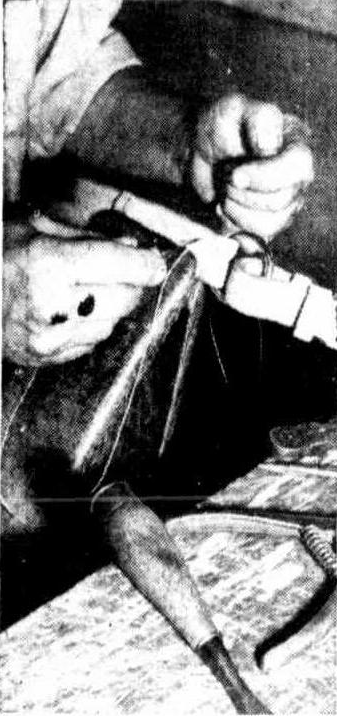
One of Brisbane's oldest and best-known craftsmen W.A. Wizard Smith was at work. Pieces of leather lay about the room, straps hung from hooks, riderless saddles bestrode wooden horses. The three sections of a plumber's bag lay on the table 'ready to be assembled. 'I can yarn while I sew this,' he said. 'I can do it -without thinking now.' He took two threads shining with beeswax, threaded them on their needles, pushed his awl through the leather, and the work began. The fingers flashed out and in, as the thread was pulled through, jerked tight, and pushed through again. His tongue was thrust out to give emphasis to a tightening tug.
If the honk of cars outside had been the neigh of horses, and if the rattle of trams had been the creaking of bullock waggons, the picture might have been 70 or 80 years old. 'When I was a boy I went to work for half a crown a week.' he said. 'And I worked 10 hours a day. We had no holiday on Saturday afternoon. 'Leather was about 9d. per 1b. then. Now it goes up to 3/6 per lb. People say they don't get much for their hides. But they forget that all hides are not fit for the tanner. Many of them are too scarred. You can't use scarred leather in a saddle.'
'Old Timers'
He gave the thread a firm tug as it reached the end of a seam, and began to talk of the old days when he was a young tradesman travelling out West. Tradesmen might have to mend a bellows in a blacksmith's shop, put leather on the shafts of a hansom cab, or mend leather dashboards. Everything was hand sewn. Those days had gone. When he was on the Georgina and out Charleville way a drover would often come in with 100 horses in his plant. There might be 30 riding saddles to deal with and dozens of pack saddles. Names of some of the famous old-time drovers . . .
Well, there was Reg. Thompson, Albert Williams, Mr. Woods, Clive Ross, Andy Clarke, Tom Brown, Ted Setatree, Jimmy Laffin, Dougall Cameron, Albert Williams and a companion, he believed, had made one of the most remarkable droving journeys in the history of the West: they travelled across Australia from Western Australia to Queensland. Ah, they were men who knew what a good saddle was, though each had his particular fancy in makes. They wouldn't look at one that didn't have first-class counter-lining to make it comfortable on the horses' backs. They had piles of equipment . . . hobbles, packs. Albert Williams might come into Charleville one day and say that he was taking away 2000 bullocks. 'Better equip my plant,'' he would say. Two years later he would be back again. He would want his plant renovated for the next trip. In those days the drovers would think nothing of spending as much as £100 on their gear, one job he did earned him £96.
Knowing the Niceties
Droving was a gentleman's game now compared to what it used to be. The old-timers could not bring their stock to the nearest railhead because in most places there were no railheads. So they placed a lot of reliance on the saddler who fixed their gear for them. But the man who could pick a saddle and pick it well had not died out, although styles had changed. There might be people owning cars to-day who had never owned a billy goat before, but there were people owning horses who had always owned horses and whose fathers had owned horses. And, in the country, there would always be things that only a horse could do. A genuine bushman would come in and look at a saddle and know whether it was what he wanted without even getting into it. Of course there were a few people who couldn't ride in a spring cart with the tail board up and they mightn't know the niceties of a saddle. In the early days the saddle was flat seated, with snort flaps and low knee pads. But that had all been changed. Now seats were curved, flaps, and knee pads were longer. Saddlery had advanced about 100 per cent.
He agreed that it would be hard to beat saddles made in Queensland. Queenslanders were not the only ones who shopped in the Paris of saddlery. One day a man stepped off a ship from Noumea, came into the city, and bought one of his saddles. A Victorian who had come to Queensland by car dropped in, looked over the saddles, and took one away with him to the South. Orders went beyond Queensland's western border into the Northern Territory and into South Australia, and even Western Australia. Two had gone to New Zealand, and many other inquiries had followed.
For Haile Selassie
But his proudest achievement, was the saddle that left Australia addressed to Djibouti. It was for Haile Selassie, Emperor of Abyssinia. It was a plain riding-saddle, and was made on behalf of Mr. Arnold Wienholt, well-known Queenslander, who went to Abyssinia during the war with Italy. The maker did not know until it was finished that it was destined for the Emperor. Another saddle was made for one of the Emperor's leading generals. 'Mussolini hasn't written for one yet, but you never know,'' said the saddler. 'Anyhow, I'd better finish this bag now,' he added, and in a few minutes the hands were flying to and fro as they had years ago making harness or patching equipment for stockmen out Georgina way.
William 'Wizard' Smith made a name for himself and his saddles. It is unfortunate that nothing has been found in the press as to when Wizard retired from his Queen Street premises, however he may be gone, but his memory is not forgotten.